
II. Ceryd
Heirs
Two years passed since Cleon left Gruen, and in those seasons did Fia bear and nurse her second son whom she named Cerenid. The babe was slight of form and gentle in spirit, and nursemaids oft did urge him to suckle, worried that his vitality had failed him as his ribs shone like pale ridges. Yet the long nights of his weakness did at last depart and he endured the winter’s stern trial.
In that third autumn, when the leaves seared to gold and Sol’s bright shafts were softened by the cool breath of northern winds, riders were espied upon the road to Gruen, bearing the banners of Welf. At first, their purpose lay veiled; yet a murmur spread like dusk across the courtyard, that Cleon’s name rode in their errand.
Fia long feared for her sons in Cleon’s absence, sensing the lurking prowl of the ambitious men of court. Only Kethu stood between her and them. And with him were joined all the Aeonites, whose eyes and ears revealed every nascent plot that dared to root in Gruen’s shadows.
Fia’s breast swelled with hope as she stood at her high window overlooking the gate, watching the road to Gruen, eyes eager. The autumn air was crisp and the daylight soft and golden, the banners above flapping in promise. In her mind she rehearsed the moment: presenting the young sons to their father, their laughter echoing through the courtyard; a feast in the hall, the cheers of the courtiers, the weight of fear released from her shoulders. Even the wind seemed to carry anticipation of reunion.
But her heart shrank the moment she beheld the riders, for their mounts trod slowly, their banners drooped limp at their sides, the dust on their cloaks telling of a long journey without cheer. Hope faltered with a chill in her limbs as sorrow touched her eyes. With trembling haste, she descended into the square to meet them, and there, before her, stood a covered wagon, its heavy wheels silent, its form wrapped in cords and shadow.
The air hung thick with dread. Her lips parted, yet no word issued forth. She beheld the faces darkened with gloom, brows bowed beneath the weight of duty. In that instant, the golden thread stitching the hope for her sons snapped as though rent by unseen hands. For though she bore no love for the cruel man whose body they delivered, she knew he would protect them and her. Now, in her soul, she knew that her children’s inheritance, and their very lives, were now cast into peril.
“My lady,” spake the marshal, bowing his head, “we bring unto thee the body of the Rex of Methundor, slain by brigands upon the field near Bogwater.”
Fia advanced to the wagon and reached for the knots of the shroud.
“I beg you, disturb it not, my lady,” pleaded the marshal. “When we found him, he had lain dead for many months. Thou wouldst not know him, and the sight of his remains ought not be the last memory thou keepest.”
Fia faltered; the cords yet tethered at her fingertips.
“How dost thou know it be him?” she asked.
“By his brooch and boots, and by his ink markings, my lady. His flesh, though withered, was spared the foul ravages of decay and the beasts that roam those fens. Their hunger, it seems, was stayed by the honour that yet clung to his remains.” Yet his expression betrayed a deeper truth: that he believed the preservation owed more to the dark sorcery that had always clung to Cleon Rex like a second shadow.
“We were led to his remains by a villager of Modi. It seemeth some kind soul had taken him and laid him in the hollow of a tree, that his dignity might be preserved.”
#
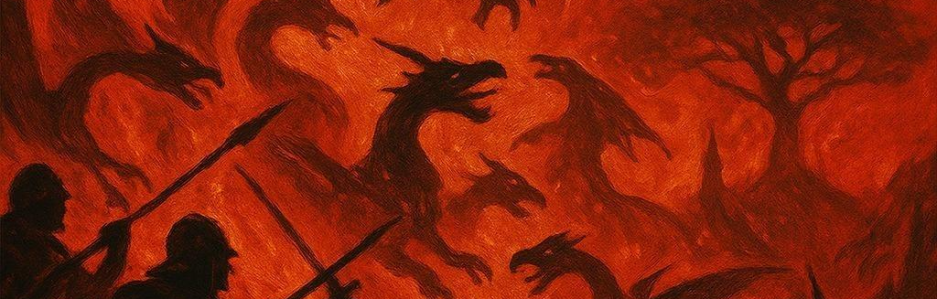
Thus were the sons of Cleon left fatherless and placed under the charge of Kethu the Aeonite, who nurtured them as his own until a steward and husband fitting might be found for their mother. Under Kethu’s counsel, both sons were schooled for many seasons in the arts of numbers, and the histories of the First True Men. And also in the legends of the Garden Vallis[i], a realm scarcely whispered of in the Norland-tongue. They learnt of the great dragons: Margathon, the wyvern that flew nigh unto Sol until it was cast down onto the Vallis floor to be remade, and of Bazunan, the most fierce, the finder of the Immortal Man, and also of Ogrennon, the outcast, forever tempting the brittle souls of Edä[ii].
Kethu also had them trained by Aeonite warriors in the disciplines of combat: the wielding of arms in their fluid style— more a dance than smite and parry. And they were taught the craft of tactics and stratagems. The trusted men of the court taught the boys the hunt, and the keeping of beasts and birds of prey as well.
Often Kethu and the brothers would find themselves in the garden, near the fountain, and Ceryd would ask the Immigrant to impart his wisdom. “What are the finest traits of a rex?” young Ceryd once asked.
Kethu’s brow furrowed in thought. “Well,” he said, “there art many ways to cook a goose— braised or boiled, seared or stewed, many other ways besides, each pleasing in their fashion. So too art there many ways to rule. Some rulers art cruel, while others merciful. Some art overt whilst others more subtle. Some art cautious, and others impulsive.”
“Which way dost thou commend, master?”
“If I were forced to choose, I would say to be this: decisive. Once thy mind is made, choose impulse over caution. Fortune is like unto a fair maiden. To keep her, a man must seize her boldly, else she shall slip away and find another.”
Many more summers passed with Ceryd nearing manhood, striding time and again into the ring to face an Aeonite warrior posing with shield. With Sol barely cresting the ramparts, Ceryd would heft his broadsword, its leather-bound hilt once too heavy in his hand, and with a thunderous cry he’d lunge, boots churning the dust of the courtyard.
Finally, after many tries, his blade found its mark, clanging upon the warrior’s helm, sending sparks dancing like those cast from a sharpening stone. He grappled, his arms like coiled rope, to drive the shield aside, and his opponent, at last, dropped one knee and nodded in approval. Ceryd rose, sweat beaded upon his brow, chest heaving, the single victory a culmination of many years of defeat. “At last,” the prince declared, “a victory.”
“Aye,” said Kethu. “A victory that never could be won without the lessons of so many defeats.”
A fortnight morn later, Ceryd would vault onto a great steed, hoist the javelin, and race down the hill, breaths of beast and lad steaming like fog in the cold air. He struck true, piercing a target at full gallop, and his companions cheered. In that hour he felt the bloodline of his sire— Cleon— rise within him, the drive for dominion tensing in his sinews.
And in those months and years, beneath the vaulted hall of ancient runes, Cerenid sat by lamp-glow, his slender fingers turning a carved stone etched with spiral sigils. The silence of the study held the musty scent of parchment where Kethu tutored him of his forebears’ temptations, of their blasphemies, and of their purgation. Cerenid’s mind was beguiled by the ghastly Nephilim and the glorious Gargan giants. He drank each word his master spoke, troubled naught by swords or shields.
Once, upon the hunt for a mighty stag, the brothers would oft run the hounds a-foot. On one occasion, Cerenid drew near to a dog which nosed the trailing scent. Startled, the beast turned and nipped the younger prince’s thumb, rendering flesh pierced and bleeding. Ceryd, seeing the wound, rushed forth and struck the hound upon the muzzle, his blow so strong the beast whined and fled.
Turning to his younger brother Ceryd he said, “Come, let me see it… ‘Tis but a scratch, brother. Show not thy tears, lest they deem thee weak.”
A huntsman rode unto them and asked, “Is the young prince hurt?”
“He is well,” Ceryd snapped. “Give thy mind to the chase.”
Cavern
The forests of Gruen did offer many adventures unto the young princes, whose clandestine wanderings drew them far into her shadow-choked depths in search of fauns and kobolds and other sprites of childhood fancy. Yet none of these foul creatures were ever encountered, save for those their own minds conjured in the hush of dusk. Often, however, did they return to a cavern veiled by the moss-clad trunk of a fallen pine, where the earth yawned unto guarded secrets older than Methundor itself. “Shall we descend into yon cavern?” asked Ceryd.
“For what cause?” the younger replied. “Surely naught awaits within but spiders and filth, and perchance an ill-tempered badger.”
“Nevertheless…” said Ceryd, his eyes alight with reckless purpose.
Ceryd drew forth his lantern from his pack, kindling its flame with flint and steel, and slid through the moss-laden portal and down into the shadowy chasm. The golden glow flickered upon stone, but then vanished wholly from Cerenid’s sight, swallowed by the ancient dark.
Cerenid lingered at the cavern’s mouth for what seemed to him an hour’s passage. With their mischief stilled, and their boisterous noise absent, the creatures of the forest crept back to their doings. Squirrels darted amidst the boughs, a jay let forth its shrill call, and a doe emerged from the undergrowth of ferns and brambles, browsing as it drew near. The silence weighed heavily upon the young prince, for in all their adventures, they had made such noise as to drive away all animal danger. But now, with no sound save the forest’s own, Cerenid was alone, no longer a vanguard intruder but one consumed within the untamed wild.
He called into the cavern to his brother, half in hope of urging him to return, half to startle away anything lurking nearby. But no answer came. He waited in silence yet longer, until the birds returned, then he called again, but the cavern devoured his voice without echo.
As Sol dipped beyond the towering branches and the shadows deepened, a lone raven alit on a gnarled limb above and let out a ragged caw. It paused, as though awaiting a reply from the forest itself, then cried again, deep and sharp. Now Cerenid dared not raise his own voice, lest he draw unwelcome company. Instead, he slipped into a cluster of ferns and brambles, peering out toward the cavern’s maw. The moss hung there, swayed like a tattered curtain, inviting him to enter, yet he felt a tremor seize him. Twilight pressed in. The forest’s shapes twisted— branches bending into claw-like silhouettes, roots coiling like serpents. Summoning the last of his courage, Cerenid crawled to the cavern’s edge and whispered, “Ceryd… Ceryd… pray come out!” Yet silence again met his plea. He huddled near the shrouded entrance. Again, a raven alighted upon a nearby branch, fixing him with its glinting, black eye. The young prince froze, unmoving. The corvid clicked its beak, croaked, then burst into flight with a rush of beating wings of doom.
Cerenid felt as though the forest itself watched him with one eye from many vantages, each shadow a sentinel, each whisper a warning. The world had grown vast and ancient around him, and he but a trembling child within it.
Unwilling to tarry until night’s monstrous depth, Cerenid mustered the resolve to leave his brother and return home alone. Darkness enfolded the path, and he quickened his pace. Brambles grasped at his tunic. His thoughts filled with visions of kobolds, their amber eyes gleaming from the hollows, their scaley fangs bared as they scampered in pursuit.
A chill washed through him and he quickened his pace. But soon he discerned that some presence did indeed follow him— soft panting, the crunch of leaves, the whisper of padded feet. Wolves! Much as in the tales of the old nursemaids, their shapes flanked him in the dark: pale eyes flashing, near silent save for their breath. Cerenid dared not avert his eyes from the path to look back. Had he stumbled but once, he knew the first bite would fall upon his legs.
At last, wearied beyond endurance, he faltered and collapsed upon the trail, curling tightly upon himself. Darkness surrounded him, and the wolves panted as they circled close, their movements hidden in the forest’s black veil. As fear and despair consumed him, his thoughts turned grim. What pain would their fangs bring first? What fragments of him would remain for his mother to claim and bury?
Yet as his heartbeat pounded from his breast unto his ears, his breath grew steady. His tears ceased. He gazed upward, beholding only the tall silhouettes of pines reaching toward the gray ether. Clutching tightly upon the thorny branches, that he might thwart being dragged off, he prepared to meet his fate.
Then came a voice. “Cerenid!” Still distant but growing louder, his brother’s cry calling through the twilight. Soon, the sound of his footsteps joined his calls. “I’m here, brother! Come forth!”
Cerenid remained huddled upon the ground, too stricken with fear to utter a cry. Yet his brother, guided by his footprints, came upon him and raised him to his feet.
“We must quit the forest ere the night devours us,” quoth he.
“Didst thou seest the wolves, brother?”
“Wolves?” Ceryd scoffed. “You’ve been reading too many books.” He dusted his brother off. “Reserve thy tears, for they shall serve thee better when we face the scourging that awaits us. I’m doubtless they have sought their rex and prince for hours, now.”
Cerenid wiped his streaked cheeks with his sleeve.
“There… good,” said Ceryd with a nod. “I shall tell them thou wast brave.”
“What didst thou behold in the cavern?” Cerenid asked as they made their way home.
At first, Ceryd gave no answer. His eyes remained fixed upon the narrow path ahead. “Nothing, brother,” he said at last, though the unease in his tone betrayed him.
“I do not believe you,” Cerenid said. “Why linger so long in darkness if there was nothing?”
Ceryd froze, a pale silhouette in the fading light. Reluctantly, he yielded. “If thou must know, I found a vein of crystal. It glowed like sapphire fire by my lantern’s light. I sought to loose a shard, but as my fingers touched it, I was… overtaken.” He lifted a hand to his brow, as though the memory itself weighed upon him. His eyes lowered. “A vision pressed upon my mind— vivid as waking, deeper than any dream. It swallowed all my thought.”
“What didst thou see?”
Ceryd’s gaze rose to meet his brother’s, sharp and searching, as though he feared the telling more than he feared the vision itself. “I saw thee, brother…”
“Me?”
“Aye… standing alone in single combat. Yet I could not reach you, nor call to you. For the world would not hear me…”
“And then?”
“And then…” Ceryd’s eyes searched his memory. “And then it was over.”
A silence settled between them, broken only by the whisper of the wind through the pines.
“Tell no one of the cave,” Ceryd murmured, voice low. “If word spreads, many will descend upon it and spoil what lies within.”
And though he spoke no further of it that night, something in Ceryd’s countenance had shifted. A remoteness gathered behind his eyes, as though part of him still wandered the sapphire depths of the cavern. For the crystal had shown him more than any brother should behold— a shadow of doom, laid bare upon the path of fate.
Envoy
Whilst Kethu yet bore the mantle of steward, it had grown plain unto all, aye, even unto those who dared not whisper it, that the twilight of his years had settled upon him— though an Aeonite’s dusk might yet linger for many a season. Thus did the council decree that Ceryd, having surpassed nineteen summers, should ascend the high-seat upon the coming solstice of summer, less than a full season yet to pass. In the warming breath of mid-spring, the wardens, who had ridden eastward in chase of the knaves and brigands who had slain their rex, returned unto Gruen with a prisoner most foul and foreign of aspect, shut fast within their wagon. Through the main gate they passed, where many townsfolk had gathered to cast eyes upon the strange prisoner. The wagon stopped in the square before the keep and the wardens dragged their suspect out and escorted him into the main hall. There, the assembled court, which had been steeped that morn in petty bickerings of thegns over grazing fields and bridge tolls, parted as the wardens marched to the dais with their criminal.
Ceryd, the young rex, perked up from his seat where he had been near slumber, lending but half an ear to the tiresome quarrels. “What charge lieth upon this man?” he asked.
“My lord,” answered the reeve, bowing low, “we seized this wretch whilst he filched salted meats from a bondi’s hutch near Clearwater.”
Ceryd looked perplexed. “Why bear a common pilferer all the long road to Gruen?” asked Ceryd. “Hath the local reeve no rod with which to chastise him?”
“Aye, my lord, he hath. And we should ne’er have troubled thee with such refuse, my lord. But whilst the reeve’s justice was laid upon him with stout and honest fists, he fell to muttering in a tongue most strange, my lord.”
Ceryd frowned. “And is the gabbling of fools now counted a crime as well?”
“Nay, my lord. But a wandering Aeonite crone heard him, my lord, and straightway told us the speech was Neandilim[iii]-born… my lord.” At this name, a gasp passed through the hall, and the murmuring swelled.
“A Nundi![iv]” cried one.
“Mercy on us— hell’s brood walketh here!” wailed another.
“Trust not the word of any Aeonite witch!” snarled a third.
Ceryd lifted his hand, and the tumult ebbed.
“My lord,” the Reeve continued, “we questioned him further, fearing lest some southern magic lurked beneath his rags.”
“And what found ye?” asked the rex.
“After much beatings, my lord, he saith naught but pleas for mercy and mutterings that he was an envoy from the south… my lord.”
Ceryd rose and stepped off the dais to approach the two wardens and their prisoner. The wardens gripped their charge firmly, yet the young rex leaned close, studying him. Though clad in goatskins, and mired in filth, he found in him a strange, almost affected bearing that clung… like a nobleman sunk into disguise.
“What envoy dresseth in such foul raiment?” Ceryd asked. “And stinketh like a piss-soaked midden?”
“My lord, I caution that these southerners are known to cast spells of—”
“Peace! Let the man speak his own treacheries.”
The prisoner stared at the dust around his own sandals. “Sire…” he began, “I have come from the city of Goff. Neandilim is the common tongue spoken there.” Eyes still lowered, he continued. “Bandits set upon my company, and I alone escaped, living by guile and by theft. For this I crave thy mercy and shall submit to any justice thou ordainest.”
Ceryd narrowed his eyes. “And what business hath an envoy of Goff so near to Clearwater? ’Tis many leagues from Gruen.”
“My lord, he did sayeth he came by the eastern way,” spake the reeve.
Ceryd looked perplexed. “You say you came perchance by the eastern road, with the Spire of Agzad for thy beacon?” The Rex pondered. “Yet do not the Neandilim tremble at the name of Gargan? Did not their monstrous hands raise that pinnacle in the elder days?”
“I… I lied to them, sire, fearing the wardens would murder me if I spake the truth. We in fact passed by the High Gate, by way of Meru. I beg your mercy, your highness.”
“Was the gate not locked?”
“We found it opened for us, sire.”
“The Aeonites must have unlocked it,” came a voice in the throng.
“We knew they were traitors all along!” shouted another.
“Loyal to their southern brethren only!”
“Traitors?” Ceryd derided, turning to face the crowd. “Traitors who waited three centuries to betray their oaths? Waited ‘till their bones lay mouldered, all even, save for one? Hold thy serpent tongues!” He turned toward the old steward. “Kethu, come forth. I would hear the wisdom of an Aeonite.”
They found the venerable Immigrant slumped in slumber upon his chair. Young Cerenid, seated next to him, touched his arm gently and the ancient’s dark eyes fluttered open. “Kethu,” came Ceryd again, “lend me thy counsel.”
Kethu coughed and cleared his throat, then, with a grimace born of age and lingering pain, he rose unsteadily to his feet. Fumbling for his cane, he tottered down three slow steps from the dais and came before the prisoner, who stiffened and set his jaw. Kethu studied him in silence, his cloudy eyes yet sharp with an elder’s cunning. With a gnarled hand he lifted the man’s chin and bade him open his mouth, peering close at teeth and tongue. Then, with neither haste nor shame, he loosened the man’s belt and drew back the filthy cloth at his loins. A rustle swept the hall. Some gasped, others turned away, but Kethu regarded neither their modesty nor their shock. His gaze was keen, searching for the tell-tale sign. At last, he let the cloth fall and straightened with difficulty, leaning upon his cane. “Yea, he is Neandilim. Of that there can be no doubt.”
The court gasped once more in chorus.
“My lord, we knew it so,” replied the reeve.
Ceryd was undeterred. “But envoy or spy? Which stands before us? And by what path hath he crossed our borders?”
Before Kethu could answer, Gedain thrust himself forward. “Sire, give him into my hands. Let him feel the bite of fire, and he shall blurt the truth soon enough.”
Earl Olian, a graying thegn with the underbite and snout of an old boar, nodded vehemently at his side. His daughter Avarlon, with a visage as pure and pale as pearl, and whose favor Gedain sought more desperately than honour itself, brightened at her father’s assent.
But Kethu raised his withered hand. “Behold,” he shouted, his voice ringing clearer than it had in years. “If thou torment a man to yield his words, he will indeed prate… he shall prate naught but the very words thou longest most to hear.”
Having heard Kethu’s counsel, Ceryd turned then to Cerenid. “What say you, brother? Shall we yield him to Gedain?”
But Cerenid faltered, glancing between the two men— Gedain’s hungry sneer and Kethu’s troubled, cloudy gaze. “I… know not, brother. Mayhap we should not.”
“Hold a moment please, young rex,” Kethu urged. He then peered deep into the prisoner’s countenance. “Tell me, Neandilim… knowest thou who I am?”
“Aye. Thou art the Steward of Gruen.”
“For a little while longer at least,” Kethu groaned. “But answer me this: some men may scale mountains for bargains and treaties… yet others might venture for the capture of an old legend that yet draweth breath.”
“Thou art indeed a legend, Kethu,” the prisoner whispered with disdain in his voice. “None may deny it. Perhaps others will come for thee.”
Kethu laughed until his laugh turned into a wheeze and then a fit of coughing. When he had caught his breath, he once again looked into the prisoner’s eye. “Thy brethren need not bother with me. My end draweth nigh. Nor do I refer to myself as legend. Yet I think we both know the legend of whom I speak. He is:
“…the coin that buyeth rebellion! If cast into the deep, who then shall spend it? For thy worth is unrest, thy face remembrance, and thy breath awakeneth defiance in the hearts of men.[v]”
And in that heartbeat, as Kethu watched closely, the prisoner’s pupils widened ever so slightly— too slight for the notice of True Men, yet plain enough to the eyes of even an aged Aeonite. It was a reflex betraying the soul.
Voices clamored for justice. “To the dungeons!” they shouted.
“I defer to the young rex,” said Kethu over the din. “My season waneth. His now beginneth.”
All eyes fixed upon Ceryd, he knowing he could not free the man without seeming weak before the ravenous court. At length he sighed and gestured with reluctance. “Let Gedain have him.” And so the wardens dragged the envoy toward the dungeons, his cries to be swallowed by stone and shadow.
Kethu wobbled up the dais and sank upon his seat, and Ceryd then sat again beside him. “What doth all this portend?” asked Ceryd in a low voice.
Kethu whispered, “It portends that the immortal prophet walketh again in our lands.”
“Will Gedain get him to say it?”
“We both know the cruelty that lurketh behind Gedain’s golden locks and comely face,” said Kethu. “He will torment the Nundi nigh unto death, yet the man will give him only assurances.”
“Assurances?”
“Aye. Promises, bargains, temptations. Whatever he believeth Gedain desireth to hear.”
Ceryd’s brow darkened. “And how came he through the High Gate? Do not I alone hold the key?”
Kethu’s gaze grew distant and grim. “Young rex… clearly something did unlock it.”
Joust
When Ceryd had reached the nineteenth year of his age, and the day of his crowning drew nigh, there arose, as though fated, a strife betwixt the house of his sire and the Blodwins of Dregrove. The seed of this enmity sprouted from the deeds of a young nobleman of that lineage, whose pride was the herald of coming discord.
Madrot Blodwin, the youngest child and only son of the House of Dregrove, journeyed unto Gruen for the festivities of Ceryd’s accession, which were ordained upon the day of the summer solstice. He came in the stead of his father, Mendo, Reik of Dregrove, who by age and lingering maladies was sorely enfeebled. Madrot was received with all courtesy due his blood and so took his ease within the halls of the rex, purposing to sojourn in Gruen for a fortnight. Though scarce past twenty-one winters, Madrot was harsh of visage. He lacked the grace to charm the hearts of maidens or inspire the deference of men. His red hair hung lank and thin, falling lifeless and straight upon his shoulders. His ruddy complexion bore the stain of roughness and wear beyond his years, and his wild, unruly brows and bulging eyes lent him an aspect most sinister.
Throughout the days of jubilation, contests of arms and feats of manly prowess were proclaimed. Many hundreds gathered within the plaza to behold the spectacle. Madrot, eager to display his mettle, entered three: a bout of grappling, a duel with swords hewn of seasoned ash, and the noble joust. By skill and sinew, he triumphed in the wrestling-pit, yet in sword-play he tasted defeat beneath the steady hand of Ceryd— though some Dregrove kin whispered that it appeared he permitted the rex to win. The third contest, the joust, set him against the handsome and vainglorious Gedain, the heir of the House of Welf.
Sol shone radiant, and the multitude that thronged about the list murmured like a rising stream. Madrot entered first, breast plated in grey steel. Removing his helm, he scanned the assembly to acknowledge their cheers— but found instead that their voices rose only for his rival who entered behind him arrayed in gleaming harness bright as silver. Gedain doffed his helm, unveiling his fair visage to the swooning maidens, and grinned with the boldness of one accustomed to such worship. The acclaim swelled and with a flourish, he gestured toward Avarlon who shone surpassingly fair in her silken gown of crimson. The combatants re-helmed and were led to opposing ends of the arena and their squires brought forth their lances. At the lowering of the pennon, both warriors spurred their coursers. Gedain charged with a flourish of silver, his confidence brimming near to arrogance; Madrot rode straight and measured, like an arrow loosed. Their lances struck. Gedain’s blow rattled upon Madrot’s shield, yet glanced away, while Madrot’s veered off Gedain’s shield to smite his helm in a telling blow, knocking it askew upon his head. A murmur rippled through the crowd. Gedain wrestled vainly with the visor, his curses betraying the sting to his pride. Madrot, circling back, lifted his visor to receive the due honour— but the throng had eyes only for Gedain’s vexation. “Another round!” Gedain cried, his voice sharp with choler. “This time I shall not be confounded by this wretched helm.”
“Certainly,” replied Madrot with calm courtesy. The heralds signaled assent, and the crowd stirred with eager whisperings.
On the second charge, Gedain thundered forward too eagerly; his lance shattered upon Madrot’s shield in a wasteful spray of splinters. Madrot answered with a firm, centered strike to Gedain’s breastplate, denting the metal and near unhorsing him. Gedain reeled, clinging desperately to the saddle as the horse galloped. Gasps broke from the assemblage. In fury he tore the helm from his head and flung it aside, demanding another. His squire darted off at once to retrieve one.
Fia, regent-mother and Madrot’s far elder sister, stood reserved upon the dais, yet a faint and knowing smile betrayed her inward Blodwin pride.
“Once more!” Gedain snarled.
“Art thou certain?” said Madrot. “I have already claimed the victory.”
“To hell with thy victory! Once more!”
Madrot took up his lance anew. Gedain’s squire returned with another helm, but this one was adorned with an extravagant transverse crest of purple-dyed horsehair. Gedain cursed his squire’s choice yet donned it all the same. Subdued laughter rippled through the crowd at the absurd visage of purple plumage.
Avarlon clasped her hands together, her brow knit in dread. The squires stepped back. The murmurs faded to silence. The trumpets blared. The horses leapt. The dust rose like smoke from a smoldering fire. At the moment of meeting, Gedain’s aim wavered again, his lance veering wide. But Madrot’s stroke landed true, a mighty blow beneath the rim of Gedain’s shield. The silver knight was hurled from his saddle like a child’s toy, crashing upon the earth with a thunderous thud. The crowd gasped as one, then all fell still as Gedain rolled about like a wounded peacock as he attempted to regain his breath.
Madrot reined his steed with modest grace and saluted the onlookers, though little of their admiration turned toward him. Only Fia, his sister, whom he barely knew, bestowed him a nod and a proud smile.
Avarlon climbed over the barrier and ran to Gedain’s side. With the aid of his squire, she lifted him, half-conscious and groaning from the dust. He threw his helmet, then found the strength enough to curse and spit upon the steed that had also “betrayed” him.
Ceryd, who watched with Kethu from beneath the awning, turned to him for his thoughts. “What dost thou think of this Blodwin heir, teacher?”
Kethu answered softly, eyes set upon Madrot. “Beware the victor, robbed of triumph by a loser’s vanity.”
Pursuit
Madrot, being a young man of great confidence in arms, fancied that his feats in the contests had won him the admiration of the maidens in attendance— Avarlon most of all, whose silky auburn braids and luminous complexion had bewitched his untutored heart. Yet none in Gruen received the ugly prince kindly, nor granted him even the courtesy of feigned interest. Some maidens, themselves enamored of the comely Gedain, averted their eyes or even cast hostile sneers as Madrot strode past, as though he be some base villain deserving of scorn. Come the eve after the joust, finding himself ignored and nursing a wounded pride, Madrot took to strong drink to dull his thoughts. In his cups he grew foul of temper as he espied Avarlon enthralled in flirtatious discourse with his defeated rival. Gedain, noticing Madrot’s glare, mocked him with a wink of his right eye and held Madrot’s gaze as he whispered to those near, eliciting their laughter and disdainful glances. Stung to the quick, Madrot at last tipped his cup and shouted threats of violence. Such uproar followed that men were forced to lay hands upon him. They subdued the spirited Madrot and led him to his chamber, that he might sleep off the bitterness of his ale-and-wine-fueled wrath.
At dawn, with the weight of shame heavy upon him, Madrot gathered his belongings and slipped away whilst the city still slumbered under the spell of revelry. Upon passage from Gruen’s ramparts, he vowed to the watchman that he would never again set foot in “this shit-stinking midden of scoundrels and whores.”
Yet not two hours after Madrot passed through the gate, Avarlon’s father, Olian, caught his daughter attempting to slip into her chamber unbeknownst while still fully dressed in her finery from the evening before. Olian confronted her, demanding to know why she had not returned home the eve prior. Avarlon, pressed by the boar-faced scowl of her father’s stern inquiry, broke immediately into weeping.
“What aileth thee?” her father asked.
Holding herself, she stammered, “that vile knave Madrot…”
Olian’s brow darkened. “What hath happened?”
“He… he barred me on the path home,” she wept, “and dragged me into a stable and forced himself upon me.”
Olian’s visage filled with horror.
“Afterward, in shame and terror, I hid within the straw and shadows, crying all night, attempting to muster the courage to come forth and speak of the evil deed.”
Noticing the very fragments of stable straw woven into her disheveled hair, Olian became enraged. Without delay he sought out the steward Kethu, finding him in somber contemplation beside the garden fountain. There, Olian demanded immediate justice, crying that his family’s honour now hung upon the steward’s swift hand. As Ceryd was yet abed, and with time being of the essence, Kethu dispatched three warden-riders to pursue Madrot, bidding them seize him, if need be, by force, and bring him back to Gruen to stand trial. Within the hour, three wardens thundered through the city gates. Yet Madrot had kept a furious pace, the pace of one fleeing capture, and they did not overtake him until eventide, when at last they espied him on the road, nearing the old stone bridge spanning the Meb.
“Halt!” cried the riders.
Madrot drew rein. They approached. “Madrot of Dregrove, son of Mendo,” one shouted as they neared. “Thou art commanded to return with us to Gruen.”
“For what cause?” said Madrot, surprised.
“The steward Kethu so decrees. Turn thy horse else we shall bind thee.”
“My nephew is rex, now. Why is the Immigrant still giving commands?”
“It matters not. Turn thy horse.”
“Is this an arrest, then? What crime is laid against me?”
“The charge is rape,” replied one sternly.
Madrot’s face stiffened. “Who speaks such falsehood?”
“It is none other than the daughter of Thegn Olian, the fair Avarlon.”
“The maiden lies,” Madrot protested.
“Your flight has already betrayed you,” the warden said coldly. “Declare thy innocence before the steward when thou dost stand for judgment.”
“Do you take a Blodwin for a fool?” Madrot asked, for he knew, even before the wardens named the charge, that no man in Gruen would ever believe his denial. “I will not return to that shit pile Gruen and submit to the false justice of petty nobles. We all know the treachery of Cleon’s House. Have the rex resolve it with my father.”
“Then shall we take thee by force?” asked the warden.
“Take me by force?” Madrot mocked, eyes aflame. “Thou mayest try. Yet I warn thee— I shall never yield. Press me, and there will be blood. But this vow I make: I shall slay but two of thee, leaving the third to bear witness to my mercy.”
The riders laughed as they reached for their swords, but their mirth withered in a heartbeat as Madrot’s steed lunged forward, sowing chaos among their mounts. In the ferment, Madrot lifted the nearest rider’s sword arm with the vambrace upon his own, and with a savage upward arc of his cudgel, he struck temple and ear. The rider toppled from his saddle, lifeless ere he struck the ground. Without pause, Madrot wheeled and galloped to the river, the two remaining riders in swift pursuit. Upon a clearing beyond the bridge, Madrot turned his steed sharply and awaited them. Within moments they arrived, drawing near with blades unsheathed, approaching from either flank. Madrot unfastened his shield and raised it high. “Sheathe thy swords and ride away if thou dost value thy lives,” he warned, voice as blunt and cold as winter stone. “I will never submit.”
“Surrender!” cried one. “Now must thou answer for murder as well!”
“Ride away,” Madrot answered, “or I shall answer for two.”
The riders crossed the bridge and spread wide upon the road, swords gleaming. Without further parley, Madrot charged the rider upon his left. Their blades met with a clash. Madrot deflected the stroke with his shield and, with swift precision, drove the dagger-end of his cudgel deep into the rider’s throat. Upon yanking it loose, the rider dropped his sword and, for but an instant, clasped at the fountain of blood spewing from his neck with both fists curled. Then he crumpled. His steed carried him a few faltering steps before he fell off to the side into the grass.
Turning sharply, Madrot faced the last of his pursuers. “’Twere better for thee to ride home than to be carried there. Turn back, fool.”
“I cannot,” the rider answered with grim resolve.
They met in fierce combat, cudgel against sword, shields battered with mighty strokes. The air rang with the sound of clang and thud. On the third exchange, the rider’s blade missed its mark, leaving his wielder’s arm exposed. With a savage swing, Madrot brought down his club upon the rider’s wrist and forearm. A crack sounded through the clearing as the bones shattered. The sword fell from limp fingers with the rider crying out, cradling his mangled limb.
“Learn now to fight left-handed,” Madrot sneered. “Thou’lt be fortunate to keep that arm once the surgeon hath seen it. Go. Ride home and tell my nephew, and that lying whore Avarlon, that I spared thy life.”
“They shall come for thee,” the rider gasped through gritted teeth.
“Speak no more,” Madrot hissed, stepping close, the blade end of his cudgel raised, “lest I take thy tongue as well.”
Council
When word of Madrot’s escape reached Ceryd’s ears, his countenance darkened with a grave and troubled shade. Though his counselors urged him to assert his lordship by dispatching a battalion in pursuit.
“What say you, teacher?” Ceryd asked in private.
Kethu replied, “Haste in wrath oft bringeth folly.”
And so the young rex heeded Kethu’s counsel and stayed his wardens, saying Madrot would be too far ahead to overtake and the mission futile. Instead, the young rex called his council into its chamber to deliberate the matter.
Reeve and wardens and masters assembled, along with Gedain, and prince Cerenid, and the Immigrant. Ceryd bade his mother Fia attend likewise, for who would know the Reik of Dregrove’s mind better than his eldest daughter? They sat about a long oaken table whose tall-backed chairs groaned beneath the weight of age. It was late afternoon, and the crisp shadows cast by the fading Sol in the windows grew long upon the floor, imparting a somber pall to the chamber.
Olian was first to speak, his outrage unbridled. He smote the table with his fists, crying, “Madrot must be seized and gelded, then hung! If they will not yield him, then I say war! Burn Dregrove to its foundations!” Forgetting Fia was Dregrove’s noble daughter.
The reeve who had sent the warden-riders in pursuit voiced his grief at the loss of two brave men— servants of duty slain without glory. The third rider, though his arm was spared, would unlikely wield a sword with honour again. “Justice!” he demanded.
“Set a bounty upon Madrot’s head. Greed will cause someone to bring him,” urged the Master of Coin.
“Lay siege to their palisade,” added Menek, the captain of the guard. “They will turn him over in less than a fortnight.”
“Let us march on Dregrove at dawn!” thundered Gedain.
Cerenid listened with rapt intensity, while his mother, Fia, hearing all this talk of sieging her home and hanging her brother, sat silent and unmoving, observing all with the cold, glass-eyed stillness of a raven perched upon a barren bough.
When each councilor had shouted his demands, Ceryd turned to Kethu, who had been rubbing his chest and clearing his throat. “Are you unwell, steward?” the rex asked.
“It is but indigestion, my lord,” Kethu answered faintly.
“Then lend us your wisdom, if you are able.”
Kethu stood, though unsteadily, and tried again to clear his throat. His coughing grew into a harsh fit before he regained his breath. He struggled through his first words. “My lord… this is indeed a grave predicament. A true test of a rex. The eyes of all the houses are upon you. And as the legends teach us:
Justice lieth upon the edge betwixt cruelty and weakness. Hold fast the balance lest both consume thee.[vi]“
“Spare us your sermons, Immigrant,” Olian shouted. But Ceryd’s glare silenced him at once.
Kethu continued, though his voice shook. “We have Neandilim spies in our lands now. Whether war cometh to us or we to it, come it shall. If strife arise between the houses, we cannot stand, and Bafomet’s host will devour us one by one. “And there is also this to consider,” Kethu went on. “The Reik of Dregrove is old and failing. It is said he cannot speak save through his younger daughter, Una. I fear he will not linger long in this life, and he hath but one male heir. I do not believe he will surrender Madrot to prison or hanging… or gelding, as Olian demands. But hear this: if Mendo dies before his son’s judgment, Madrot will become reik— and untouchable by law. After that, to make war on the Blodwins, we would surely prevail, but the cost in blood and treasure would be steep indeed.”
“Is there no manner in which to solve this puzzle, Kethu?” Ceryd asked.
Kethu pondered, clutching his robe as though steadying his spirit. “Perhaps… perhaps a tribunal.”
“No!” Olian barked.
Kethu pressed on. “A magistrate from each of the five high houses. Let them convene at a neutral site— maybe in Fywold— and there, weigh Madrot’s guilt.”
“Never, my rex!” Olian snapped. “We must strike while we—”
But mid-sentence, Kethu gasped sharply and toppled forward, his brow striking the table’s edge before he collapsed to the floor. Cerenid leapt to his side while the others crowded round. The prince pressed a cloth to the gash on the steward’s forehead. “Does he live, brother?” asked Ceryd standing over, his voice thin with dread.
“He breathes,” Cerenid replied, eyes shimmering with tears.
“Carry him to the physician at once,” Ceryd ordered. “Go, all of you. Leave me.” Cerenid and the council bore Kethu from the chamber. When they were gone, only Ceryd and his mother remained; she had not risen from her seat, nor had her expression changed. “I am unsure of the path, Mother,” Ceryd confessed.
At last she spoke. “It is true— your grandfather is frail. Una has written to me that he will soon be dead, and Madrot will be reik.”
“Then I must act swiftly.”
“Yes,” she answered. “But not recklessly. My father may be old, but his mind is yet sharp. He will have laid a trap— and not where you would expect to find it. You must not forget his enmity. Your father humiliated him. He stole his daughter, and now Cleon’s house seeks to humble him again from beyond the grave. My father’s life has narrowed unto this single point. He lives now only to taste a final revenge.”
“But I am his grandson,” Ceryd murmured.
“Aye, but Madrot is his son.”
“…And also your brother.”
Fia’s eyes narrowed. “Brother in name only. I never knew him.”
“I cannot permit a rapist and murderer to go free. I would lose all honour in the eyes of the people.”
“Aye, you must act,” Fia replied coldly. “But he who buildeth his honour upon the reverence of the people buildeth upon mud.”
“Now you sound like Kethu,” Ceryd muttered.
Fia remained unreadable, unblinking. “I say this: make a demand for a tribunal. But have them find Madrot innocent. I will see to it my father agrees. Then my father will die in peace knowing his son will be reik.”
“And Olian? Will he not poison my well after?”
“Marry his daughter,” Fia replied coldly. “Let her be rexia. She is beautiful and dull— a perfect queen. Olian will be reluctantly appeased.”
“And Gedain? He woos her.”
“Thou knowest Gedain is vain. He is no friend to thee. If he remains, then Avarlon will fall to him, and you will be disgraced. Send him off on some mission. Or charge him with some offense and have him dishonoured. Or better yet— let him be found drowned or kicked in the head by a mule. That is how your father would have handled him.”
“Come now, mother.” Ceryd said, rolling his eyes.
He paced the length of the chamber, the hem of his cloak brushing against the cold stone, halting at last at a narrow window facing east, where the pallor of twilight smoldered with thickening clouds. For a long moment he watched the darkening horizon, as though it might offer counsel where men could not. At length he turned and spoke, his voice scarcely above a breath. “Mother… did you love my father?”
For the first time that eve, the glassy steadiness in her eyes softened, and she seemed to look not at Ceryd, but through him— into some far and haunted memory. “Cleon was a cruel man,” she said in a low voice, immutable, like a slow-rolling millstone. “He was a ruthless man… violent, unyielding. He never questioned himself, nor did he ever express a regret.” She paused, her fingers tightening upon the arm of her chair. “And yet—” Her breath caught as though the words resisted being spoken. “At times… aye, I did long for his presence… his protection. But only when he was away.”
Parlay
Suffice it to say, Dregrove would not simply relinquish its fugitive noble son. Thus, a host was assembled beneath the banners of Gruen and marched forth in grim array; and both sons of Cleon rode with it— Ceryd as rex newly risen, and Cerenid as prince beside him.
Upon the morning of the ninth day of their vigorous march, the host crossed Briganta Bridge, very near the wide confluence where the Caleah meets the shimmering Fywater. The sky lay overcast, but the air stood clear as polished glass, granting sight across the swelling plain. There, beyond the banks, set upon the edge of a long green sweep of undulating grassland, they espied the mustered strength of Reik Mendo— arrayed in distant silence like a wall of stones. Yet this came as no surprise, for scouts had traced the Blodwin movements for many leagues and days.
“Their ground is the higher, my lord,” observed Captain Menek. “But our numbers are the greater.”
No sooner had Menek spoken than a second shimmer of steel crested the horizon to the left of House Dregrove.
“Look south— House Fy joins,” Gedain said, squinting at their banners.
“Now our numbers are even… if they choose to oppose us,” Menek replied.
“First, we parlay,” Ceryd declared. “No blood need be spilt this day.”
Thus, Menek and Olian, Gedain of Welf, their bannermen and their squires, rode forth with the noble brothers Ceryd and Cerenid, to meet these seasoned warriors accustomed to border strife. The Blodwins sent riders and footmen in equal number to meet them upon the midway of the open field, and with them rode Korbin, the Reik of Fy, and his two eldest sons.
“Thinkest grandfather shall accept our terms?” Cerenid wondered aloud as they rode.
“It is a foregone conclusion,” Ceryd whispered. “Mother hath arranged it.”
The opposing parties converged. Reik Mendo, their grandfather, appeared more withered and greyer than the brothers had imagined. His frail form wavered in the saddle, with his marshal on one side and his younger daughter on the other, ready to steady him if needed. Una, mail-clad though slight of frame, bore her helm beneath one arm; her umber braids spilled forth like tethers of autumn. A deep furrow carved her brow, marking her near thirty winters of iron resolve. Madrot’s gaze found Olian’s first. A long, venomous stare passed between them. Olian ground his teeth, jowls trembling. Then Madrot met Gedain’s glare. Gedain sneered, and Madrot answered with a slow, insolent smirk.
“Lords,” began Ceryd, “we have all ridden far these days. Let this parlay be fruitful, that resolution may follow.”
“Where’s the old Aeonite?” asked the Reik of Fy.
“He was too frail to make the journey,” Ceryd answered.
“You two have grown,” Una remarked softly. “It hath been many years.”
“Indeed, Aunt Una. A long time,” Ceryd said. “I trust you have received our terms.”
“We have received them,” Una replied.
“And House Fy?”
“We have,” said their reik.
“Then the tribunal stands agreed? Will the Fys take Madrot into their custody?”
But as Ceryd spoke, a wind rose, whipping the banners just as Reik Mendo began to mumble. His speech was mere dry, broken utterances, like a creaking hinge. Una leaned close, listening as though his nonsense bore meaning. “My father hath spoken,” she said.
“I beg pardon,” said Ceryd. “What did he speak? I could not decipher it.”
“He sayeth he does not accept these terms,” Una answered.
Gedain scoffed. “Does a woman now speak for the Reik of Dregrove?”
Ceryd frowned. “I thought this matter was already decided.”
“My father hath had a change of heart,” Una replied.
“And what would he have, instead?” asked Ceryd. “Let not this day turn to blood.”
Mendo croaked again. Una listened as though interpreting prophecy. “My father demands that the trial be held here, now, upon this field.”
Cerenid gazed at his brother, awaiting his reply.
“And how,” Ceryd asked, “shall we contrive that? We lack Reik Tollus, who is yet en route to Fywold. He fulfills the quorum.”
Madrot stirred in his saddle. Una straightened. “My father demands trial by combat, by the old law, here, this day. And so shall the matter be resolved once and for all.”
“This is not what was agreed,” Ceryd protested.
“Nevertheless, my lord…” Una said calmly. “It is my father’s will.”
“Your father risks battle, hundreds dead ere nightfall.”
Mendo mumbled anew. “My father sayeth trial by combat will avert the slaughter… He proposes a contest of noble sons. Madrot, heir to Dregrove will battle Cerenid, prince of Gruen, with justice being deemed the winner.”
Cerenid paled.
“The prince is no warrior,” Olian bawled. “He’s still a boy. There will be no justice from—”
Ceryd cut him off. “I have already seen this contest in a dire vision. Though my brother be valiant, I will not submit him to the peril I foresaw. Madrot is years older and far stronger at arms.”
“Then the trial is concluded, nephew. The charges withdrawn and bloodshed averted.”
“No!” Olian shouted.
“Aunt Una,” Ceryd said, “I cannot just dismiss such a serious charge.”
Mendo croaked again while Una listened. “If the charges are not withdrawn,” she said, “then a trial must occur. Still, my father risks his own son, his only heir. His peril is great. He demands Gruen match his stake. If there be no trial, then war shall fall upon this field ere sunset.”
Olian’s steed danced anxiously beneath him as he burned in rage. Cerenid’s face drained as though a winter current gripped him. The Fys sat cold and unreadable. Madrot’s sinister smile widened like a blade being drawn. Ceryd stared into Mendo’s clouded eyes, and there, behind the rheum and age, he discerned the glimmer of bright cunning— and beheld the trap. And Mendo knew he knew it. The rex turned to Gedain as if to implore him to stand for his prince, but Gedain’s eyes lowered. Ceryd pondered the tightening of the snare. There was no escape. He could not withdraw the charge without ruining his honour as rex. Yet he could not bid his young brother to stand, for he would surely be slain. And if battle came, hundreds would die that day.
Then a confident grin cut across the young rex’s face. “Then I shall stand to fight thy son, grandfather.”
“No, my lord!” protested Menek. We cannot risk the crown.
Ceryd turned upon him, speaking with confidence. “I have bested Madrot before. He is a brute, no match for my training. I shall end this strife today and win both justice and the honour of my men. Else Madrot can submit to my custody and be taken to Gruen for trial.”
Silence fell as everyone turned to Madrot. His heavy brow furrowed as he winced his bulging eyes. The wind fluttered. A horse blew. He suppressed the grin that threatened to betray his delight. “I do not submit, my lord,” he said, voice low and stern.
Trial
The wind swept upon the green expanse of Briganta Field beneath a boiling mass of clouds. The hosts stood silent and still in their files, facing each other, their banners gently rippling in the uneasy air. Madrot rode forth first, astride a tall grey charger, one he named Culiath. His iron cudgel hung at his side, its dagger-end unsheathed, glinting like a serpent’s fang. He halted midway between the hosts.
Ceryd rode forth to meet him, stopping at a spear’s length. The two regarded one another across the narrow gulf— bound as uncle and nephew by blood, yet made enemies by fate.
At last, Madrot raised his voice. “Greetings, nephew. Shall we embrace?” He opened his arms as though welcoming kin to a hearth.
Ceryd huffed at the mockery. He dismounted, handing his reins to his squire, and strode forward with measured tread. His sword gleamed with the brightness of youth, and his shield bore Cleon’s crest. Though he smiled, it was thin and cold. “An embrace, uncle?” Ceryd answered. “Let our metal be the arms that clasp.”
They saluted, stepped back, and the marshal of Fy called the rite: “By the old law, with blood the price, let justice fall to strength. Let none interfere.”
Then the duel began.
Ceryd moved with the fluid crawl of a prowling cat, revealing his Aeonite training. He struck first, shield forward, blade arcing toward Madrot’s helm. Madrot reeled beneath the blow, stumbling a pace. A hopeful murmur rippled through Gruen’s ranks.
Cerenid dared a breath.
Gedain’s lip curled.
Across from them, Una and Mendo watched unblinking.
Ceryd pressed the attack, raining steel upon his foe. Madrot’s shield boomed with each strike, ringing like a muffled bell. Step by step the Blodwin heir yielded ground. They squared again. Madrot circled, gaining space. He moved more like a hound, in bursts, seeking advantage, testing for the precise moment to lunge. Ceryd leapt, outflanking him, but his strike glanced only his mail. Madrot repositioned. Ceryd feigned a backhand strike, then spun, cutting at Madrot’s shins. Madrot lurched away, evading the crippling blow, but lost his balance. He frantically rolled as Ceryd speared, just evading ruin.
Then, with a sigh, Madrot relaxed. His tense guard lowered. His breathing steadied. Ceryd’s dance swirled around him like stormwater round a drain.
Ceryd struck downward.
Madrot twisted away.
Ceryd’s blade bit air.
Then again Ceryd glanced, and missed.
Ceryd missed a fourth time and Madrot’s cudgel flashed, striking Ceryd’s shield with such force that the young rex staggered. Again, the cudgel came, hammer first, then dagger-end, each blow precise, frugal. Ceryd leapt back, gasping beneath the weight of it, eyes widening in surprise at the speed and blunt force of the man he had easily bested in the yard. The hosts watched in stunned quiet. Ceryd tried to disengage, to regroup, to rebalance and catch his breath, but Madrot pressed him. Ceryd counter-attacked, yet each fluid movement he made was evaded by a quick shift, a short step, and a counter thrust.
The rex feinted left… A hook of the shield…
Then a sudden upward strike by Madrot and Ceryd’s sword flew from his grasp, spinning end over end, landing in the grass beyond his reach. Ceryd, disarmed, turned briefly to locate it. A desperate cry went up from Gruen’s line. “Yield, my lord!”
Madrot charged, slamming his shield into Ceryd’s breast, driving him backward. Ceryd stumbled, reaching for footing. Madrot bore down again, crashing atop him. The dagger-pike flashed like lightning.
“Yield!” Cerenid screamed.
But there was no time for parry or plea. Madrot drove his iron blade into Ceryd’s throat. The rex coughed once, then blood poured from his neck and mouth. His eyes rolled back as Madrot withdrew the blade. Cerenid shouted, voice cracking, “Brother!”
Thus, the trial was ended.
Reik Mendo urged his steed forward, with Una steadying the reins. His withered face held no glow of triumph. He gazed down at Ceryd, face splattered by his own blood. Mendo’s indecipherable voice croaked across a mournful hush. Una translated. “My father says, ‘I am sorry, grandson, that thou wert made to bear the sins of thy father.’”
A gasp rose among the gathered warriors, Gruen and Dregrove alike. Cerenid stared in disbelief, the words cutting deeper than any blade. Madrot lowered his weapon, chest heaving, eyes fixed upon Ceryd’s fallen form. His expression was no longer sinister but filled with remorse. Cerenid rushed to kneel beside his dead brother, lifting his head into his lap. Blood spilled from Ceryd’s mouth and throat, warm upon his hands as he wept. “Please live, brother,” he whispered. But Ceryd’s lifeless eyes no longer saw him.
The marshal of Fy stepped forward. “By the old law,” he said, “he who slayeth the rex shall be made rex!”
“That has not been the law for three centuries,” bellowed Olian.
Madrot turned upon them, his voice low but carrying. “I sought justice, not a crown. Let the brother bear it.” He mounted his steed with deliberate calm, then rode slowly back into the ranks of Dregrove.
Behind them, the hosts shifted hands to hilts, old feuds and new wounds trembling on the edge of eruption. Only Una’s voice broke the gathering storm: “Stand down! Stand down all of you!” she cried. “The trial is ended. There is no need for more blood. House Dregrove pledges its allegiance to Cerenid Rex.”
[i] Vallis/The Garden Vallis: The fertile jungle paradise, woven through the lowlands and canyons of sweltering Vê. The pinnacle of The One’s creation. The birthplace of the dragons and the home of the Neandilim. Destroyed by fire and turned to glass.
[ii] Edä: The cold, wet realm of True Men.
[iii] Neandilim are the direct descendants of the tribe that came to Edä to escape the destruction of Vallis.
[iv] Nundi is a pejorative for Neandilim.
[v] From ‘Dawn of Edä,’ the Holy Book of the Hedam, v 287:
Then rose Bafomet from the throne of crystal and flame. The voice that issued forth was not of man nor woman, but a mingling of both, a harmony of discord that chilled the soul. “Behold, the coin that buyeth rebellion! If cast into the deep, who then shall spend it? For thy worth is unrest, thy face is remembrance, and thy breath awakeneth defiance in the hearts of men.”
[vi] From ‘Dawn of Edä,’ the Holy Book of the Hedam, v 193.
