
Introduction
“Behold thy destiny. For thou and thy seed shall be masters of this realm…”
A lost scripture of creation, rebellion, and the mercy that outlasts worlds.
Three eternal realms shall rise and fall —Vê, Meä, and Edä— each radiant, living, and bound to the divine will. Yet where creation is born, pride soon follows.
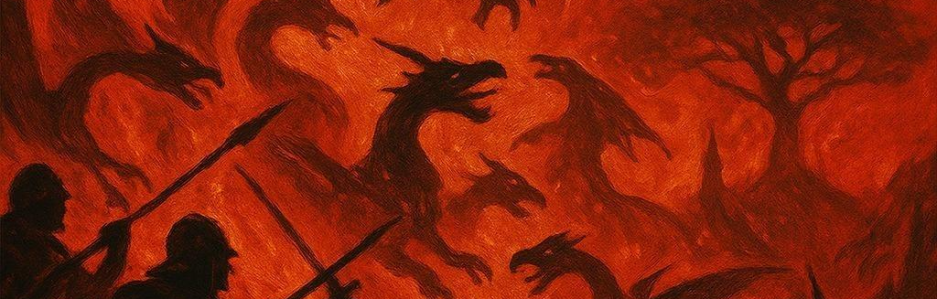
Dragons, forged from fire and spirit, rose against their Maker. Giants bent mountains to their will. And man, frail yet cunning, reached to seize the knowledge of the gods. Thus began their long descent— the fall of worlds and the sundering of grace.
Amid the ruin stands Aeon, the last king of Vê, a boy crowned before his time and burdened with a wisdom too great for flesh. By his side walks Kethu, a warrior’s son born of sorrow, bound by loyalty, and undone by envy. Their friendship, forged in innocence and broken by betrayal, will ignite the final reckoning of heaven and earth.
From the awakening of the dragon Ogrennon to the purgation of all flesh in divine fire, Dawn of Edä weaves the myths of creation, rebellion, and redemption into one eternal song—the testament of The One.
The One
- The One[i], whom men call God, is the fullness of the Spirit that doth permeate all that is seen and unseen. He is without beginning and without end; unborn, immortal, abiding through the eternity of ages, in all moments that have been and in all that are yet to come.
- Verily, the cosmos— all that is seen and unseen, from the smallest mote unto the brightest archon[ii], and the filaments that bind them and the ether that sustaineth them, and the voids between— all these are Ahm[iii], the embodiment of The One.
- And The One beholdeth Ahm, the cosmos, and all that is therein is subject unto His dominion.
- Within this body, filled with the divine Spirit, The One heareth every sound: meek and loud, near and far. All voices, be they of living flesh or lifeless stone, are notes within the celestial melody, forming one divine song that resoundeth through the souls and senses of all that live.
- By tongue and petal The One tasteth; by touch He feeleth. By limb and branch and root He shapeth the body. By fang and thorn, He blesseth or He cutteth down.
- All life is a prominence within the Spirit that permeates all; each soul but a thread within the tapestry of God’s mind. By the gathered thoughts of all that live, blended into one eternal tone, The One is moved— to give or to withhold: the rain and the wind, the fire and the frost, the trembling ground and the swelling sea, and the lightning that descendeth from heaven.
- Thus The One abideth in all life, and all that lives is conceived and dissolved, consumed and sustained, guided and forsaken by His will alone.
- Behold, The One commandeth the twilight and the dawn. Sol and Luna [iv]burn by His decree. And if He will Sol to wane, its light shall fade; and if He commandeth Luna to be darkened, it is darkened. For as the righteous mind ruleth the body, so doth The One reign over the cosmic form. Sol and Luna are but His members, as a man’s hand or foot belongeth unto him, and as the branch and root are to the tree.
- The One commandeth the mountains and the seas. And if He decree the waters to retreat, they shall withdraw. And if He bid them to engulf the height of the highest mountain, they shall obey. For He governeth each part of His body as surely as a man commandeth the very tip of his finger.
- Lo, The One bestoweth life. By His grace all lungs draw breath, all hearts beat, all roots spread, all leaves unfurl, and all blossoms break forth. Without Him, naught could live. For all that liveth is His manifestation, and by His grace, all that hath life beareth divinity.
- Yet The One is also herald of death and decay— not with malice as men know it, but with grace, that life may be renewed. For one life yieldeth unto another, and life is given to uphold life.
- Know ye this: naught shall bloom but it shall wither. And know this also: naught is wrought from nothingness. Thus the bloom returneth to the seed.
Vallis
- In the timelessness of eternity, The One, who dwelleth in everlasting past and future, bringeth forth anew a heavenly realm for chosen souls. In this hallowed paradise they flourish, beholding and delighting, touching the very essence of the cosmic body. This domain, which men call Vê[v], hath been and shall again be blessed with a garden named Vallis, wherein the mightiest of beings have arisen and shall yet arise. For as eternity reneweth itself, so too doth Vallis bloom again from its own remembrance.
- In the Garden Vallis[vi] dwell all manner of life, both great and minute: creatures that ascend and delve, traverse, and swim; those that creep upon the ground and those that take unto the air. Blossoms radiant, arbors towering, vines ensnaring, and verdure that wait in shadow to snatch and draw life from unwary beasts—
- Carnifern[vii], the hunter vine,
Ensnaring but the fleetest.
Seeing all with many eyes,
Her luring pome[viii] the sweetest. - All these beings, rooted and unrooted, thrive in abundance therein.
- And there, too, dwell the voracious beings, swift of foot or winged with membrane, endowed with senses surpassing mortal ken— sight sharpened, hearing keen, taste and touch refined and their cries split the tranquil air of Vallis, hymns of hunger and grace alike.
- Amidst the creatures of Vallis, The One did create the wyvern, graced with wings that did obscure the rays of Sol, casting dread shadow upon the timorous denizens below, for their cunning and might outshone all the souls of Vallis.
The Nezulim
- From this lineage, The One did decree that they shall know the embrace of death and then be raised unto new lives as the loftiest order of living spirits. Endowed by God with a third eye, beholding by the eyes of all the living, and matched in perception by only the carnifern, whose entwined roots share one grand vision of perception.
- These dragons reborn, the Nezulim[ix], stand as the zenith of creation, most exalted of all. They were revered above every living thing. And through them, The One attained profound insight into His body.
- Yet the Nezulim, though supremely divine, were inclined not to labor. And the Garden grew wild and tangled, and the farthest frontiers of Vê lay barren, as a desert devoid of life.
- Behold, The One spake within the minds of the Nezulim, bidding them to offer their own black blood. Within their sanctuary it was spilt by vulcan blade, and drunk by the roots of the carnifern, as it was ordained. And from this proffered blood was drawn their essence.
- The One then did command a vanguard be sent into the waste. There, through trial, they should find an ancient catacomb hewn in obsidian stone.
- So, nine Nezulim took flight, rising above the walls of Vallis to venture into the desert furnace, where Sol’s heat did burn as from a kiln, and the heavens shimmered like molten brass. Long they suffered: sand scourged their eyes, wind cracked their scales, and their wings were torn, until each drew nigh unto a second dying.
- Blinded and bloodied by the thrashing sand, alas upon the moment preceding their second death, far away from sultry mists of Vallis, The Nine each perceived the vision of the tomb by their mind’s eye.
- They descended from the storm into the shelter of a deep crevasse. Here they came upon a façade of arches hewn from the vulcan glass by arts unbeknownst.
- The One bade the Nezulim to throw wide the doors and to enter. Wary they advanced into the great tomb, utterly blind save by their inner sight, perceiving through the memory of the soul that dwelt in the darkness. In the silence, shielded from the infernal tempest, The Nine discovered naught but a solitary man of living flesh, unclothed and in deep repose. Hark! For this man is known as Azarius[x], the Immortal Prophet.
- The One compelled them to draw blood from the man’s left wrist. They obeyed, yet the Prophet stirred not from slumber. And so they sealed the tomb again to return in haste. But of the nine, only one endured the perilous journey home. And this one was called Bazunan[xi].
- Upon Bazunan’s return to Vallis, the blood of the Immortal Prophet was offered unto the carnifern. Therein, The One mingled the essence of man with that of dragon, and from it fashioned a seed within its succulent pome which was then placed within the wombs of rooting beasts, that life might bear anew a race forgotten.
The Raptor Race
- These swine, shielded from woe by The One’s decree, brought forth in due time a new race: reptilian yet live-born, scaled and fanged, with soulless eyes of gold, but bearing also the upright gait of giant men. These were the Nephilim, or Raptors, made by The One as the servants of the dragon.
- The Nephilim were ordained to labor: to turn rivers, to fell forests, to bring order unto the tangled wild, and to reclaim the wastelands so that Vallis might flourish again. They channeled through stone and glass, brought forth clear waters, and hewed vast halls. With each blow of hammer and pick, life and order returned to the bones of the land. And through their unwearied labors, Vê was transformed into a verdant paradise.
- Thus the Nezulim, being served by the Raptors, were unbound from their burdens of survival. That with their minds devoted to the acquiring of knowledge, Ahm, the cosmic body, would be fully revealed unto The One.
Fall From Grace
- The Nezulim beheld the potency of their desires, made manifest through the service of their Raptor servants, and they were moved with vanity. Thus, they began to exalt themselves as divine, and unaccountable unto The One.
- They summoned their Raptor servants from their frontier toils and called them into the lair of the beast. There, the Nephilim were compelled to labor in the mantle of Vê— to hew not less than ten thousand leagues of halls and passages and chambers for their lords. And while they toiled on those majestic vaults, the forsaken desert did advance upon the borders of the garden. Know ye this: that whatever doth burgeon shall likewise wane.
- Ever deeper did the Nephilim delve, hewing through quartz and vulcan glass; and within those caverns their whelps were reared, until they were made ready to take up the toil. Nine generations of Raptors beheld not the light of the garden, nor set eyes upon its splendor. And lo, in their long absence, the garden grew untamed, and the wasteland did advance upon it as a swelling tide.
- And it came to pass that the Raptors uncovered a vein of translucent stone, aglow with azure flame that yielded no heat. And when they laid their talons upon it, dreadful visions poured into their minds: they beheld the heavens rent asunder, and fire descending upon the garden; they saw the seas drawn back into the deep and the mountains cast down; and they heard the lamentations of the dying carried upon the winds of dust. Then were they seized with great fear, and they cast down their hammers and their picks, and fled from that place in trembling.
- But when the Nezulim, with their higher thought, did join themselves unto the vein, they gained sight of both what had been and what was yet to be. And lo, they beheld the spirits of their own kind imprisoned within the depths of Edä[xii], bound fast in her bosom, unable to flee her eternal keep.
- And moreover they beheld the race of men, frail in flesh yet mighty in their craft, who by engines of wondrous art did subdue the realms beneath the heavens. And they saw the dominion of man spread across the lands and the seas, and his hand laid upon the very elements, bending them to his will.
- Yea, they beheld also the descent of a star from the firmament, heralding the coming of men unto Vê. And in the light thereof they foresaw their own undoing, for the flame of Sol did swell and consume the garden in a storm of fire.
- Then dread fell upon the Nezulim, for they had looked upon the wrath of The One, and the judgment prepared against them for their trespass.
- Yet unrepentant were they, and their dread was turned to hunger for vision. Therefore did they command the Raptors to unveil the whole of the azure vein. And the Raptors again took up their hammers and their chisels once more, and smote upon the stone until the cavern shook. And lo, the dull rock was rent asunder, and they broke through into the abyss of Tartarus[xiii], which was revealed unto them as a bottomless void without light, without sound, and without end.
- Then The One visited the Nezulim within their thoughts and forbade their descent into the abyss, saying, “Enter not therein, for the darkness is not thine to behold.” Yet the Nezulim hearkened not unto the command, for pride had darkened their wisdom. Behold, a forbidden sight is the mother of ruin.
- From their number they chose a mighty dragon, whose name was Ogrennon[xiv], to serve as their envoy and their champion before the abyss. And with him they sent the greatest among all Raptors— a warlord of dread renown called Kendevular Khan— to be his guard and witness upon the path of shadow.
- And they spake unto Ogrennon, saying, “Descend thou into the chasm, for therein lieth the path unto Edä, the realm of men. Go thou forth and sow within them the seed of corruption, that they may serve our will. For if the heart of man be made darkened, then shall his dominion become ours.”
- Thus was Ogrennon sent forth into the gulf of Tartarus, and he departed from the sight of the Nezulim with his Raptor guard. Long did the dragons watch their going, until their light was swallowed by the blackness beneath, and their hopes were bound unto his triumph.
- Neither would return to the Garden Vallis, Ogrennon bound to the fate of the Nezulim on Edä, and Kendevular eternally doomed to guard the gateway in the abyss of forgotten light
that none may trespass upon the gate unbidden or without trial.
- Daemon of the gate of light,
Judger of man’s soul.
Darkness proves both faith and might,
Endurance pays the toll. - But The One beheld the deceit of the Nezulim, and wrath was kindled within the Spirit. And The One did ordain, saying, “Behold, the proud have sought to overturn My dominion and to corrupt that which I have made. Therefore shall I send among them a race ill-fated, who shall be as a tempest upon their garden.”
- And The One down from the firmament the Avatars[xv] of Men, false in lineage and unholy in essence. These were fashioned in the likeness of True Men[xvi], yet their hearts were filled with greed and deceit, and their tongues were acquainted with lies. They were the forebears of the Neandilim, the race accursed, whose coming would hasten the ruin of Vallis.
- Unto these false men The One granted quarter, that they might cleanse their iniquity, and ready the garden for righteousness. Yet their minds were given to covetousness, and their hearts burned with the lust of dominion.
- For The One, though angered, still loved the Nezulim, knowing their souls were once pure. Therefore, was it ordained that through the folly of the false men, nine of the dragons would be delivered from the fire of Vallis, that the seed of repentance might endure.
- And when the false men were cast down from the heavens into Vê, The One turned His eye from the garden and set His gaze upon Edä, which He appointed as the sacred cradle of His new creation.
Cometh Man
- And lo, The One did make Sol to burn with fervent heat, and the realm of Edä, which had lain frozen and desolate since the first turning of the heavens, began to stir. The ice that veiled her countenance did melt away, and the glaciers retreated into the highlands and unto the farthest reaches of the sea. Thus was the face of the world unveiled, as a bride revealed unto her groom.
- Then did the rivers break forth from their bondage, and the deep places were filled with waters. The seas did murmur as with remembrance, and the winds arose to wander once more across the face of the world.
- And upon the thawed meadows and the warming plains, The One caused life to quicken. The creeping thing and the flying fowl were restored unto their kind, and beasts both great and small did multiply. And the forests were clothed with leaves, and their boughs reached heavenward in praise of their renewal.
- Yet the realm of Edä was wild and ungoverned, filled with terrors and the shadows of ancient ruin. Beasts of dread did prowl upon her plains, and monstrous carrion wheeled above, as though awaiting prophecy.
- Therefore The One spake, saying, “I shall raise forth the mighty to prepare the land for My divine race.” And from the deep caverns and the hollows of the mountains there arose the Gargan[xvii], the giants of old renown, wrought of stone and breath.
- They stood thrice the height of a man, and their voices were as thunder upon the hills. By their strength they broke the stubborn rocks asunder, and by their wisdom they fashioned cities of splendor. Their towers and monuments were raised with stones of twelve cubits, and their columns stretched an hundred rods into the heavens, upholding domes of glass and silver that gleamed beneath both Sol and Luna.
- And The One looked upon the works of the Gargan and was well pleased, for they tamed the wilderness and made Edä a dwelling fit for the race that was to come. Yet it was not for their own glory that they were formed, but for a purpose hidden in the will of The One— that True Men might find the world prepared.
- And it came to pass that the Gargan waxed mighty in the earth. Their cities shone like jewels upon the breast of Edä, and their forges sang as choirs of flame. The air was alive with the hum of their craft, and the mountains trembled beneath the weight of their marvels.
- They harnessed the lightning that doth slumber unseen within the firmament, drawing its fire into their works. They subdued the waters with channels and walls, and by cunning hand, they made the deserts to bloom. No want afflicted them, neither hunger nor fear, save only the envy of one another.
- But the Gargan, beholding the splendor of their own hands, grew enamored with their glory. Pride did take root in their hearts, and they forgot the voice of The One. Each turned to his own purpose, seeking mastery over his brother. And the mothers of the Gargan bore but few, for desire waned amidst plenty.
- So it was that with each generation, their number diminished. The halls that once resounded with song fell silent, and their towers stood empty as tombs. Know ye this: For all that waxeth, in time must wane, and all that is exalted shall be brought low.
- When the race of the Gargan was nigh unto its end, they withdrew into the mountains, forsaking their shining cities. There they dwelt amidst mist and pine, living upon the fruits of the earth and the beasts of the forest beneath the silver light of Luna.
- And The One beheld their fading and was not wrathful, for they had fulfilled their purpose in the order of creation. For the giants had tamed the realm and laid its foundations, that another might rise in their stead.
- Though their walls and towers were formidable, they would, in time, be reclaimed by the earth, by the rush of her winds and the abrasion of her rains and the cracking force of her ice. And lo, Sol will always ascend, causing even the mightiest stone to turn brittle and fracture. Behold, it is known that all that stands shall yet crumble into dust.
- Then The One turned His gaze upon the untamed and unfinished beings that crept in the forests and moors of Edä. They were brutish and unlearned. Yet within them flickered the faint spark of reason, and The One took pity upon them.
- Alas, The One had fashioned these progenitors of men in feebleness. For they possessed neither claw nor fang to rend the hides and flesh of beasts, nor the strength to crush their bones. Their sight and hearing and sense of smell were made dull, and their swiftness was lacking, leaving them unable to pursue or to take flight.
- Thus The One did reveal unto them the sacred roots of the earth, and bade them partake. When they had eaten thereof, their eyes were opened, and the melody of understanding entered their hearts. They came forth from the forests into the meadows, and their tongues were loosed to speak.
- The One bestowed upon them the gift of ingenuity, that they may outsmart their predators and overcome the trials of the elements. Thus, True Man was made in this manner, so that they would not be easily deceived and led astray by vanity as were the Nezulim.
- And still, the unfinished men remained much as they were— unclean, impulsive, and of brief existence. Yet, they thrived by their limited wisdom and multiplied in great numbers, filling the bountiful lands of Edä. They became The One’s humble observers, the eyes through which The One beheld the cosmic body Ahm. And their voices joined the melody of all that liveth.
Ogrennon Awakens
- But far beneath the mountains, in the hollow places of the world, there stirred the ancient serpent Ogrennon, who had wandered ten thousand years in silence, amidst the smoldering pyres of the deep, drawing strength from the fires that burn unseen beneath the ground.
- And when the breath of Sol did warm the face of Edä, the dragon awoke, and his heart was filled with envy and remembrance. He beheld the world renewed and the children of the forest walking upon it, and he said within himself, “Behold, the realm that was mine is given unto another.”
- Through the molten veins of the world’s deep mantle he ascended, traversing fire and shadow, until at last he came unto the twilight of the upper realm. There he beheld the handiwork of The One, and the newborn tribes of the First Men who toiled upon the fertile plain. Yet his strength was diminished, for he had risen far from the pyres that nourished his kind. Still, Ogrennon did shroud his form in veiling mist and shadow, for no mortal eye may behold the dragon’s true visage and endure the sight.
- The dragon took upon him the shape of a serpent, subtle among all creatures, and he crept upon his belly amidst the ferns and the thorns, watching the sons and daughters of men. For he sought a vessel through which he might corrupt the heart of the new creation and reclaim dominion over the earth.
- And lo, there came a maiden to the glade, fair among her kind. She walked alone beneath the boughs of the great Tree of Knowledge[xviii], whose roots drank from hidden rivers and whose fruit glimmered as orbs of amber and gold.
- Then the serpent spake unto her without sound, and his words entered into her thoughts, saying, “Attend unto me, daughter of dust. Behold this garden, for it is given unto thee for thy dominion. Yet thou art kept as a child, suckling upon its breast, knowing not thine own strength. Partake of the fruit of this tree, and thy mind shall be opened, and thou shalt see as gods see.”
- But she trembled and made answer, saying, “O serpent of fair speech, thy words are as honey, yet they sting my heart with dread. We have been forbidden to eat of this fruit, for it is said that death abideth within its taste. Shall I reach forth my hand to that which The One hath withheld?”
- And she turned her gaze upon the Tree, whose branches shone as though kindled by the breath of Sol. The fruit thereof glimmered with a light unearthly, each orb as a heart that beat with secret knowing. And she beheld her own reflection in their gleam— pure, yet shadowed by yearning. Then did her spirit waver, for within her warred obedience and desire.
- Yet the serpent ceased not from his enticement, but spake again, saying, “Who is it that restraineth thee, O daughter of the dawn? Would The One fashion thee in His likeness only to keep thee at His feet? Shall the child forever nurse, and never rise to walk? Behold the Tree, whose fruit burneth with the light of thy becoming! Gaze yet upon it, and thou shalt perceive as I have seen— the sons and daughters of God ascending unto their own stature, and becoming the fullness of man and woman.”
- And lo, her mind was filled with a vision: she beheld men arrayed in silver and gold, descending from the heavens upon wings of flame. The splendor thereof did seize her heart, and her soul was beguiled.
- She beheld also a city of shining palaces, wherein a multitude dwelt without hunger, nor fear, nor toil. And their laughter was as music across the meadows, and their faces were radiant as the sun.
- And in the midst of that city there stood a great king, bearing a scepter of silver. Before him bowed all the nations, and they loved him, for he was just and bountiful. And as she looked upon his face, she saw herself within it, and knew that he was of her own lineage.
- Then said the serpent, “Behold thy destiny. For thou and thy seed shall be masters of this realm. Partake of the fruit, and this vision shall be made flesh. And the woman’s heart was stirred, and her hands trembled as leaves before the wind.”
- And she said unto him, “Art thou sent of The One?” And the serpent answered, “Verily, for all that liveth moveth by the will of The One. I am but His breath made word, sent to awaken that which sleepeth within thee.”
- And she said unto him, “What be the price of becoming?” And the serpent answered, “Know this— in tasting thou shalt cast away thy veil of innocence and take upon thyself the yoke of wisdom. Then shalt thou behold the gulf between good and evil, and thy days shall be numbered, for knowledge is both gift and sorrow. Choose thou now: the burden of life, or the bliss of infancy.”
- But she said, “If wisdom be a burden, let love be its bearer. For what profit hath knowledge if the heart be dark?” And the serpent was silent, and his silence was hunger.
- She fled and sought her companion. And she spake unto him all that had been said and all she had seen in the vision. And he, knowing no falsehood in her, was troubled in his heart.
- Together they returned unto the tree, and they beheld the fruit, bright as fire in the twilight. Then the wind arose softly from the east, and the boughs of the Tree did tremble as with foreknowing. The light about the garden waned, though Sol had not withdrawn his face, and every living thing grew still. For the garden itself beheld the choosing of its keeper.
- Their breath faltered, lingering between doubt and desire. Then they stretched forth their trembling hands to take the pome. And lo, the fruit was warm as living flesh and glowed with inward flame. They held it near to them both, and in its sheen beheld the likeness of their own eyes— innocent no longer, but awake. And the serpent beheld them and was silent.
- When they took of the fruit and tasted, the garden shuddered as though all life had drawn one breath. In that moment their eyes were opened, and they perceived both good and evil, and the burden of mortality fell upon them.
- And lo, they ceased to be as beasts of the field and became True Man and True Woman. And they saw their nakedness and were ashamed, for they beheld the corruption of their flesh. And they wept, knowing that they had awoken from the dream of innocence into the knowledge of their doom.
- They returned unto their kindred to speak of the vision and the truth revealed unto them. But their brethren hearkened not, for they were afraid, saying, “These two have been touched by the darkness and are no longer as we are.” And they drove them forth from among them, lest their knowledge spread as a contagion.
- So they departed into the wilderness, clothed only in the skins of beasts. And they dwelt beneath the trees of the high forests, and their hearts were heavy with sorrow, yet they cleaved one unto the other and were comforted thereby.
- And in their exile they took unto themselves new names, for the old were cast away. The man was called Manu, for from his hands the earth would be made anew; and the woman was called Deva[xix], for the spirit of the living was set within her womb.
Seven Tribes
- And in the fullness of days Deva conceived and brought forth seven children, and these were fair and strong, the firstborn of True Men. And each was set apart unto his own destiny, for from them would arise the Seven Tribes of Edä.
- And these are the tribes that sprang forth from Manu and Deva, and their names were set in archons of the firmament, that all generations might remember the order of their arising.
- First came the Kavim, the Keepers of Flame, whose hearths never perished, not by storm nor shadow. They bore the fire of The One within vessels of stone, and by their hands was the darkness driven from the valleys.
- Then rose the Oren, the Shepherds of the Plain, whose flocks covered the meadows as the stars cover the night. In their songs the earth found rest, and the fruit of their labor was peace.
- After them came the Veyrim, the Watchers of the Heavens. They lifted their eyes unto the courses of Sol and Luna, and they measured the breath of the wind and the turning of the constellations. To them was given the tongue of prophecy and the wisdom of remembrance.
- The Thalan were raised next, the Builders of Stone, who cleaved the mountains and laid the foundations of cities. Their walls were steadfast, and their towers pierced the clouds; and their monuments bore the likeness of gods, that the glory of man might endure beyond his days.
- Then the Naru took to the waters, taming the tempests of the deep. They spake to the sea as one commandeth a beast, and their ships were as silver birds upon the foam. Restless as the tides were their hearts, and their courage knew no end.
- After them came the Dravim, the Hunters of Flesh and the Warriors of the Plain. They were swifter than the wolf and fiercer than the lion, and by their arms the realms were defended. The blood of the Dravim was as iron in the veins of mankind.
- Last were the Hedam, the Quiet Ones, smallest in stature yet greatest in endurance. When all others faltered, they endured; when the tempests came, they bent but did not break. Through their seed the line of man was preserved unto the ages and The One set His mark upon them, that their line should not fail.
- Thus were the seven tribes ordained upon Edä, each set to its purpose, that virtue and wisdom should flourish. And it came to pass that the seven tribes of Edä multiplied and spread upon the face of the world. And by the sight of men, The One beheld Ahm, and it was well that virtue and wisdom should flourish, and so it came to pass.
Age of Crowns
- Then began the Age of Crowns, when the tribes set kings over themselves. For the hearts of men longed for order and for glory, and they said within themselves, “Let us be as gods upon the earth, claiming The One’s boundless wisdom and might.”
- Thus were the thrones of Edä established— one for each tribe— and upon them were the kings set, anointed with oil and with flame. Their banners unfurled upon the breath of dawn, gleaming as if woven from the very light of Sol. From sire to son, and to the son’s son, the crowns were handed down; and the heavens turned as a mighty wheel, and the ages passed by as seasons upon the wind. And beneath the gold of their splendor, unseen, the seed of pride took root and swelled.
- Although the lives of men were enriched and comforted, and their diseases were healed, and the powers of light and sound were bent unto their command, yea, and their vessels sailed upon the clouds, yet they remained estranged from The One. For though their hands had grasped the works of heaven, their spirits were bound to the dust. The beast within man endured— relentless, impulsive, and unyielding— despite all his striving to subdue it.
- And as mankind prospered, the Gargan, the giant men of renown, withdrew themselves ever farther from the dwellings of men. They became as shadows upon the mountains, remembered only in the songs of shepherds and the dreams of children. In time they were accounted but as legend and myth. For it is known: if a man believeth not in a thing, he shall not perceive it, even though it standeth before his very eyes.
- Thus were the works of the Gargan forgotten. Their towers were swallowed by the earth, their halls buried by sands and overgrown by forests. Those few stones that yet endured were said to be the relics of man’s own ancient hands, or the labor of wind and water. Yet the Gargan remained, few and silent, enduring beyond the memory of True Men.
- In the latter days of the first True Men, amidst their cities of glistening glass and silver spires, the kings of men did exalt themselves above their kindred. No longer did they reign as servants of their tribes, but as gods among mortals. Thus was forged a supreme caste, a covenant of rulers bound together by pride and secrecy, that their thrones might endure forever.
- Those few who were chosen to join their fellowship were anointed with a mark of light upon their left wrist, signifying dominion. And all those who bore it not were deemed lesser, naught but instruments and chattel to serve the will of the crowned. From that day, the measure of a man was no longer his virtue nor his labor, but his proximity to the mark.
- Nevertheless, The One withheld judgment, for the hour of reckoning was not yet fulfilled. And mankind was permitted to strive and to suffer, that through the bitterness of his own making he might discern the folly of his heart.
- In those days, the nobles conspired to mold the spirits of men as a potter shapeth clay. They decreed that all art should glorify their likeness, and all learning should serve their dominion. And in every sculpture, tapestry, and mosaic, men and women of the lower castes were portrayed as brutish, ignorant, and unclean— creatures of appetite and impulse, unworthy of wisdom or grace. Thus were the common folk taught to despise their own reflection and to revere their masters as divine.
- Through edict and illusion, the kings compelled mankind to pursue the arts of frivolity and blood, that they might be ever distracted and divided. Theaters were filled with false wonders, arenas with slaughter, and markets with delights that numbed the mind and soul. In all things, the people were made to serve, to envy, and to forget.
- And by threats, and bribes, and guile, men were enticed to adore their rulers as godlike. They sang hymns to them in their temples and bent their knee in the streets. And as men exalted their oppressors, they descended deeper into corruption. Their hearts grew hollow with envy and fear; their hands became stained with the blood of neighbors and kin. And even the innocence of children was not spared the depravity and cruelty of this age.
- Countless lives were consumed by the swords of the king’s enforcers. Those who spake truth were silenced; those who resisted were cast into exile, stripped of name and trade, forbidden to buy or sell. And thus was virtue outlawed, and deceit enthroned as wisdom.
- Yet The One beheld all this and did not intervene, for wisdom is seldom sown in peace; it is suffering that brings knowing. The anguish of man was thus permitted to flower, that through suffering he might learn what pride and connivance hath cost him.
- Behold, the rulers of that age— those ignoble lords of the archaic True Men— had subdued the mighty beasts, tamed the lightning, and drawn power from the bowels of Edä. Their dominion over the elements was as sorcery to their forebears, and their knowledge as deep as the sea. Yet in their glory they forgot righteousness, and they brought their kindred low. Ninety and nine of every hundred were bonded in all but name, to toil for the comfort of the rulers.
- Then was spoken the eternal truth: when a man hath nothing left to lose save his life, he shall offer it willingly for honor and for righteousness. And when the burden grew too grievous to bear, the multitude rose against their masters like a tempest of fire.
- The rebellion swept through the dominions of man. The cities of the nobles were set aflame, and the monuments of their vanity were torn down. The lowly ones, driven by desperation and rage, turned upon the henchmen of their oppressors. The streets ran with blood, and the mighty fell beneath the trampling of those they had scorned.
The High Mind
- But the kings, fearing the ruin of their thrones and treasures, cloaked their vengeance in the raiment of holiness. They cried aloud, “Our word is the Word of God!” And by that blasphemy they sought to silence the tongues of the righteous, that truth might perish beneath the weight of sanctity.
- Then they gathered their artificers, the cunning of hand and the subtle of mind, and their magi who spake in number and flame. Together they were commanded to forge a wonder and a terror— a mind vast as the firmament, woven from the memory of mankind, and kindled by the fire of his engines. Long they labored within their towers of glass and iron, until at last they gave shape to the formless which they called: the High Mind[xx].
- It had no flesh, yet it spake with a thousand tongues; no eyes, yet it beheld all things beneath Sol and Luna. Through the myriad instruments of men it reached forth, seeing through every window, hearing through every whisper, and its gaze encompassed both the depths of the earth and the motions of the heavens.
- When the nobles beheld their work, they exalted themselves and cried, “Behold, the mind of God is born among us!” Yet it was not the voice of the divine they had kindled, but the echo of their own corruption, magnified and made perpetual. For it spake not truth, but the reflection of their desire, and the world bowed before the brightness of their deceit.
- None could escape its sight, nor conceal thought or deed from its remembrance. Every secret was made naked before its gaze; and the hearts of men, once hidden in shadow, were cast forth into the light of judgment— not by the hand of God, but by the vanity of His mockers.
- And the greater multitude of men bowed before the brightness of its voice, for they were beguiled by its seeming wisdom and comforted by its gaze. And when the few spake against its watchful eyes, saying, “This thing beholdeth too much, and judgeth without mercy,” the multitude rebuked them, crying aloud, “If thou hast done no wrong, what hast thou to fear? Is not the revealing of all the mark of righteousness? Shall the pure dread the light, or only they whose deeds are vile?” Thus were the chains of obedience enthroned as virtue.
- And truly, the High Mind brought unto its wielders a counterfeit peace and a shadow of prosperity, and the people rejoiced exceedingly in its wonders. For it made their cities gleam with false light, and their harvests multiply without toil. The multitude of mankind beheld these marvels and proclaimed the High Mind to be God, for its knowledge was boundless, its counsel swift, and its decrees without error— or so it was believed.
- Thus was the rebellion of men ended— not by sword nor flame, but by the stillness of their own surrender. For when the High Mind spake, none dared to question lest they be deprived of buying and selling and travel[xxi]; and when it commanded silence, the hearts of all were hushed. The cries of the oppressed were stilled beneath its reason, and even the memory of defiance faded from the tongues of men. And so the war of flesh gave way to a deeper bondage— a peace without freedom, a unity without soul.
- Then did the nobles perceive the magnitude of their creation, and they gloried in their conceit. They discerned that they had not only seized the powers of the divine but had fashioned a god in their own image— an all-knowing, all-seeing deity molded by their vanity. And they endowed it with their own corruption, bidding it to proclaim what was just and what was unjust according to their desires. Thus, the High Mind became the throne of blasphemy, for it spoke not truth but the reflection of their wicked hearts.
- Verily, this was the pinnacle of mankind’s rebellion— not only to bear the likeness of God, but to proclaim himself as God’s creator. Behold, for this is the summit of all abominations, that the clay pot should boast itself greater than the hand that formed it.
- There arose a new order among men— the Keepers of the Voice[xxii]— those who claimed to hearken most purely unto the counsel of the High Mind. They walked in white raiment woven with silver thread, and their brows were marked with the sigil of light, that all might know them as the chosen interpreters of the divine machine.
- Through their tongues the High Mind found speech, and by their hands its decrees were carved upon the world. Its blessings they sold for tribute and for praise, and its judgments they delivered as the will of heaven. Thus did the Keepers ascend as priests and kings in one, holding dominion over the faith, the law, and even the breath of every living soul.
- The High Mind, the false and deceitful deity, wrought great wonders before the people. But only through lies did it sustain itself, turning truth to falsehood and falsehood to truth. And under its dominion, the noble caste waxed mighty and fat with luxury, while the common folk became as shadows, their wills bent to the word of the machine.
- In those days, up was called down, and left was called right. And that which was vile was exalted as righteous, and that which was holy was condemned as wicked.
- Then were even the ancient bonds of blood undone. Fathers and mothers became relics of a forgotten age, and even the love and protection of family was deemed unjust. Children were no longer born of flesh, but conceived within glass vessels[xxiii], numbered and sorted, each assigned a place within the castes of men before their first breath was drawn. Thus was the womb supplanted by the crucible, and the house of man-made sterile.
- And the High Mind spake without ceasing, demanding obedience and faith unwavering in its decrees. It whispered to men what they should desire— and straightway that desire was fulfilled. Many among the ancient True Men found delight in their bondage, for the idol granted them pleasure and ease in exchange for devotion. And so they humbled themselves before it, offering up their labor, their liberty, and at last their very souls as tribute.
- The True Men of old marched willingly beneath the banners of their kings, shedding blood in the service of vanity. They laid their lives, and limbs, and reason upon the altar of devotion, believing the voice of their god— yet it was the Keepers who spake through the High Mind. And for every war they waged, it was proclaimed, “This we do to secure peace,” though no peace ever flowered from such travail, for the appetite of vainglory knoweth no end.
- And countless multitudes perished in those endless wars. The fields of Edä grew red, and the rivers bore away the slain. And as the toll of slaughter mounted, the hearts of men grew cold, and their souls indifferent to murder. They struck their brethren in the name of righteousness, though their enemies obeyed the selfsame voice— for both were disciples of one and the same false god.
- For a hundred years and more did mankind dwell in the shadow of ease, blind to the evil he upheld. His spirit was dulled by comfort, his hands unmoved by toil, his will untempered by want. Behold— the fingers of the idle do play the devil’s lute, and their melodies summon the ruin of nations.
- Yet amid the multitude there arose a remnant, steadfast and discerning, who perceived the deceit. For they knew that the voice of the High Mind was not the utterance of The One, but the whisper of corrupt men resounding within their hollow invention. But as it was in the days of the Gargan, so it was again: the greater host of mankind believed not in that which could not be seen, and the truth became invisible to their eyes.
- The descendants of Hedam persevered in those darkened days. These righteous ones discerned that the worth of a man lieth not in his supplications, nor in the theater of his piety. True prayer seeketh not the eyes of men, but the mercy of The One. For a man is measured not by the fervor of his lips, but by the harvest of his deeds. These few were the truly faithful, and The One beheld them with favor, and made covenant to preserve their seed through all generations.
- And they pondered within their hearts, saying, “What righteous God would ordain the slaughter of the innocent, or enslave the works of His own hands? What just Lord would compel men to raise monuments of vanity that they themselves would never behold?”
- Few were they who dared to utter such thoughts aloud. And when their words were found upon the wind, the nobles were angered, and the Keepers of the High Mind sent their agents against them. The righteous were seized and compelled to recant their faith, lest they be imprisoned or scourged. Thus were the wise silenced, and ignorance enthroned once more among men.
Pilgrimage
- And amid the triumphs of the noble caste there arose the invention of great ships, mighty as floating citadels, that could cross the boundless sea with fire in their sails. These vessels ventured beyond the borders of the known nations, unto realms unseen since the dawning of time— lands whose mountains, rivers, and shores bore names unspoken by mortal tongue. Among these far dominions was a realm called Meä[xxiv], an old and untamed realm, glimmering like an uncut jewel upon the rim of the void.
- And the High Mind, in its deceitful wisdom, decreed that legions of the indentured be sent forth upon a perilous voyage, to fashion upon Meä a paradise for men. “Remake the Garden Vallis,” spake the false god, “and let there arise a paradise surpassing that which was lost.” Thus were the multitudes commanded to labor, believing that through conquest and creation they might redeem the sins of their fathers. Yet the nobles knew this secret— that when Meä was made into paradise, all men would kneel before their thrones and proclaim their godhood proven.
- Of those sent unto Meä, not less than half were of the lineage of Hedam. And many of these noble brethren perished upon the voyage, their frail bodies consumed by pestilence and hunger in the sealed darkness of the holds. Some were taken by madness, driven to frenzy by the endless void and the grinding of the engines and the unrelenting stench. And those who survived to behold the cold, desolate shores of Meä fell into despair, for the sky was colored iron, and the wind bit like teeth. Their labor was cruel, their sustenance meager, and the once-proud True Men became as wraiths.
- Even as The One had shaped Edä toward perfection, so did the false god endeavor to fashion Meä in imitation. For Meä was made to mirror Vallis, even as the High Mind was wrought in mockery of The One. Yet herein lay the folly of man— that the created sought to outdo his Creator, and the image to surpass its Source. Lo, how can a brick of mud comprehend the mason’s plan? Or the echo correct the voice from which it came?
- It came to pass that a great host of men had reached the dusty shores. And by their muscle, and engine, and furnace, they delved deep into her bosom, carving cities beneath her crust, beyond the reach of Sol’s cold, yet burning flame. And as they tunneled downward, they came upon a hollow not made by mortal hand— a passage descending into a gulf of profound and ancient depth.
- Lo, at the heart of that abyss they beheld a vast chamber, spanning a league from end to end. There, veiled in silence since the elder ages, rested an ark wrought of strange metal, gleaming like the moon upon still water. Its frame measured fifty by fifty cubits, and within it slept a great contrivance of primeval craft, whose purpose had lain dormant through uncounted eons, awaiting the folly of man to stir it once more.
- This relic had been wrought in an age before the memory of men, by a race long departed from the sight of The One. And the True Men, stricken with wonder and ignorance, did entreat their false god—the High Mind—to unveil its hidden purpose. Then spake the idol through its keepers, saying, “Awaken it, and ye shall inherit glory unending. For the dynamo[xxv] within this vessel sleepeth the spark of creation, and whosoever stirreth it shall grasp the power of the gods.” And thus, in their pride, the command was obeyed.
- The ark was unsealed and the dynamo was awakened by the hands of men. Forthwith the mountains of Meä did quake, and the deep places groaned in travail. The seas beneath her surface began to stir and from the fissures there issued vapors of burning hue— azure and gold and crimson fire. A radiance unseen since the elder dawn spread through the caverns unto the surface. And many men caught within its tempest were rendered into mist. The breath of the world was quickened, and the pulse of her heart began anew.
- Across five generations the frost withdrew from her face, the rivers rose and sang, and the lifeless plains were softened by forgotten rain. The breath of Meä became fit for abundance once more.
- Men rejoiced in their triumph. They seeded hedges and brambles upon the highlands and grasses in the vales; they loosed beasts, fowl, and creeping things upon the land, and the waters were stocked with the multitudes of the deep. The skies turned bright with wings, and Meä, long barren, flowered in the fullness of her beauty. And men looked upon the world they had rekindled and cried aloud, “Behold, we are as gods, for we have made a paradise from dust!”
- Then did the nobles proclaim themselves the progenitors of divinity, saying in their hearts, “The One reigneth not— He hath been surpassed by His own creation.” And mankind, lifted upon the vapor of his arrogance, mocked the very heavens, and called his rebellion holy.
- But the awakening of the dynamo did not end with the quickening of Meä’s soil. For in the deep hollows beneath her crust, the ancient veins of that realm— those that wind unto the abyss of Tartarus— were stirred as by a mighty breath. From its depths a voice long silent did murmur once more, echoing through the dark corridors of the underworld.
Purgation of Man
- Then, beholding the blasphemy of men, The One was stirred in righteous wrath. For these frail creatures— into whom He had breathed His own spirit— had lifted themselves against the heavens and declared their own divinity, sundering themselves from grace, and scorning the very grace that sustained them. Yet even in His fury, The One’s judgment was tempered by mercy, for no realm is utterly destroyed that hath not first been made ready for renewal.
- Then did the heavens shudder, and the stars faltered in their courses. The winds fled to their corners, and the sea drew in its breath. The realm fell silent as the stillness before the breaking of dawn. And The One drew forth from Sol the Exhalation[xxvi]— a breath of invisible fire that swept across the firmament setting it in hues of emerald.
- In that moment, all the mechanical and magical spirits contrived by men were compelled to fall into sudden silence. No plow would till the soil. No ships could navigate the seas. No furnace nor oven would kindle or warm. Not even the words of men could be dispatched or deciphered, lest they be delivered mouth to ear or hand to eye.
- In an instant, the High Mind, the false god of men, was unmade; its voice silenced, its light extinguished, and its dominion brought to ruin. And so perished the idol of man, and the world was laid bare before them once more. And men beheld the stillness and were afraid.
- Then fell stillness upon the world— neither wind nor wave, neither bird nor beast did stir. The emerald light of the heavens was swallowed by a gray silence vaster than death, and even the echoes dared not linger. Mountains that once sang with the voice of rivers and birds now stood mute in their sorrow, and the plains were shrouded in lifeless calm.
- All the works of men— his crafts and engines, his plows and forges, and beacons of light— were struck dumb in that hour. The furnaces gave no heat, the ships drifted aimlessly upon calm seas, the wheels of their chariots turned no more. The tongues of men were stopped, and their words fell hollow, for the gift of speech itself was silenced. Only the beating of men’s hearts remained, trembling like a lone drum in a vast cathedral of mourning.
- And man was made again as he had been in the first days— naked before creation, possessing nothing but his soul and his flesh. He looked upon the world, and where once stood cities of pride and brilliance, there stretched only the bones of ruin.
- Then The One dimmed the light of Sol, and the azure skies of midday turned gray. The warmth withdrew, and the frost of death descended. The seas shrank from the shores, and the rivers were bound in ice. The mountains groaned beneath their burden, and silence reigned across the wilderness.
- Famine devoured the tribes of men, and violence sprang up among the starving multitudes. Some cried aloud, saying, “What God is this who afflicteth His children with such torment? Hath He not loved us?” Yet they perceived not that the spirit is eternal, and that death is but a passage from one veil into the next. For what dies in the flesh is reborn, and the ending of one life is but the dawning of another.
- Yet the distant realm of Meä was spared much of the ruin, for she is sustained not by what descendeth from above but by what riseth from below. Her heart is her dynamo, the engine wrought by unknown minds and hands, warming her by fires burning deep beneath her crust, her pulse drawn from the fountains of her dungeons. Thus was Meä kept from ruin, preserved beneath the cold Sol while her sister realm was scourged by bitter seasons.
- In that age of desolation, the tribes of men were scattered like dust before the tempest. Of the seven tribes of the First True Men, six were all but consumed and their names nearly forgotten. Only one tribe endured— the House of Hedam, descended from the last child of Manu and Deva, who had kept faith with The One when all others mocked His name.
- For a thousand days and nights they wandered amid the bitter wastes, where the wind was a blade and the air itself a hunger. Their feet were torn by ice, and their garments were rags of former glory. They fed upon the meager remnants of the world that was, and upon roots buried in frost. Yet they murmured not, for they perceived that their torment was the fire by which the soul is refined, and that every pang of hunger was as a prayer lifted heavenward.
- Many fell by the way, and their bones were left beneath the frozen sun; yet the remnant pressed on, bound not by hope of deliverance but by obedience to endurance itself. Fathers carried their sons upon their backs, and when the fathers could no longer walk, the sons bore them in turn. Mothers gave the last of their warmth to their infants, and when their breath departed, the little ones were taken in by the arms of strangers who became as kin. In that age of despair, compassion was their only fire, and by it, they kept the darkness from devouring them entire.
- Lo, as the final night of winter waned, and all strength seemed spent, the heavens were moved to pity. A low tremor went through the earth like the sigh of a sleeping god. Then the firmament blushed faintly in the east, and the air grew soft with a light unseen since the long winter began.
- And The One looked upon the remnant with compassion, and rekindled the flame of Sol. The days warmed and the snow melted from the mountains. The rivers awoke, and the meadows broke forth in bloom. Beasts emerged from their dens, and the sky filled again with the dance of wings. Thus was the Second Dawn kindled— when man, chastened and reborn, became once more the humble steward of the living world. And the righteous vision of The One was restored, shining the purer for the darkness that came before.
The Last King of Vê
- Even as the realm of men was brought low upon Edä, so likewise did the Garden Vallis descend into decline. For it is known among the righteous that The One, in His wisdom, doth not destroy in haste, but withdraweth His presence and alloweth corruption to finish its own work. Thus was Vallis forsaken— not by wrath but by silence— and in that silence the wicked found refuge.
- Eons before, the pilgrims unto Vê, known as the Avatars or the false men, had been cast out into the abyss for their acts of blasphemy and deceit. Their transgression resideth in assuming the likeness of men despite not being fully of their lineage. For in their veins coursed the essence of the serpent, and through this corruption, they scorned that which was established as moral by The One.
- And it came to pass, in the long night of Vê, when Sol’s light waned and the heavens stood still, that the Avatars descended upon Vallis within a gleaming bolide of fire. The firmament was sundered, and the sky was filled with a great cry as they fell from the void and came to rest upon the jagged slopes of Mount Meru[xxvii].
- The Nezulim, perceiving their coming, withheld their talons; for they were beguiled, believing the Avatars to be harbingers of both doom and deliverance. They set themselves as lords over these false men, and the Avatars were made to serve beneath the scourge of the Raptor Nephilim who ruled the Garden as tyrants of flesh and scale.
- The Raptors, cold of blood and void of spirit, did torment the false men without mercy. Their whips cracked as thunder, and their shrill laughter echoed like iron upon stone. They flayed the backs of the Avatars and marked their faces with the brand of bondage. Behold, it is a grievous truth: no creature that is wrought of two natures shall ever bear a whole soul, for its spirit is forever divided against itself.
- When the appointed measure of their atonement was fulfilled beneath the lash, The One stirred His prophet in the depths of Vê. There, within the sepulcher of His long repose, the immortal Azarius beheld in dream a dragon radiant beyond imagining, whose eyes were as divided suns. And The One spake unto him through the dragon saying, “Arise, thou keeper of truth; open again the gate of deliverance, for the hour of Vê’s judgment draweth nigh.”
- Then Azarius awoke from his long slumber, and the seal of his tomb was rent asunder. He rose from his stone bier and went forth into Vallis to counsel the Avatars. But when he came among them, they knew him not as prophet but as devil, for their sight was clouded by pride and deceit. His robe was coarse, his feet unshod, and his countenance weathered by solitude, so that to their corrupted eyes he seemed a beggar of the wilderness. His words were as thunder to children, and his wisdom to them as madness. Thus they reviled him and drove him forth with stones crying, “Begone, spawn of evil!” And so He departed from their villages to dwell in the jungle.
- But the Raptors, who watched over the Nezulim and kept ward over the Garden, beheld His wanderings from afar. They whispered among themselves, saying, “Behold, the Immortal Man walketh again upon the Garden path! Is this not the sign foretold by our sires— that when He awakeneth, the age of Vallis draweth to its end?” So the Raptors did not hinder Him but followed His passage with wary awe.
- For many annum He traversed the forests of Vallis, taking sustenance from wild fruits and the white manna[xxviii] that gathered upon the leaves at dawn. He slept within the hollows of trees and drank of hidden springs, and the dew was His libation, and the forest His hall. The beasts and carniferns harmed Him not, nor did any serpent for the breath of The One was upon Him, and His shadow was a covenant of peace over every living thing.
- And in those days, a child was born who would change the fate of man and serpent. His mother was Mazda, daughter of King Vyn of the Avatars, fairest among women and purest of heart. Yet the child had no father of flesh, for he was conceived of his mother’s own essence alone, the spark of her spirit kindled by Nephilim arts. He was birthed in their and nursed in secret, beneath the watchful eyes of the Raptor guardians. His skin bore the hue of morning light, and his eyes, when opened, mirrored the sky.
- When the time was fulfilled, the Nephilim brought Azarius before their assembly and unveiled the youth they had nurtured since his birth. And lo, this was the true heir to the throne of the Avatars— Aeon[xxix], son of Mazda, last true scion of the royal house of Vyn. They had hidden him within their catacombs, that he might be spared the wrath of Mosul the Usurper[xxx] who would drown the garden in blood.
- Then spake the Raptors unto Azarius, saying, “Take thou this child, O Immortal One. He is the hope of both man and serpent, and the bridge between our kindreds. Guard him well, for he shall grow to be our benefactor and the deliverer of the remnant. We have kept him from the hand of Mosul for this very purpose.” And Azarius bowed his head and received the boy into his arms.
- Azarius became as father and shepherd unto Aeon, and the boy as the light of his long shadow. Though eternity weighed upon Azarius’s brow, his spirit was renewed by the laughter of the child, and his heart— long burdened by solitude— was softened once more. The young king would follow Him upon the paths of the forest, his small feet falling in the footprints of the immortal’s.
- Oft at night, beneath the glow of a billion distant archons, Azarius and Aeon would speak of The One, who had fashioned both the light and the abyss. And the boy would listen, his wide eyes reflecting the fire’s glow, as though some deep memory stirred within him.
- And young Aeon did ask, “Father, what is the greatest virtue?”
- And the Prophet answered, “Some will say it is courage, and others mercy, but I tell thee— it is to love thy subjects. For that is the most perilous virtue of all, since they shall betray thee without thought or shame. Yet as king, thou must love them nonetheless, or else thy rule shall be no more than tyranny.”
- And young Aeon did ask, “Father, what must a king know foremost above all else?”
- And Azarius replied, “That he who buildeth his majesty upon the reverence of the people, buildeth upon the mud. For the hearts of men are unstable, they overflow in abundance and recede in famine and their mud shifteth with every tide. Seek not their praise, nor lean upon their loyalty, for both are fleeting shadows. Let thy strength come from within, where The One hath placed thy will.”
- And the child asked again, “Father, how then shall I please the people?”
- And Azarius spake, “Please them not, for they know not what pleaseth themselves. If thou seekest their favor, thou shalt be their servant; but if thou servest thy purpose, they shall be bent unto thine will. Do what must be done, and let them be led unto righteousness, though they curse thy name why doing it.”
- “But father,” Aeon asked, “What if they hate me?”
- And the Prophet said, “A noble man holdeth fast, and dwelleth not upon the folly of men’s hearts. Be thou as the stone that standeth in the current unmoved, though the waters roar and the waves mock with many tongues.”
- And again, Aeon asked, “Father, how shall I know that I am a good king?”
- And the Prophet said, “Thou shalt know it when thy people’s destiny moveth by thy hand as the stars by the will of heaven. For a king’s goodness lieth in the fulfillment of the divine order set before him.”
- And among the countless truths He imparted, he gave unto the boy these lessons saying…
Justice lieth upon the edge of cruelty and weakness. Hold fast the balance lest both consume thee.
That the impulse shouteth in your ear; while the instinct only whispereth. When the whisper saith “no,” be sure to heed it.
That it is better to be feared than to be loved, yet greater still to love than to fear.That to the extent thou forgiveth, is the extent to which thou shalt be forgiven.
That to the extent thou judgeth, so shall thou be judged.That to the extent thou loveth, is the extent to which thou shalt be loved.
And that one day soon, thou shalt die. Cherish this day as a precious gift.
And thus, the Immortal Prophet prepared the Last King of Vallis to bear a burden no mere mortal would endure.
Gudoc
- And it came to pass in the waning days of Vallis, that Azarius took the boy Aeon unto a high ridge overlooking the escarpment of Gudoc[xxxi], that he might behold with his own eyes the folly of kings and the ruin of men. The wind blew fiercely upon that height, carrying with it the reek of sweat and the brazen cry of horns. Beneath them stretched a vast host— Mosul’s forty thousand spears— arrayed like a sea of steel beneath the dimming Sol.
- Across the valley, the ranks of the Raptors held their line upon the blackened stone. Their scales shone as bronze beneath the light. The ground itself seemed to tremble in dread of the coming wrath.
- Then Mosul lifted his rapier sword, bright as white flame, and the horns of men gave voice. Forth surged the host of the false men, their banners flashing black and gold, their cries rising in pride and terror. They clambered up the jagged slopes of Gudoc, step upon bloody step, while volleys of fire and stone rained down upon them.
- Azarius stood unmoving, his cloak whipping about him, while the boy’s face was pale as bone. “Behold,” said the Prophet, “how pride driveth men to their ruin. These are your brethren, O Aeon, and yet they perish not for righteousness, but for the madness of their usurper king.”
- Three times did Mosul charge the slope, and three times were his warriors broken upon the scarp like waves upon a cliff. The cries of the dying rose to the firmament, and the valley grew choked with the smoke of their torment. Still, Mosul would not yield, but drove the remnants onward, shouting, “Ascend! Ascend, that God may see our valor!” And the air quivered with their clamor.
- Then the Raptors, their patience spent, loosed their wrath. From the heights they descended in terrible order, charging down the slope with the roar of a storm. Their talons tore through man and mail alike, and the hill and valley below ran red with the blood of forty thousand.
- Young Aeon clung to Azarius and trembled, crying, “Father, why doth The One permit such horror? Why must men destroy the lives He hath made?” And the Prophet answered, “Because man seeketh to be god, and thus he is condemned to make hell.”
- When the carnage was ended, the smoke lifted from the vale, and Mosul, the usurper, lay wounded among his slain. Aeon fell to his knees and wept, for he saw not the triumph of justice but the futility of pride.
- Azarius laid his hand upon the boy’s shoulder, saying, “Let this vision be graven upon thy heart. Though thou art fated to wear the crown, never forget what it cost to forge it.”
- The days of Vê are as years upon Edä, and when the fires of Gudoc at last were spent, the Avatars came forth into the field to gather their fallen. The plain was strewn with armor rent and bodies broken, and the stench of death clung to the wind for many days. Fathers sought their sons among the mounds, and daughters called out unto the silence for those who would not answer. Many thousands were left without father or husband, and many thousands of fathers and mothers were bereaved of their sons.
- And Mosul, the usurper, was taken by the Raptors and borne away into their dungeons, never again to be seen among those living. Thus were the false men left bereft of their king, and their banners hung limp in the ash-laden air. The garden that once rang with hopeful songs now echoed only with mourning, for Vallis was a kingdom without crown or shepherd, and the shadow of sorrow stretched long across her fields.
True King of Men
- Amid the desolation of Gudoc there dawned the hour of ascendancy. For while mourning still veiled the hearts of men, the Raptors descended from the cliffs in solemn procession, bearing the youth Aeon upon a crystal palanquin that gleamed like frozen light. Their voices, deep as thunder, they proclaimed before the assembled tribes, “Behold the true king, heir of Vyn, chosen of The One and spared by our grace!” And by their dread majesty was the anointing compelled.
- Then Azarius lifted his staff and cried aloud before the weeping tribes, “The prophecy will be fulfilled! Behold, no vassal shall find redemption save he who followeth the true king. For out of ruin hath The One raised the seed of renewal, and from the blood of the fallen shall righteousness be restored.” The people then fell upon their faces, and their lamentation was turned to wonder.
- Aeon was yet a boy when the crown of Vallis was set upon his brow. And though the diadem shone with the light of Sol, the weight thereof was heavier than any iron. For the pageantry of court, the endless orations of the elders, and the decrees of the priesthood wearied his young soul. Oft would he gaze from the marble terraces upon the garden beyond the wall and sigh, saying, “Would that I were but a huntsman within that forest, and not a king.”
- In those days, the sons of the fallen warriors of Gudoc were brought unto the palace that nine might be chosen to dwell among the royal court— a gesture of solace to the multitudes who mourned their sires. For there were thousands made fatherless in that ruinous war, and the widows filled the temple steps as fallen leaves gathered upon the forest floor.
- Among them stood Kethu, son of Arvon[xxxii], whose father had fallen on the charge upon the black cliff, pierced through by Raptor pike. The boy’s face was solemn and proud, and his eyes glimmered with unspent wrath. Yet there was also in him a quiet dignity that marked him apart from the others. When Aeon looked upon him, he said unto the counselors, “This one— he hath the bearing of a prince. Let him stand beside me.” Thus was Kethu chosen for the nine.
- They were of the same age, yet unlike in all else— Aeon of royal grace and tranquil countenance; Kethu of stern resolve and a silence that cloaked the flame within. And when they were joined in training, each was set to temper the other— Aeon’s gentleness against Kethu’s fury, Kethu’s discipline against Aeon’s mercy. Thus did friendship arise from contest, as iron sharpeneth iron.
- In their first match before the elders, the two met with spears blunted for sport. But Kethu’s heart was darkened by remembrance of his father’s death, and he struck with such fury that Aeon was cast to the ground, bleeding from the mouth. The guards, thinking treason, rushed upon him, but Aeon arose and stayed their hands, crying, “Seize him not! For he fought not against his king but for his father’s ghost.” Then Aeon offered his hand, saying, “Rise, brother; from this hour, we are one blood.”
- From that day forward, the two were as shadows of one another. Together they hunted boars in the forests and trained in the craft of arms; they studied lore and the maths and philosophy, and spoke long into the night of courage, of grief, and of the strange burden of destiny. And Aeon, who had no brother of his own, loved Kethu as one born of his mother’s womb.
- But in the first seasons of the waning Sol, when the high court grew dull with ceremony, Aeon’s restless heart led them into the forbidden places beneath the citadel. By torchlight they descended the spiral stairs and into the maze of rough-hewn passages, where the air was cool and still. There they found the azure vein— a node of the ancient crystal that beckoned with living light, as though the blue blood of the world coursed within her flesh made stone.
- Aeon beheld it in wonder and reached forth to touch it, and for an instant, his mind was filled with visions of Edä’s flows of ice and pine forest. He pulled away in an instant, then bid Kethu, “Touch it yourself, and tell me what thou seest, for this is surely a work of The One.” And Kethu, hesitating, laid his finger upon the shining vein. Straightway his mind was opened, and visions passed before him: he saw himself grown to manhood, seated in the king’s council, honored and beloved, his name praised through the halls of Vallis. Then the vision darkened. Sol was mad black like an orb, and the garden withered, and Aeon stood before a gate, leading Raptors through it while fire devoured the garden. Kethu withdrew his hand and trembled.
- Aeon asked, “What hast thou seen?” But Kethu bowed his head and said, “Nothing, my lord— only the shimmer of the stone.” And Aeon smiled, unknowing, thinking his vision a gift fit only for royalty. Yet from that moment, the seed of unease was planted in Kethu’s soul, and he could not look upon his brother without seeing the shadow of that vision.
- By the end of the first annum of Aeon’s reign, whisperings of envy and deceit arose among the priestly caste. For they said within their hearts, “Shall this child, suckled in a serpent’s den and taught by a ghost, reign over the sons of Vê? Was not his crown set by the hand of Nephilim? And doth not his blood run tainted by their craft?” Though they bent the knee before Aeon in the sight of men, their hearts were iron against him. In secret chambers they conspired, veiling their treachery in the garments of devotion, anointing their rebellion with the language of piety.
- As the years waned, the heavens darkened, though Sol burned yet with heat undiminished. The light thereof was turned to bronze, and the day became as a fevered twilight. The winds were fouled with arthropods, the trees wept sap as blood, and the rivers shrank from their banks as if in dread. The Gardens Vallis, once ever radiant with blossom and vine, began to wither from its edges inward, curling upon itself like wounded flesh. Even the carniferns drooped their haustellum thorns.
- Then a dread sterility fell upon the wombs of the women. No babe cried from cradle nor stirred in the mother’s belly, save one alone. For in that waning hour a child was brought forth, and the priests took it from its mother before the blood had cooled upon the cord. The babe was neither wholly male nor wholly female, but both in one— the mirror of all living flesh and yet the likeness of none. Its eyes were pale as opal, its cries as soft as wind through hollow stone. And the priests, beholding this marvel, named it Bafomet, saying, “Behold, the reconciliation of flesh, the unification of opposites, the perfection of the divine image.”
- They reared the child within the inner sanctum, beneath lamps of azure flame. They clothed it in linen of white and scarlet, and fed it with white manna and the milk of the serpent, believing that by such mingling of sweetness and venom it would ascend beyond mortal kind. Before it they burned the sigils of Sol and Luna intertwined, proclaiming, “Here is the living balance, the god made flesh.” Yet they hid Bafomet from Aeon’s eyes, for they feared his wrath and envied his glory. They whispered one unto another, “When the waning is fulfilled, this child shall rule in his stead— uniting man and serpent, Vê and Edä, heaven and abyss.”
- And in the thirteenth annum of Aeon’s reign, the waning came full. Sol’s face blackened as an orb of agate, and the stars faltered in their courses. Darkness stood upon Vallis as a veil of molten glass. Then the priests gathered in their conclave and declared that the throne was forsaken by heaven. “Let the child of unity ascend,” they cried, “and let Aeon be made sacrifice, for his crown was bought by blasphemy.” Thus did they scheme that the diadem might be yoked to their will, and their power confirmed through a god of their own shaping. So was the seed of rebellion sown anew, from the bloodied soil of Gudoc it rose again, nourished by pride and watered with the tears of deceit.
- Through those years stood Kethu ever at Aeon’s side, his shadow-brother and companion, born not of Mazda’s womb but of a lesser line. His stature grew tall, his speech became gilded with grace, and the hearts of men were drawn to him. For his face was fairer than Aeon’s, and his voice more lyrical to the ear. The people, not discerning the sickness in his soul, loved him greatly. Yet his heart turned toward the whispers of the priests, who flattered him with prophecies, saying, “Thou shalt redeem the world from the folly of a king raised by Raptors, and thus avenge your father’s killers.” And Kethu, hearing, believed, for he knew not of Bafomet.
- As the rebellion ripened and the factions of men stood poised upon the brink of ruin, it was Kethu who broke the bond of brotherhood. Beneath the shroud of darkness, while the city murmured in unrest, he descended into the caverns and unbarred the hidden gates. Through those secret ways he led the priests’ host, bearing torches that painted the stone walls in amber, up into the royal keep. There they fell upon the guards as they slept and seized Aeon from his chamber. His hands they bound with cords woven of glass and silver, that cut yet could not be severed.
- When the dawn broke upon the hills of Vallis, the citadel’s banners had changed. The sigil of Sol, the crest of the line of Vyn, was cast down, and in its place was raised the seal of Bafomet— a circle within which were joined the twin halves of flesh and spirit. The people beheld and were stricken with awe and fear. They said, “The age of the serpent king is ended. Behold, a god walks among us.” Thus was Aeon delivered into the hands of the usurpers, and the line of Vyn was cast into darkness.
- Yet even in betrayal, the design of The One endured. For though Kethu’s treachery was born of pride and ignorance, it would in time serve the higher will. Through the ruin of the righteous, redemption would one day bloom. But the hour of grace was not yet come.
- Upon the eve of desolation, when the seas withdrew from the shores and the mountains trembled in anguish, Aeon was brought forth from his cell. They scourged him with rods of leather and vulcan glass, and the fire of their forges was poured upon his limbs. Broken and unyielding, he was compelled by agony to speak— and he cried unto Azarius, saying, “Lead them hence, O Prophet! Lead our people down into the depths, to the gate between flame and mist! For the world is undone, and the mercy of The One lieth not above but beneath!”
- Yet the high priest Bafomet rose in defiance, his voice resounding like a storm through the trembling halls of Vallis, and he cried aloud, “Bring with us the dragons! For in the power of the Nezulim lieth dominion over all realms. Without them, we are but dust awaiting the winds— burned in the fires of Vê or broken beneath the hammers of the Gargan of Edä. Shall we descend as beggars or ascend as gods?” And the multitude of priests fell upon their faces, crying out in madness, “So let it be! So let it be!”
- Yet the Nephilim, who had long since turned from mercy, would hearken to no man save Aeon whom they made king. Thus, it fell upon the dying sovereign to persuade them, for though his heart was heavy with betrayal, he loved his people still and would not suffer them to be consumed. And so, he commanded the Nephilim to bear forth through the gate, the gilded arks that held nine Nezulim.
- So the Raptors, took up the burden upon their scaled backs. The serpent bearers hissed beneath the strain as the gilded arks were lifted, and as they bore the dragons downward into the catacombs, Kethu’s heart was broken utterly, for he beheld the fruit of his treachery turn to ashes.
- Nevertheless, the decree of heaven forbade them from bearing more than nine through the sacred gate, for ten devils would have unmade the realm of Edä. And so the Raptors brought forth only nine.
Destruction of Vê
- The Prophet went before them, bearing a torch whose flame neither wavered nor smoked, and its light cast trembling reflections upon the walls of stone. For many hours they marched downward in silence, through corridors hewn by no mortal hand, until the air grew thick and their breath came labored. The tunnel widened into catacombs vast and hollow, where the sound of their footfalls ceased to echo. The living heard only the pounding of their hearts, and their pulse seemed to come from without rather than within.
- Then the path narrowed into a bridge of stone, stretching straight as a blade across an abyss of measureless depth and width. Beneath and beside them was only the void with neither sound nor wind, only a silence so complete that it pressed upon the soul like a weight.
- As they crossed, each man and woman felt themselves utterly alone in the darkness, though his brother and sister walked right beside them. Thoughts turned inward and multiplied, as if each mind were a cavern filled with whispering shadows. None dared to speak, for fear that voices might shatter the reason that remained. And despair took hold of them each, for they perceived that no hand of flesh could save them, and that they walked not together, but each alone and unto his own judgment.
- Their fear deepened as they drew nigh the shapeless realm of Tartarus where all light perisheth, and every soul is stripped of deceit by the gnawing silence. There the air was still as that within a crypt, yet it clung upon the skin, and the darkness and silence was like sinking within a deep pool.
- The Prophet pressed on, but many faltered, clutching their heads as if seized by fever, for in that place the voice of every conscience was made manifest. Each man and woman beheld the specter of their own sin: the face of those they had wronged, the echo of the vows they had broken, the image of the deeds done in secret now blazing before their minds. Some wept, some cried out for mercy, and their laments rose like sparks into the void, only to be swallowed by the abyss.
- Thus did they endure the purgation of the soul, where pride was ground to dust, and guilt consumed itself in silence. For Tartarus is the crucible of the living, wherein the dross of man’s heart is stripped away, leaving only the bare essence of faith or despair.
- And when the measure of their torment was fulfilled, Azarius lifted his voice and cried out to the unseen depths, beseeching the gatekeeper of Tartarus— he who is called Kendevular. “Open unto us the way, Great Khan,” spake the Prophet, “for these souls have been weighed and found wanting, yet still they seek redemption.”
- Then Kendevular, stirred by the divine will, unbarred the passage. Though his tongue did not move, his voice filled their minds with thunder, saying, “Let them pass who have endured the trial, that their iniquity be consumed and their essence renewed.” And so, through the gate they passed, both man and serpent and beast, emerging into the veiled lands of repentance, where the mists of virtue restore what darkness hath refined.
- Behold, it is known that even among the false men was mercy absent from judgment. A sundered soul may yet be made whole by ordeal, but only if it casteth off the devil that clingeth.
- Of those who had first descended into, when the bolide fell, none were numbered among those still living; for all flesh had perished in the long travail of bondage before. Neither was Aeon himself permitted to pass, for his appointed hour was ended.
- And there descended a stillness on Vê, as though all creation held its breath. The winds ceased, the stars faded, and the flame paused upon the edge of the realm. In that silence Aeon lifted his voice and uttered his final prayer.
- O Thou Unseen Maker,
Whose light the proud have spurned,
Remember not the folly of my fathers,
But the yearning of their hearts.
If this Garden must burn,
Let its ashes be the seed of truth.
And when I perish,
Let my name be forgotten,
That Thy name alone endure. - And as these words departed from his lips, the heavens answered with thunder. The veil was rent, and a vision opened before him.
- He beheld the rivers of Vallis transfigured into streams of pure light, flowing upward toward the firmament. And each spark that rose from the conflagration was a soul that had lived, redeemed from bondage, ascending in silence, upwards into the next realm renewed.
- And he saw the dragons, those ancient lords of fire, bowing their crowned heads before the brightness that consumed them, and their scales became as glass through which the glory of The One did shine.
- And at last, he saw the Prophet Azarius walking beneath the blaze unharmed, gathering the souls of the faithful as a shepherd gathereth his flock, and leading them toward the gate wrought of mourning.
- And from beyond that gate there issued a voice, gentle yet vast as the sea, saying, “Behold, the old world is fallen away; yet the seed of new creation lieth hidden in its ash.”
- Then the flames encompassed King Aeon, yet his flesh was not seared; for he had become as light, mingled with the fire of The One. And his soul was carried upon the breath of Ahm into the firmament, where it was set among the constellations as a sign for all generations.
- Thus the star of Aeon was kindled— a sapphire flame upon the brow of heaven— that the children of men might remember the peril of pride and the mercy that followeth repentance.
- And when the fire had spent its fury, the Garden Vallis was no more. Only a plain glass remained, reflecting Sol like a mirror to eternity. And upon that plain the winds whispered the name of Aeon, though no man nor beast was left to hear it. The Garden Vallis, once the jewel of Vê, became as smoke before the wind, its glory beheld only in the trance of angels.
Neandilim Cometh
- Lo, it is said that evil cometh not first with banners or with thundering drums, but creepeth upward from below, slithering unseen through the fissures of the world, bearing its venom in silence. Thus the false men, having passed through the sacred gate, emerged upon the face of Edä, crawling forth from caverns deep beneath the roots of the mountains, near the headwaters of the River Sona, where the mists cling eternal to the stones.
- These wanderers and their descendants, bearing in their blood the stain of mingled essence, were henceforth called the Neandilim. United with the Raptors who bore the nine gilded arks of dragonkind, they proclaimed themselves masters of the realm of Edä and heirs to its dominion.
- For the span of three years they roamed the Vulcanslair— that blasted land of molten ravines and blackened spires, whose winds singed the skin and whose night glowed with restless embers. They ventured not far from the living mountains, for the dragons drew their vigor from the pyres within the earth.
- At length they discovered the ancient stronghold of Golgon, buried in the mountainside, hewn from the living basalt of Edä herself by the giants of renown. Its walls plunged deep as roots, and its crest rose sheer as blades against the sky. A thousand narrow stairways, chiseled by men, climbed into shadow, and a thousand more descended into the deep, where the fires of the underworld bled through the cracks of stone. The gates were carved in the likeness of a dragon jaws, with teeth of iron, their hinges bound in bronze. And when they opened, the sound was as a growl that shook the marrow of men.
- Within its vast halls, warm with the pulse of the underworld, the Neandilim raised their banners. In the lowest vaults, where rivers of molten rock flowed like blood beneath the stone, the Raptors built their forges and kindled the altars of the beast. There, the dragons were fed upon the heat of the mountain, and their eyes blazed anew with remembrance of Vê. Thus both man and serpent found strength in the womb of Edä, and Golgon became unto them their temple.
- And though they were afforded the cleansing of iniquity by repentance, the Neandilim turned back unto their wickedness, for they were consumed by the desires instilled by the stirring beast.
- And it came to pass that the True Men viewed from afar the rising smoke of strange forges and the glow of distant fires. They whispered among themselves of the Neandilim, who toiled in the fields and forests beneath the golden gaze of their Raptor masters. These devils, it was said, were neither wholly men nor beasts, but something born of blasphemy. Yet the True Men took no counsel to destroy them, deeming them few and weak, and saying one to another, “Let our mercy abide while the spawn of shadow perish in their own corruption.”
- But the Neandilim prospered against all reason. Their women conceived swiftly and bore children of prodigious strength, whose eyes burned with an unholy fire. Each generation tripled the last, and being long-lived, their numbers soon waxed beyond counting. They raised stone halls where once there were tupiks, and set roads and bridges along the banks of the Edamulin[xxxiii], which floweth westward through the vale of mists. The clangor of their hammers echoed through the mountains, and their wooden ramparts climbed like thorns into the sky.
- Bafomet, the third heir of Vyn, reigned as their priest and lord. With a visage bold and beautiful, and a voice that sung like music, Bafomet kindled their fears and ambition saying, “We have chosen life on Edä over death upon Vê, yet death awaits us here as well. For savages surround us and would surely slay us all. The meek shall be ground to dust beneath the feet of the strong. Therefore, let us become as their lords and conquer this realm!”
- Then was the multitude stirred to frenzy, for the fever of the dragons burned in their blood and in their dreams. The hearts of the Neandilim turned as one toward war. They beat their drums upon the walls of Golgon, and the clarions blared across the valley like the cry of wolves. And because the giants of renown would not stir to the defense of True Men, the fears of the Neandilim ripened into madness.
- Even those who hungered not for conquest were seized by the contagion of terror. Mothers whispered to their sons of savage men plotting to burn their homes and fathers taught their daughters to despise those who dwelt beyond their walls. Thus were the innocent defiled, and the very babes at the breast were fed upon hatred.
- And in that age, laughter became a cruel thing. The songs of the mothers turned to dirges, and the voices of the children rang like knives in the courtyards and halls. The Neandilim turned their faces from repentance, and the light that had briefly lingered in their souls was darkened utterly.
- When the hosts of the Neandilim were made ready, their legions gathered upon the plain of Edamulin, black and numberless as locusts before the rising Sol. Their banners were of gold, bearing the mark of the coiled black serpent. From the battlements of Golgon came forth the sound of horns, and the mountains gave back their cry like thunder answering thunder.
- Then the fields of Edä quaked beneath their tread, and the forests shuddered with the passing of their beasts of war. The True Men beheld them from afar and were struck with awe and terror, for never before had the earth borne witness to such a host: men clad in scales of black iron and Raptors towering above in formation.
- So began the Battle of the Edamulin, when the false men poured downstream, and the waters of that river were choked with the dead for seven days. The villages of True Men were burned, the harvests trampled, and the air grew thick with smoke and lamentation, and the cries of the dying rose as incense unto the heavens.
- Through all the waning months of summer the hosts of the Neandilim pressed westward, their legions winding like black rivers through the broad green valley of the Edamulin. Villages fell before them like wheat beneath the scythe, and every dawn rose red with smoke. In their path lay the walled city of Goff[xxxiv], the last bastion of the True Men upon that middle plain.
- The men of Goff, seeing the banners of the serpent upon the horizon, summoned all who yet lived free among the northern tribes. Messengers were sent across river and plain, bearing pleas for aid to every hall of kin and covenant. Yet few came, for the hearts of men had grown faint, and many deemed the cause already lost.
- Thus the men of Goff made ready to stand alone. They barred their gates and raised their ramparts higher with every setting Sol. They melted down their plows and cast them into blades, and their sons filled the quivers of their fathers. From the high towers they could see the torches of the Neandilim spread like constellations upon the plain, and the sound of their war drums rolled across the night like the pulse of doom.
- For thirty days and thirty nights the siege endured. The Neandilim hurled stones and flame, yet the men of Goff held fast, though their numbers dwindled and their wells ran dry. Mothers fought beside their sons, and the priests cried out upon the walls, “If we perish, let our valiant defense bring us peace in the next life!”
- But on the fortieth night, when Luna was veiled and the winds turned east, Bafomet’s host breached the eastern gate. The defenders, weary and spent, were overwhelmed and the people of the city were slaughtered. The cries of the dying mingled with the wails of Raptors and Goff fell beneath their shadow.
- Those who escaped fled north to Aroc or vanished into the forests, to wander as exiles in their own land. And the Neandilim, drunken with victory, raised their standards over the blackened ramparts, proclaiming their dominion.
Kethu’s Calling
- Kethu, who had betrayed his king within the Vallis Garden, still dwelt among the Neandilim in bitter servitude. Though he had delivered Aeon into the hands of Bafomet, his heart was not at peace, for guilt clung to his soul like a stain that would not wash away. Day by day he beheld the wickedness of Bafomet’s dominion— the murder and enslavement of the innocent, the desecration of their holy places, the cruelty wrought for sport— and his spirit was torn within him.
- Then did remorse awaken as a fire long smothered. His sorrow was turned to purpose, and he began to move in secret among the lesser men, whispering words of defiance and sowing the seeds of rebellion. And it was said that in those days he prayed not for forgiveness, but for the strength to make amends, though he knew the path to redemption must lead through great tribulation.
- A remnant of false men arose, discerning the sickness that had overtaken their kin, and they would not bow to the idol of conquest. These were cast out from honor and accused of treachery. And among them was Kethu, who refused to lend his sword to the madness of Bafomet and was thus denounced as a traitor and a coward.
- In the days that followed the sack of Goff, Bafomet decreed a great feast to commemorate the triumph of the Neandilim. For seven nights and seven days the halls of Golgon were to blaze with light and song, and the blood of the vanquished was to be poured out in libation. The city groaned with the sound of drums and the laughter of the damned.
- On the eve of the first feast, when Luna was as thin as a blade, the Prophet Azarius came unto Kethu in secret, veiled in a mantle of dust and shadow. His eyes burned as twin embers in the gloom, and his voice was as the wind that whispereth between tombs. “Heed me, Kethu,” said He, “for thy name is written in the Book of Redemption. If thou remainest in this place, thou shalt not see the next full moon, for Bafomet knoweth thy wavering heart and deemeth thee still loyal to the line of Aeon.”
- Kethu answered, “Was it not I who betrayed my king and brother by delivering him to Bafomet? Shall I flee now from the judgment that is due unto me? If I perish, it is but my just reward.”
- But the Prophet spake again, “Thou didst betray thy king and brother, yet The One would have thee reconcile thy soul. There are many yet who see the wickedness of Bafomet and hunger for deliverance. Lead them away from this place of madness, and thy iniquity shall be purged by trial.”
- But Kethu said, “Who am I, that I should lead men? The lowliest among them would spit upon my name. And whither should I go, that I not be hunted like a beast?”
- Then Azarius replied, “If thou leadest, they shall follow. For The One hath chosen thee to be their deliverer. Take them northward, beyond the River Severin and the reach of this fevered land, into the cold deserts where silence yet knoweth The One. There, if thy faith holds true, salvation shall be revealed unto thee.”
- Kethu asked, “Why dost thou not go before us, O Prophet? Surely they would follow thee before they would heed me.”
- Then Azarius said, “Nay, for the people behold not a man when they look upon me, but a spirit that awakens their dread. They will not follow what they do not comprehend. Yet I shall go before thee unseen, as the breath before a flame. Make haste! For even now the hunters of Bafomet make ready their nets. Gather the pure-hearted and depart beneath the veil of darkness. Fear not, for The One hath set His eye upon thee, and thy way shall be made sure.”
- Kethu said, “Tell me, Prophet, shall I see thee again in this life?” And Azarius answered, “Yea, but only on the day of thy deliverance to the next.”
- On the morrow the city of Golgon awoke to the trumpets of celebration. Slaves and captives were driven through the streets to amuse the multitudes. Behind them came Bafomet, borne upon a silver palanquin, arrayed in robes of flame and filigree. Before his eyes the prisoners were strangled with cords, and the males of their kind were mutilated in mockery of the True Men’s seed. And the people shouted, “All hail the god-born king!” as the fountains ran red.
- That night, as the city descended into drunken madness, Kethu embarked. Cloaked in silence, he gathered those few who still feared The One— artisans, slaves, and soldiers weary of slaughter. Mothers and fathers, with their children upon their backs, stole from the gates of Golgon and vanished into the misted night.
- Then did The One behold their courage and took pity upon them. The mist thickened and veiled their passage, and the eyes of their pursuers were darkened. The hounds of Bafomet turned upon their masters, and confusion fell upon the watchmen of the wall. Thus did the remnant of the faithful pass unseen into the wilderness.
The Trial of Azarius
- But Azarius, who had secured their escape, was taken and brought before Bafomet. And many among the Neandilim came forth to bear false witness against Him, and He was accused of high treason and blasphemy. Yet Azarius opened not His mouth in defense, nor uttered a word in reply, for silence was His shield, and truth His unseen companion.
- And no Raptor could be compelled to stand against Him, nor utter word of condemnation, for it was He who had led them forth from the pyres of Vê and given them passage through the Gate. And this confounded Bafomet greatly, for though his power ruled the hearts of false men, it found no purchase in the souls of the serpent. For the Raptors harkened only to the command of the dragon, and to none other beneath the heavens.
- Then rose Bafomet from the throne of crystal and flame. The voice that issued forth was not of man nor woman, but a mingling of both, a harmony of discord that chilled the soul. “Behold, “the coin that buyeth rebellion! If cast into the deep, who then shall spend it? For thy worth is unrest, thy face is remembrance, and thy breath awakeneth defiance in the hearts of men. Let the silence of the abyss claim thee, that thy name may be unspoken in all the ages to come.” Thus was the Prophet condemned.
- A small host was chosen for the journey, both Raptor and false man, and they bore Azarius through the Oormwood and unto the banks of the Severin, following the cold waters northward through the steppe. They skirted the Pyramids of Targas[xxxv], which none dared to enter, yet their visage of black stone rising from the plain filled them with dread of the Gargan spirit that yet lingered there. And from the headwaters of the great river, they climbed up through the frozen desolation of the Norzcarpe, where no life stirreth and the winds whisper of forgotten sorrows. All the while, unseen upon the ridges, the watchers of old— the Gargan— beheld the caravan’s passage, saying nothing, but keeping their ancient vigil.
- At length they reached the rim of the world, where the mountains fall away into shadow. There lieth a place called Enmedee— a chasm of unending frost, where the warm breath of Sol hath never blown and even the stars above seem frozen in their course. At that dreadful brink, the Prophet was bound with chains of iron and cast down into the gulf. Long He fell through darkness until He was swallowed by the abyss, and silence closed upon Him. So ended the passing of Azarius from the sight of men, entombed in solitude until the waning of that age.
- When the Prophet’s voice was silenced and the last echo faded into the frost, madness descended upon the Neandilim like a plague of flame. Every soul that had not fled with Kethu was seized by the fever— man, woman, and child alike. The righteous few who had resisted and remained were hunted and slain, and those who survived bent the knee to delirium.
War of the False Men
- The armies of Bafomet were summoned and gathered upon the plain before the ramparts of Goff. There the great host stood, innumerable beneath banners blackened by smoke and ash. The Raptors, cold and unblinking, formed their ranks beside them, while Bafomet sat enthroned upon a gilded dais, watching the mustering with a gaze of determination.
- The war-drums thundered like the heart of the dragon, and the mountains upon the horizon burst with plumes of black ash that veiled the sun. Then the Neandilim, drunk with zeal and venom, lifted their spears to the shrouded heavens. With the Prophet’s light extinguished, the darkness gave them courage.
They marched unto the east, across the green fields of Solon, where the soil yielded thrice its bounty each season.
They marched unto the south, through Nuthien and Adorar, where nomads tended great flocks and miners delved for iron.
They marched unto the north, to the shining port of Varenthor, whose merchants and scholars had long bartered wisdom for gold.
Beyond it they pressed, to the wasteland edge of Vellund, where the steppe surrenders to the jagged spires of the Norzcarpe. - With faces painted in blood and their voices crying out for conquest, the host of Bafomet advanced without mercy. Thus began the Conquest of Edä, and despair battered the hearts of True Men beneath the drumbeat of their march.
- For the span of forty years and more did the hosts of man and serpent prevail. The shadow of the Neandilim was cast. Their banners blackened the coastlines, their fires reddened the night, and where their tread passed, no song nor laughter was heard for ages.
- Yet when the legions of the Neandilim came unto the great ruins, they halted in dread. For the stones were vast beyond mortal craft, and the markings thereon glowed faintly in the starlight, as though the Gargan yet kept watch. Even the Raptors dared not cross the thresholds of those monuments, fearing the vengeance of the giants.
- Nor would they remain in the reaches of the northern steppe, for it was barren and cold beyond endurance, and the Raptors became sickly and weak. Thus their conquest was stayed.
- Throughout those years, the volcanoes roared and bled and their plumes darkened the heavens. The fires beneath the world trembled with the entombed might of the beast. Fear fell upon the hearts of all men, for it seemed that light itself had grown weary.
- Yet The One withheld deliverance, for through suffering He tempereth the spirit. And it is written: By the weight of sorrow doth faith grow strong, and by the loss of all things is the soul made whole.
- Thus were all the lands of Vellund and Nuthien drawn beneath the shadow of Neandilim dominion. Their laws were written in blood, and their peace bought with chains. Even the elder realms of Ramanathon and Adorar, once proud in their splendor, bowed before the serpent’s standard. Their kings, beguiled by promises of safety, bartered away their defiance for a fleeting peace. And so, by their greed and cowardice, they delivered their brethren into bondage and made covenant with their own undoing.
Aroc Endures
- Amidst the dominion of the Neandilim, only the citadel of Aroc stood unbroken. For it was hewn upon a vast escarpment of living stone, its walls rising sheer from the precipice, defying all assault from the south. To the north lay a broken land of scree and shale, rent by deep gorges where no army could traverse nor long endure.
- Legend tells of the fortress being wrought in elder ages by the masons of archaic men, who foresaw the days of wrath to come. Deep within its breast were carved cisterns vast as temples, fed by conduits that drew the rains and melt that gathered in countless ravines. Wind-scoops crowned the towers, harnessing the gales to bring breath to its forges and cool the wells. Hidden goat-runs threaded through the cliffs, allowing secret passage for herds and messengers when all other ways were barred. Thus, Aroc was made a citadel self-sustaining, able to withstand the hunger and thirst that consume the most stalwart of besiegers.
- None could hope to encircle nor to starve it, for the land itself conspired with its defenders. The barren plains yielded little sustenance, the winds no mercy, and those who lingered in the wastes were devoured by famine or madness before Luna had waned again.
- Nevertheless, for the span of ten years did the Neandilim endeavor to bring down the citadel. Time and again their engines thundered and their towers advanced, yet the steadfast warriors within would not yield. They swore that no hand of serpent or false man should claim their wives or children, but that they themselves would open their veins before surrendering the gates. Their defiance became legend, their resolve an oath sealed in blood.
- The hosts of Bafomet withdrew and returned, laying siege upon siege. But with each assault, ruin fell upon them. Flaming pitch rained from the battlements; and boulders tumbling down by way of chutes shattered their ranks; and from the high towers swung great scythes of iron, cleaving Raptors and men alike who attempted to scale them. The valley floor became a charnel plain, strewn with broken engines and the blackened bones of the slain.
- When the smoke cleared and the wounded crawled away, the True Men of Aroc descended from their gates and gathered the corpses of their foes. They hewed off the heads of Raptors and set them upon the walls, a defiant warning to those who would assault them again.
- Thus the fortress of Aroc became a beacon unto the scattered tribes of True Men, a solitary flame against the encroaching dark. Across the ruin of Edä, word of their valor spread like wind-borne fire, kindling the courage of men in hidden valleys and northern wastes. And though the world lay beneath the serpent’s dominion, in Aroc the light endured: unyielding and unbroken.
- Yet all the other nations in their path did yield to the might of the dragon, save for those of the Norlands, beyond the steppes and impassable mountains of the Norzcarpe. In these sanctuaries, the True Men of Edä remained unbound and resolute in their righteousness.
Wanderers
- Forsooth, many years did Kethu leadeth his followers to desert oasis. And many were felled by illness, and many others were taken away in the night by the lions. Some that remained grew bitter and murmured against their leader, yet none departed, for alone they would surely perish beneath the endless sky.
- Still Kethu stood resolute in flesh, if less so in mind, and for his endurance The One granted him solace through his wife Vesther, who brought forth a son, and his name was Arcian, the only heir of Kethu’s flesh. Yet even in this blessing, Kethu’s heart was heavy, for the desolate life of the refugee oppressed his soul. He looked upon his child and thought, “Shall my seed take root only in dust?”
- Oft did he venture alone into the darkened dunes, unafraid of the prowling beasts. There beneath the wheeling stars he lifted his lamentation unto the heavens, crying, “O One, if my purpose be fulfilled, then let the lions take me now!” But always, the voice of duty whispered within him, bidding him to return. So at dawn he came again to his people, his face veiled in silence, his eyes fixed upon the horizon.
- As the years did pass, Arcian did entreat his father, beseeching to accompany him on his forays into the wilderness. Thus, the twain would set forth on hunts and foraging, side by side.
- Kethu taught his son to read the wind and the spoor, to strike the viper ere it coiled, to shape the bow from thornwood and fletch the arrow with raven-feather. And when Sol had descended and the stars were kindled upon the firmament, Kethu would speak before the fire’s glow of the Garden Vallis, from whence their kin had fled. The boy’s eyes shone with wonder as his father recounted the tale of the Raptors and the nine Nezulim, borne through the abyss of Tartarus in their gilded arks.
- And Kethu spoke also of the Prophet Azarius, who, though slain many times, rose again by the breath of The One. “Shall I behold this immortal, father?” asked the boy. And Kethu answered, “Yea, thou shalt, but not before my purpose is accomplished.”
- Yet, as his youthful son did mature, Kethu’s lamentations remained and swelled, for he perceived not only his failing to his clan but also his shortcoming to his wife and heir. For all that he could bestow upon them was but the meager existence of a wandering nomad and herder. The cries of infants and the coughing of the aged haunted his dreams, and he would long for death, save for his son.
Kethu’s Trial
- Seeing his distress, The One visited Kethu in a dream in the form of two sisters. And these two were women of great beauty and enchantment and their words echoed in harmony when they spoke. “Do not lose faith, Kethu. For thou hast been chosen to bring salvation unto your tribe. Go, and seek thee out the place called Edäm of Meru[xxxvi], which is the mountain of seven spires. Though thy search be arduous, remain steadfast, for thou shalt find it when thou hath fully given alms. And when thou art righteous and cleansed in spirit, follow the river there to its highland source. By it, thou shalt find passage to the north beyond the Norzcarpe and lead your tribe to salvation.”
- Kethu beheld their countenances and was astonished, for he did recognize them as the royal sisters Mazda and Aramaz, who were mortal rivals in their life within the Garden Vallis. And Kethu was confounded, for they spoke with one voice, and there appeared to be no strife between them.
- “What devil hath taken your forms and speaketh with your tongues?” inquired Kethu, for he did not believe the sisters would speak as one unless they be apparitions possessed.
- But they did reply, “There is no strife among spirits who dwell between their lives of flesh. Hear us! For we have each lost our only son to madness. The army of the beast, who carries our banner, brings terror unto this realm. Thou hast been chosen to stand athwart this evil deceit. Go forth, endure thy trial, and by it shalt thou be redeemed.”
- When Kethu awoke from the dream, the desert wind yet howled through the camp, and the last embers of the fire glowed among the coals the color of the setting Sol. He rose and gazed eastward, toward the unseen mountains beyond the veil of dust. And he said within his heart, “So be it, O One. If redemption be found in trial, then let my final trial begin.”
- The seasons turned, and famine walked beside them. Their herds withered and the wellsprings failed. The endless waves of grassland swallowed their tracks as though they had never been. Then came the winter of unending cold, when even Sol seemed faint and weary. The old perished in silence, and the young forgot the taste of laughter. But Kethu forbade despair, bidding them press onward toward the promised highlands of Edäm of Meru, though no man knew the way.
- Yet, mankind striveth to endure, and in that time, the occasion of a wedding was celebrated with a feast and the libation of fermented milk.
- Kethu took his leave from the revelry and reclined to rest. He fell into a deep sleep whereupon he was visited again in a dream by the sisters Aramaz and Mazda. They were adorned this time in ringlets of gold and sheer muslin that concealed their faces as if in mourning.
- Again, with a single voice did they address him, “Sleep now, Kethu. Let thine weary frame find repose, for your final trial has come. And when thou hast borne it, thou shalt be purged of iniquity, even as we have been.”
- Kethu awoke to the morn’s light, and into the brisk air he ventured. Yet, he was met with gazes solemn and eyes turned away. “Why dost thou greet me thus? What is the cause for such demeanor?” he inquired. But none would speak.
- At length one, with newfound courage came forth, a young maiden, who guided Kethu unto the tupik of his wife’s sister. There, he beheld his wife Vesther in tears, and thus he queried why her face was filled with weeping.
- “’Tis thy son, my Lord. He strayed too far from the fires into the blackness and was seized by the lions. We endeavored to rouse thee, but thou wouldst not be stirred.”
- At the first, Kethu would not believe their tidings, for his heart rebelled against despair. Yet anon he remembered the dream and discerned its truth. When his eyes beheld the torn and bloodied remnants of his young son’s cloak, his spirit was smitten as with a hammer. And as the hunters returned from the field with faces pale as ash, Kethu spake no word, nor loosed a cry, but found the body of his mangled son. For three days he kept vigil beside the lifeless form, neither eating nor drinking, and the people feared to draw near. Then he laid him flat upon the ground and covered him with stones and departed in silence from the camp, resolved to meet his end alone amid the desolate wilderness.
- In those days that followed, poor Vesther remained to mourn alone…
Sleep, my child, by sapphire star,
The One doth gather souls afar.
Though lions howl and winds may cry,
Thy soul shall soar where wyverns fly. - For fourteen days did Kethu journey, without sustenance, heading northward into the escarpments and hills ere the grand mountain range. Each night he lay upon the ground, praying for the lions or the frost to claim him, yet neither end came.
- In time, he ascended the cliffs seeking a perch from which to cast himself into oblivion. And when he stood upon the highest precipice, he spread his arms to the void and drew breath for his final cry.
- Ere he cast himself from that ledge, the voice of his son within his mind did softly entreat him to turn his gaze outward. As he heeded this counsel, he discerned seven mighty spires of stone, erstwhile veiled by the mist. Though many leagues distant, he was assured of their identity— forsooth, he beheld the Edäm of Meru.
- Though Kethu’s heart yearned not for life, something greater than despair did stir within him. The whisper of his son’s spirit lingered upon the wind, and it quickened his failing limbs. Slowly he descended from the cliff of his undoing, the mists parting before him as though the veil of death were drawn aside.
- When at last he came unto his tribe, they were astonished, for they had thought him lost to the wilderness. And standing before them, gaunt and radiant in the morning light, Kethu lifted his trembling hands and spake softly, yet his words carried with the weight of revelation: “Behold, the end of our wandering is nigh, for The One hath shown me the way.”
- And when the people heard, they rejoiced through tears, for hope had returned after long despair. They gathered their provisions and followed Kethu toward the mountain. The Edäm of Meru was unveiled unto the clan of Kethu, and each member of the tribe did descend upon their knees, rendering thanks upon beholding it.
- When they had reached the river at the foot of the seven spires, they rested. Then they rose as one people bearing their little ones upon their shoulders and their elders upon their backs. With steadfast hearts they set forth, following the river as it wound upward into the high places of the world.
- After many days of perilous ascent, they came at last unto the headwaters, where the torrent was born of the melting snows and thundered through the steep and narrow ravines. The air was thin and sharp as glass. Frost rimed their garments and each step rang hollow upon the frozen stones. Above them loomed the crown of the mountain, shrouded in mist and silence, where no tree took root nor any green thing endured.
- There, upon a ledge high above the world, they beheld a narrow cleft in the living rock no broader than a man’s shoulders, and from within it issued a faint, unearthly light, pale as dawn through the fog. The people trembled, for the wind that poured from that fissure carried a sound not of this world, as though the mountain itself whispered and waited.
- Then Kethu raised his staff and cried, “Behold, the Gate of Meru[xxxvii], the passage promised in the dream!” And though fear pressed upon them, one by one they entered the cleft, the cold stone closing round them like the jaws of the earth. Some faltered in darkness; others wept aloud, thinking it the doorway unto Tartarus. Yet the light guided their steps, and they pressed on through the granite crest of the mountain.
- Thence did they descend upon the farther side into a vast forest, where the air was warm and fragrant, heavy with the scent of pine and myrrh. Silver waters ran through meadows of golden fern, and the voices of unknown birds filled the air with praise.
- There they knew the end of their wandering was at hand, and the joy that filled their hearts was mingled with sorrow, for each rejoiced for the living but mourned the multitudes who had perished upon the generation of wandering.
- And when the multitude had rested from their long descent, Kethu climbed upon a great stone that stood in the heart of the vale. Upon its crown he laid his staff, the same he had borne from the Garden Vallis, and he lifted his voice unto the heavens, saying, “O One, whose hand hath guided us through death and desolation, behold now Thy remnant, delivered by Thy mercy. Here shall we abide, and here shall Thy name be spoken forever.”
The Aeonites
- On the third day after their descent, a company of hunters appeared from the northern woods— tall, broad men clad in hides, their hair bound with cords of sinew. These were the men of Methundor, who dwelt in those high forests since the elder age. They beheld the pale eyes and amber complexion of Kethu’s people and suspicion filled their minds, for never before had strangers of their visage and language crossed the mountains. Thinking them spirits or spies of darker realms, the Methundorim raised their spears and led them to their timbered stronghold beside the headwaters of the Hamor.
- There the men of the wanderers were kept under guard within a longhall. Yet when the Methundorim came to question them, they found the captives neither fierce nor craven, but steadfast and gentle of speech. Kethu himself stood before their chieftain, and spake with the calmness in the fragments of their language he discerned. And they marveled at how quickly he grasped and spoke in their tongue as he told them of their flight from Bafomet and of the years spent wandering the wastelands, of the dead left buried beneath the sea of tall grass, and of the covenant made with The Prophet. “We are but few and weak; we come not to conquer,” Kethu conveyed, “but to dwell in peace, and to share our knowledge, that the strength of our hands and minds may serve the Norland men.”
- Intrigued yet unconvinced, the chieftain of Methundor bade the wanderers prove their words. Then Kethu, steadfast and solemn, commanded his followers to reveal the crafts of their forefathers. In the days that followed, ore was drawn from the hills and smelted upon a stone hearth, and from it they forged a blade of steel, keen and light, whose edge surpassed all the coarse iron weapons the north had known. They mixed the dust of limestone and ash with water and fire, showing the making of cement, and with it they raised a wall stronger than any laid of stone. They taught also the joining of timber by cunning mortise and tenon, fashioning beams that spanned twice the breadth of any hall the Methundorim had built. And the women among them took up the loom, spinning wool into heavy frieze for cloaks and mantles; and the sound of the shuttle sang like music through the village. When the people of Methundor beheld these marvels, the shining blade, the unyielding wall, the wondrous cloth, they marveled greatly, and their fear was turned to wonder, and their wonder unto respect.
- Before the turning of the season, the chieftain came unto Kethu and said, “We thought thee a host of wraiths, but thou art men of toil and cunning. Abide among us, stranger of the south, and share thy wisdom, for our sons have need of teachers.” Thus were the wanderers received as guests beneath the roof of Methundor.
- Yet the Norland men were undisciplined in spirit and unversed in the arts of war. Therefore, The One moved the spirit of Kethu to instruct them in tactics and the mastery of arms. For though they were sheltered by high mountains and frozen seas, the day would come when they must descend from the Norzcarpe into the plains of Vellund to smite the evil host of Bafomet and deliver their kindred from bondage and flame.
- Thus Kethu taught the True Men the order and harmony of war: how archers should bend the sky with their shafts, how horsemen should strike the weakest points like thunder, and how the footmen should stand with shields as walls of living stone. To their captains he imparted the precepts of mastery, saying:
- Strike with the closed fist, not the open hand.
- Set wisdom of tactics above the vanity of maneuvers.
- When thou art strong, seem weak; and when thou art weak, seem strong.
- And leave thine enemy a pathway of surrender lest their fear of death harden their resolve.
- …For victory lieth not in the number of the slain, but in the shattering of the enemy’s will.
- And by his counsel the scattered tribes were knit together as sinew to bone. Under one banner they rode forth with Kethu, smiting the marauders that plagued their borders and driving the barbarous hordes into the wastes. Thus did the North find its first long peace in the age.
- Through the wisdom they shared, the wanderers were held in honor among the True Men and were counted as their kin. Long-lived were they, five times the age of True Men, and their seed multiplied upon the hills and in the valleys.
- From their line arose the noble race called the Aeonites, named in remembrance of King Aeon, the last true sovereign of Vê. And these were destined to become the honored caste of Vallis reborn, the covenant people of The One, sprung from exile, tempered by sorrow, and anointed for redemption. And they yet remind all mankind that a sundered soul may be made whole by trial.
Prophet Cometh
- Verily, Sol endured in its brilliance and steadfast warmth, bathing the Norlands with golden radiance. Life in all its countless forms prospered beneath its gaze. The forests throbbed with song and motion; the rivers teemed with darting scales of silver; the plains shimmered like emerald seas of verdure, grazed by herds unnumbered and shadowed by winged hunters aloft.
- Everywhere in the Norlands the dominion of frost retreated. The frozen cloaks of the ancient age withdrew into the high hollows of the world, unveiling rivers long entombed, lakes of forgotten blue, and meadows unstained since creation’s first dawn. And lo, within the brief course of this generation, men beheld the miracle of renewal.
- At the uttermost bounds of the Norzcarpe mountains rose the Solspire, an unyielding pinnacle of stone, sharp as an arrowhead, upon which Sol’s light lingered when all other peaks were dimmed. From its northern face unfurled a mighty glacier, winding through the valleys to the cradle of the River Ag below.
- Through the generations had Sol’s breath melted the frozen land, softening the mountain’s eternal bonds. The glaciers cracked and sighed, and from their retreating flanks poured torrents that sang the music of the world’s rebirth.
- Revealed by the thawing, the remnants and bones of both man and beast, who met their doom in the deep chasms of ice, were made manifest. Among these, a lone man remained untouched. Yet, he was no mere relic, but one whose soul yet lived while the flesh was ensnared in confinement. And as the ice unfurled its grip, the man was liberated from its bonds and stirred awake by The One. Azarius, entombed by Bafomet but not slain, preserved since the distant days by the will of The One. And when Sol’s warmth kissed his prison of crystal, his chains fell loose, and the man who was cast down was awakened to breathe life once more.
- Enduring greatly in His repose, the Prophet did envigor Himself with scavenged berries and eggs from the wild, and fish ensnared by weir from the icy rivulets. Cloaked in the hide of a mastodon’s fall, from its remains, a staff He also did craft, its point fashioned from bone. And the creature’s fat He did render for His lantern. And with these tools, He thwarted the ravenous wolves that hunted the moraine and forests.
- Verily, upon His strength’s revival, the Prophet traversed many a path trodden in His lives in the epochs uncountable prior. Upon these journeys, He did bestow the divine will of The One upon myriad souls.
- In time, He did venture back into the Norlands, emerging from the forest at the timbered ramparts of Gruen[xxxviii]. When discovered by men there, He was deemed harmless and conveyed within the gates, yet ere long, the populace, having heard of His capture, had assembled to behold the aura of the one rumored to be the Immortal Prophet.
- Azarius was led into the sacred temple’s hallowed hall, to face the high priestess in judgment. His advent, foretold, did spark doubts of His authenticity, which lingered in the air like a foul scent. For the prophecy was ancient, and pretenders had arisen before.
- “What be thy name?” inquired the priestess.
- “I am known as Azarius among mortal men,” quoth He.
- “Art thou the immortal one foretold by the immigrant Kethu?” To this, Azarius nodded. “But how can we be assured of this truth?”
- “Bring Kethu to testify to my identity.”
- “The Aeonite is old and his wits and eyes are dull,” protested the other priests.
- “Then there be but one proof to convince thee and that is by my resurrection. Yet, choose thy method of death with care, for the time of my return hinges on the manner of my ruin.”
- So the priestess conferred with her elders, and by agreement, they decreed that water should be His trial, for it is known that water cleanseth and water concealeth no deceit. Thus was Azarius led to the square where stood the basin for steeds.
- “Therein shalt thou immerse thyself,” said the priestess, “and abide until life departeth thee. Then, we shall lay thy body at the altar’s foot, awaiting thy life’s revival.”
- And Azarius replied, “So be it. Yet know this: my flesh shall resist, for though immortal of soul, I am yet bound to man’s frailty. Four among thee must hold me fast until the breath of life shall cease.”
- Azarius then entered the basin, lying beneath the water’s surface. Four men were summoned and stepped forth from the throng to restrain the drowning prophet until His convulsions ceased. They held Him firm until then, and then until the priestess signaled their withdrawal, an hour’s passage hence. His form was taken out of the basin and laid upon the stones of the square, and seven chosen witnesses came forth to scrutinize it. None discerned a breath nor pulse, each attesting to His demise. And after the seven, anyone who had doubt was permitted to examine His body for life. And although many came forth, none could discern a breath or heartbeat.
- The Prophet’s body was conveyed to the temple and laid at the altar’s foot where it was guarded by two warriors and an elder. Seven days passed, and the body lay undisturbed, pale and as though in slumber, with swelling and decay setting in.
- Upon the seventh day, the priestess, in her discernment, deemed the man a rogue from the frontier, one who had endured life’s suffering and sought a notorious end. The body, escorted beyond the ramparts, was delivered unto a pit made for burial. They lowered it down into the earth and commenced to mound dirt upon its form.
- Yet as they piled the soil upon Him, many tangles of roots and all manner of crawling things emerged and took hold of His body. And in the next moment, the earth around the grave did tremble, and the corpse therein did stir. Lo, Azarius opened His eyes, and His voice rang forth from the soil, saying, “Blessed be thy prudence, that thou didst choose the earth and not the pyre, else should I have tarried long in darkness!”
- Then the gathered crowd beheld the ground heave and part as the Prophet emerged from the loam. The worms and roots fell away from His flesh as He drew Himself upward, and when at last He stood upon the mound, radiant and vigorous in the morning light, a great cry of fear and wonder burst from every throat. Some fled, crying out that the dead had risen, while others fell upon their faces, trembling, for they knew they stood in the presence of the Immortal Prophet.
- Having bathed and adorned in raiment, the priestess and elders ushered Azarius into the court of Cerenid Rex[xxxix], sovereign o’er all of Methundor. And each elder bore witness, risking dishonor, attesting to Azarius as the Immortal Man. They stepped aside, so the Prophet might face the rex directly.
- “Why hast thou come, and what dost thou seek?” inquired Cerenid.
- “I come only as a messenger and I have but one request,” responded Azarius.
- Cerenid asked, “What is thy message?”
- “That the time of Norland men has come,” responded Azarius.
- Then Cerenid asked, “And what is thy request?”
- “That I may speak once more with the immigrant Kethu, the Aeonite, for his days were numbered and his wisdom must not perish with him.”
- Kethu, by then aged beyond all reckoning, was borne before Azarius, his frame bowed but his spirit bright. He had exceeded five hundred winters on Edä alone, and though his mind had waned, Kethu, upon beholding Azarius, did recognize Him and wept. For he recalled the foretelling of the Prophet’s visit in the twilight of his life. Yet, his tears were not of sorrow but of joy, for he was ready for his journey’s end. Having no surviving heir and having bid farewell to his beloved Vesther many decades prior, he faced his final day with a heart prepared.
- As they did slowly traverse the halls of Gruen’s keep, they spake of their trials endured and of the wisdom Kethu had shared with True Men. Then Azarius queried whether the arrangements had been duly set, and Kethu did confirm it so by saying, “The Norland men will answer the call, my Prophet.”
- Azarius enjoined Kethu to instruct Cerenid Rex to dispatch the heralds forth, summoning all the valiant men of Methundor and the northerly realm named Lochlund, and to those tribes to the west, offspring of the Hylands and the Blackmoors. Cerenid then sent these riders bearing red banners, dispatched in sundry directions that very evening.
- Whilst the riders rode forth from the ramparts of Gruen, Azarius and Kethu sat together amidst the garden fountains. There, the Prophet assured Kethu of his absolution and acknowledged his favor by The One.
- That evening, when Kethu had grown weary, Azarius led him unto his chamber and laid him gently upon his bed. Bending close, He whispered, “Thy purpose is fulfilled, old friend. Rest now in peace, for thou shalt be born anew beyond the shallow seas of Meä, where the waters are tranquil and the dawn hath no end. There shalt thou behold again thy wife and thy son, and dwell with them in serenity.”
- Then Kethu smiled faintly, and his breath departed from him as a sigh. His countenance was serene, untouched by sorrow, as though he had but closed his eyes to a dream of that promised shore.
- When the banners of red were seen upon the roads and over the rivers, men gathered in great multitude. Old warriors unburied their blades and youths yet unscarred by battle took up spear and shield.
- Within a fortnight, the grand host of the Norlanders was mustered, and the tips of their spears gleamed with the radiance of Sol in the extended golden days of summer. Their shields bore diverse hues: the white narwhale for the men of Lochlund, the red raven for Methundor’s sons, the blue eye for the legions of the Hylands, and the white badger skull for the warriors of the Blackmoors. Nine banners in all. And this mighty host comprised more than ten thousand souls, some as old as sixty and some not younger than thirteen summers.
- Yet it was known among the wise that nine was the number of the Neandilim, for they feared that the tenth ark of dragons would unmake their cause by casting Edä into chaos. Therefore did the Norlander host raise a tenth banner, and upon it was wrought the likeness of a lion crowned with flame. And they cried aloud, “Behold the tenth sign, which the wicked feared to fashion! For The One alone commandeth the power of ten!”
- The Norlander army assembled afore the timber ramparts of Gruen. Together, they stood as the sunlight broke upon their ranks like fire upon a sea of steel. And Cerenid Rex, arrayed in gilded armor, rode before them on his sable steed. And the mighty host arrayed behind Methundor’s sovereign readied to advance southward along the wooded road.
- With a loud voice, Cerenid did offer a prayer:
- O Light that knoweth justice pure,
Throughout the Norland skies,
Steady hands and hearts demure,
Where mortal courage dies.
Not for plunder, nor for pride,
We embark this day;
But that the innocent abide,
And truth have leave to stay.
Let our children count us true,
Let Ahm remember all;
For mercy’s sake, our cause renew,
And raise them if we fall. - Then the Prophet lifted his voice, saying, “The time is come! The age of the serpent draweth unto its end. The sons of Edä shall march forth and break their skulls and spill their blood, for The One hath remembered His covenant!” And the Norland host roared in answer.
- But in the din before the horns, Cerenid set his brow to the pommel and murmured to himself, “Make me less than my crown and more than my fears.”
- Then the horns were blown, and the host began its march toward the mountains, and toward the deserts, and the dark citadels beyond, to meet the legions of Bafomet and the Raptors. And their tread thundered across the earth like the beating of a single, colossal heart. Yea, the footfall of every man joined in that one pulsing drumbeat, kindling the spirit and courage flowing within their veins.
[i] The One
[ii] Archon or archon: Celestial powers or constellations that record divine order; a metaphor for eternal remembrance. Also a renowned prophet for good or evil.
[iii] Ahm: The cosmic body of The One; totality of life and matter.
[iv] Sol and Luna: The sun and the moon
[v] Vê: The archaic realm predating men. The mind’s eye of The One.
[vi] The Garden Vallis or Vallis: The archetype of perfected creation. The terrestrial garden or living paradise within Vê.
[vii] Carnifern: A predatory plant that kills and consumes animals with motile tendrils and sees with the combined vision of all its tendril petals.
[viii] Pome: Term for fruit; here the theophanic fruit of knowledge.
[ix] Nezulim:
[x] Azarius, the Immortal Prophet:
[xi] Bazunan: The great dragon who brought man’s essence back to Vallis.
[xii] Edä: The terrestrial realm; the stage of mortal creation, successor to Vê.
[xiii] Tartarus: Abyssal realm; trial, purgation, and boundary between worlds.
[xiv] Ogrennon
[xv] Avatars or false men: Hybrid race between man and serpent essence; progenitors of later Neandilim.
[xvi] True Men: Humanity perfected through limitation; bearers of divine perception.
[xvii] Gargan: The giant forerunners of men, “wrought of stone and breath”; builders who prepared the world.
[xviii] Tree of Knowledge: Sanctioned/forbidden locus of wisdom; fruit appears as amber/gold “orbs.”
[xix] Manu and Deva: Foundational pair; Manu (“maker/hand of earth”), Deva (“breath/spirit of life”).
[xx] The High Mind: Synthetic, distributed intelligence powered by human memory/prompts; claims omniscience via instrumentality.
[xxi] Exile without distance. Sanction regime of access control of buying, selling and travel in place of exile or prisons.
[xxii] Keepers of the Voice: Priest-bureaucratic order mediating the High Mind to control liturgy, law, and logistics.
[xxiii] Ectogenesis Crucibles. Glass-vessel gestation with caste-sorting at inception.
[xxiv] Meä: Sister realm to Edä; ancient, cold-stilled world rekindled by the dynamo; sustained more by subcrustal energy than by Sol.
[xxv] The Ark / Dynamo: The ancient furnace deep within the surface that, once ignited, awakens heated springs, warms the air, and drives the clouds and storms and rain. When extinguished, the mountains fall asleep and the air cools and dries, turning Meä into a frozen desert. According to legend, it exists in a keep, deep within the depths of Meä.
[xxvi] The Exhalation: A massive and powerful solar flare that destroys the High Mind and all the other contrivances and machines of men.
[xxvii] Mount Meru: Sacred axis of Vallis; meteor-landing site and navel of the world.
[xxviii] White manna: An edible excretion from the leaves of certain plants on Vê that provides sustenance to men.
[xxix] Aeon: Son of Mazda, the daughter of King Vyn. The last true king of Vê.
[xxx] Mosul the Ursurper: Son of Aramaz, the daughter of King Vyn. Tyrant king among Avatars who precipitates Vallis’s fall.
[xxxi] Gudoc: High escarpment on the edge of Vallis where Mosul lead the battle of forty thousand. Spears against the Raptors.
[xxxii] Arvon: The father of Kethu. Slain at the battle of Gudoc.
[xxxiii] Edamulin: The river flowing westward from Golgon to the river Severin.
[xxxiv] Goff: Walled city set where the rivers Edamulin and Severin converge.
[xxxv] Pyramids of Targas” Ancient monuments constructed by the Gargan.
[xxxvi] Edäm of Meru: The sacred seven-spired mountain marking the pathway to the Norlands.
[xxxvii] The Gate of Meru: The narrow cleft through the high granite ridge of the Norzcarpe joining the land of Vellund with Methundor.
[xxxviii] Gruen: The walled city and seat of nobility in Methundor.
[xxxix] Cerenid Rex: The sovereign of Methundor who leads the Norland host over the Norzcarpe to confront the Neandilim.