
Subscribe to continue reading
Subscribe to get access to the rest of this post and other subscriber-only content.
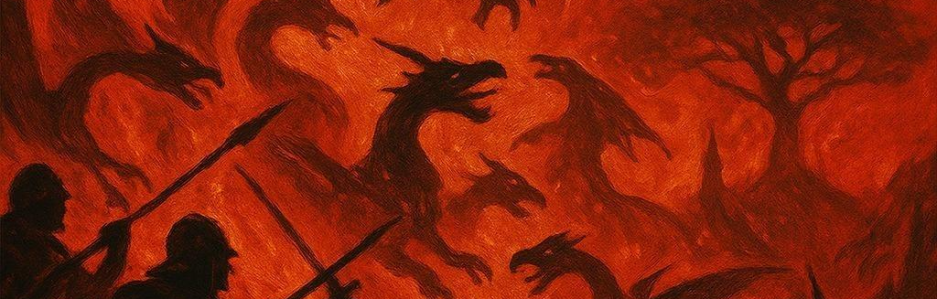
Here is the tale of the re-genesis and destruction of the sacred world of Vé; the transfiguration of the dragons and coming of men; and the arrival of the bolide heralding the great exodus and the end of the realm. An epic mythic fantasy-poem of dragons, men and worlds — free to read online.

Subscribe to get access to the rest of this post and other subscriber-only content.
Subscribe to get access to the rest of this post and other subscriber-only content.
Subscribe to get access to the rest of this post and other subscriber-only content.
The host of Gruen plodded southward in a long, mournful procession that stretched near a mile on the old Fywater road. To their left brooded the murky forest, her shadows alive with bird calls and the faint rustling of creatures meek and monstrous. To their right flowed the Fywater, no longer wide and shallow, coursing gently in the open sward of Briganta, but a stony, swirling torrent, an ever-narrowing fermentation tumbling from the highlands. Veiled by the towering wall of evergreens, the foothills unfolded, climbing southwards into the great white peaks beyond. Near the head of the column creaked the wagon bearing the remains of Ceryd Rex, tightly bound in canvas and wrapped in the banner of Gruen. Cerenid rode behind, silent and grim, while those who rode beside him spoke in hushed laments of “Such a brief reign” and “What a fine rex he would have made.”
Upon the third eve of their slow march, they came upon the village of Wargsdale, which was an arrangement of humble huts and a wood longhouse that served alike as great hall and temple. Within the longhouse they placed the remains of Ceryd and pitched their tents upon the green to take their rest for the evening. Ceryd’s remains were ever guarded, and his face was uncovered so that villagers were permitted to gather to look upon it and mourn as custom bade. Ceryd, once radiant with youthful command, had become pale and blue about the lips and hollow at the eyes. The villagers filed past to view him with bowed heads, murmuring prayers and fragments of old chants.
O One whose spirit fills each soul,
Guide the dead to River Thol.
Before they drink to cleanse their past…
…Their die of fate be fairly cast.
Cerenid took no meal, nor did he remain long in vigil of his beloved brother. With naught but a nod to his guard, he retired early to the solitude of his tent. But deep in the night he was awoken by the clamor of shouting and the pounding of frantic footfalls. Bursting into the chill air, he beheld flames flickering through the windows of the long house and smoke wisping through its thatch roof against the backdrop of the fire glow. His first thought was of his brother, who lay in state within, and townsfolk attempting to brave the flames to retrieve his remains. Villagers swarmed about, rushing to and from the well with sloshing buckets, crying out in despair and dread lest their hall be consumed. Cerenid remained at the threshold of his tent, transfixed by the roar and whirl of flame, the glow upon the sweating faces, the heat that rolled across the village green like a boiling wave.
As his gaze followed the figures darting to the well, their path caused him to notice his guard was not at his post and had joined in the desperate commotion. A heartbeat later, he spotted Una emerging from the flames’ glow, approaching, treading with haste, two Blodwins of arms on either side, their flowing cloaks scorched by flame, both drawing their blades. Fearing their purpose, he stepped back by instinct. But just as he did, a hand clamped hard upon his neck. A dark figure loomed at his flank with a blade already poised to plunge between his ribs.
“Put down your dagger, fool!” Una shouted, her crisp pitch cutting through the din of chaos.
Startled by her command, the assassin twisted to flee, but instead, his face met the weight of a hammer blow, crushing his nose and knocking him to the dirt, blinded and gasping. The Blodwin guards pounced, beating him soundly with mailed fists and booted heels until he lay bloodied and groaning. “Stand him up,” Una commanded. The assassin was hauled upright between them, swaying like a reed. Cerenid watched, frozen by confusion as Una peered into the assassin’s broken face, searching through her memory. Frowning, she took his hand and examined his ring. “I know thee,” she observed. “Thou art Kaldwin Fy, seventh son of Reik Korbin.” Her voice twisted into scorn. “Are there so few men of talent left in Fywold that your father must hazard his own brood upon murder?”
Kaldwin answered not, feigning the stupor of a man half-senseless, though his eyes flickered with panicked wit. From behind came pounding hoofbeats. Three riders approached, each clad in the deep blue capes in the custom of House Fy. “Unhand him,” barked the foremost. “Deliver unto us the rex, and ye shall live.”
Una laughed with mocking disdain. “Ye shall let me live? Know ye not who I am?”
“We heed no wenches nor weavers,” the rider spat. “Stand aside, woman.”
“Una’s voice dropped to a cool, deadly calm. “Take heed of thy tongue, inbreeder. I am Una, daughter of Mendo, Reik of Dregrove.”
The riders stiffened, though their weapons did not lower. “It matters not,” another snarled. “We came for Cleon’s son, not for thee.” Then another rider spoke, “You should rejoice in our finishing the job your brother started. Hand him over or be cut down.”
Una stepped forward, eyes as ruthless as a dragon’s, reflecting the dancing flames. “Perhaps thou wilt cut me down ere thy blade find the rex. But hear this: should aught befall either of us, House Fy shall have enemies on two borders.”
She gestured to the groaning Kaldwin. “If this witless whelp is the best thy house can muster, I would not wager a single copper that ye last beyond the coming winter. My brother Madrot, hardened like steel by lies, is soon to be the reik to your west. If I fail to return, he shall know the hand that felled me. And my sister, left without a son or heir, would become reikia to your east. Together, they will come down upon Fywold, cut down your house root and branch, fire your town, and salt your fields so nothing living returns.”
A silence followed, broken only by the roar of flames and the cries of villagers dousing the longhouse roof which had caught fire. The riders remained in their saddles, staring, silent. “Choose thy fate!” Una demanded, drawing her knife.
The Fy riders conferred in harsh whispers, their faces like muddy wights in the glow. At last, the leader jerked his chin. “Kaldwin, come!”
The wounded assassin, nose flattened and bent askew and bleeding, stumbled forward. A rider hauled him up behind his saddle. And with a final glare of thwarted malice, they wheeled their mounts and vanished into the night.
Una sheathed her blade with a weary exhale. “Nephew,” she said softly, “thou must take greater care. The shadow of thy father’s deeds follows thee still. And it is yet many leagues to Gruen.”
From her window overlooking the gate, Regent Fia beheld their coming upon the road. She searched for Ceryd among the host, his flaxen hair, his flowing cape, his stern expression, riding high and noble on his mount. Finding him not, she turned and hastened down, clinging to the vain hope that her firstborn was merely delayed.
The old hardwood gates of Gruen creaked open, and the procession from Briganta, by way of Wargsdale, passed through in solemn tread, led by a great black draft horse pulling a wagon. Behind it rode Una and Cerenid, side by side, wan and weary from the long road, their countenances carved in ash and grief. They stopped within Gruen’s walls.
When Fia came upon them, one glance upon their faces dashed hope to ruin. Stepping to the wagon, unsteadied by shock, she climbed onto it with the aid of a footman. With a trembling hand she pulled back the banner covering a pine box.
“Open it!” she commanded.
The footman bowed. “My lady, I must warn—”
“I said open it!”
Neither Cerenid nor Una intervened, their faces relinquished to the storm of a mother’s grief.
With a groan of nails and crack of splinters, the footman pried the lid loose and slid it aside. Fia stood firm, looking down upon the remains of her beloved son, seeing only a pile of blackened bones and a skull, finding her champion humbled in fleshless expression. She gasped, then wept in a full flood. Her beautiful child, the wellspring of her pride, the product of her youth, the only goodness to spring from her union with Cleon— the heart of Gruen’s future no longer beat. All hope was extinguished. Though his nature was closer to that of his father’s, in his living face she saw her own. She loved him most between her sons, for only his strength and decisiveness could calm her worry. Now, before her eyes, his noble visage was reduced to a silent shriek of eternal desperation.
Fia descended from the wagon, her limbs unsure and weak. Una dismounted to help her, and there upon the cobbles they embraced with long faces, grief entwined as kin and fate.
The remains of Ceryd Rex were carefully set into a proper coffin and placed on the altar of the temple, remaining there for seven days. Candles burned at every hour and chants echoed through the vaulted hall. On the seventh day he was carried by six sworn men into the catacombs beneath the keep, and there, interred beside the reiks of old.
The golden crown of Methundor Rex was placed by the High Priestess upon Cerenid’s head, although it did rest upon his brow askew. And those who attended the crowning whispered: “May The One breathe fire into the pale brother.”
In the moments before his first counsel, Kethu, feeble and withered, was helped to Cerenid’s side at the long table by a servant, and the two sat alone in the antechamber, silent for some time. Then Sol moved through the sky, its rays, at last shone through the window, falling upon and brightening the old Aeonite’s countenance.
Seizing this, Cerenid asked, his voice low and uncertain, “what wouldst thou advise me, steward?”
Kethu pondered long, hands trembling with great age. At last, in a voice as thin and brittle as parchment he whispered, “Always beware the first who cometh making demands rather than offerings. For he hath loyalty neither to thee nor unto Gruen, but only unto himself.”
Soon after, the doors of the chamber swung wide and entered the Master of Coin. Then Captain Menek and Gedain, and after them, Olian with some lesser thegns and reeves. Fia came last, saying no word, acknowledging no man, taking her seat along the wall in cold silence. Absent was Una, her presence forbidden for her allegiance and standing in Dregrove, though Cerenid was not consulted on whether she should be allowed.
Olian took the seat opposing Cerenid, his back to Fia. Menek and Gedain sat on opposite sides of the rex. Throughout the council, Gedain spoke little, sitting with hands folded, eyes never straying far from Cerenid’s face. He watched him as a hawk might watch a rabbit. Once, when Cerenid faltered in speech, Gedain’s eyes glinted, though whether in contempt or calculation none who saw could say.
The matters of state were debated for hours, yet to Cerenid, each word sounded distant, as hollow as some foreign language uttered by haggling merchants. The treachery of the Fys was finally addressed.
“The Fys have never been loyal,” offered the reeve. “I say we finish what your father started, my lord.”
Cerenid nodded without raising his weary eyes, as if it was a mere reflex.
“We have numbers, my lord,” Gedain suggested. “I would gladly lead the host.”
Olian turned to Cerenid, watching for his agreement. The room fell silent waiting for the rex to speak, but no words came to him.
Kethu coughed as he sputtered back to presence. “The rex is tired. Let him rest. We’ll take up this matter tomorrow.”
The council was adjourned. Fia departed first, yet silent, still stricken. The others followed, all save Olian, who lingered until only he and Kethu, fading in his chair, remained with the young rex. Olian stepped close, lowering his voice to a fierce whisper. “My lord, we must act ere Mendo passes and Madrot becomes reik. Grant me a dozen riders and we shall fall upon him in Dregrove and finish what justice hath not.”
Cerenid frowned, eyes yet lowered.
“My lord?” Olian pressed.
Finally, Cerenid spoke. “Was justice not already rendered?” Would you have my brother’s death be for nought?”
“Nay, my lord.” Olian’s face flushed deep with vehemence. “That was no justice, but rather a Blodwin contrivance that slew your brother.” His voice raised. “I seek vengeance upon them… for your brother… and to restore the honour of Gruen.” His fist struck the table, making the cups rattle, stirring Kethu awake.
“I will ponder it,” Cerenid answered, almost meekly.
“Yes, my lord. Ponder it. Yet heed carefully the counsel thou keepest.”
Cerenid raised his eyes to meet Olian’s. “You refer to my aunt?”
Olian’s eyes flashed. “Aye, Una. Though she appears prudent and measured, her loyalty bends to Dregrove, not to Gruen.”
Cerenid straightened and drew a breath. “I assure you I shall ponder it faithfully,” he replied firmly.
Olian probed Cerenid’s eyes for a hint of his leaning. Not finding what he was searching for, he bowed stiffly and withdrew. When the chamber door closed and the footsteps faded, Kethu stirred in his chair and muttered: “No knave can resist a door left opened.” Then he drifted back into a wheezy sleep.
Late in the month of Goldswane[i], when the last of the leaves clung brown and brittle, and the breath of man and horse smoked pale upon the air, Cerenid rode forth from Gruen with Olian, Gedain and Menek and their squires. A storm was gathering in the north, its grey belly rolling slow like a tide whose shore was formed by the high Norzcarpe. This would be the final hunt ere winter laid its bitter snows upon Methundor.
They pursued a great stag that had been seen for many days, foraging in the cedar woods beyond the river. It was an old beast, deep brown and broad of chest, crowned with vast antlers like the branches of a long dead oak. Men said he had survived six winters of chase by hunters and wolves alike, and that no common lord should claim him lest ill fortune come upon him. Thus Menek, Cerenid’s captain of the guard, declared it fitting quarry for the young rex.
The company rode beneath the distant light of Sol, through woods of black pine and ghostly birch, the frost silvering the roots and dry grass. The hounds worked ahead, their noses low, while Menek searched for sign. Cerenid rode with his longbow strung across his saddle. His hands fumbled often with the quiver at his back, and more than once an arrow slipped loose and fell among the leaves.
Gedain smirked, though he tried to hide it. Olian saw it too, and saw also that none offered aid to the noble. Thus, he rode aside Cerenid.
“Here,” Olian said, “let me show you how the quiver ought to be turned for ease of draw.”
Cerenid responded humbly. “I know how to span a bow. It is my hands. They are cold.”
Rebuffed, Olian turned away, seeing Menek who shrugged faintly in response. Even the squires lowered their eyes. It was a small thing, yet Olian marked it— a rex ought not fumble like a child.
They found the first spoor near a freezing stream, ice clinging to the muddy ridges. Menek dismounted, knelt, and placed his gloved hand beside the hoof print. “Here he passed ere dawn,” he said. “See the depth— he is heavy, old, and proud. He runs alone.”
Gedain smiled. “As every rex should run.”
Cerenid gave no answer.
They pressed deeper into the wood, and as they rode Gedain fell back aside with Olian and Cerenid. He turned to the rex in his saddle. “What meanest thou to do with thy Nundi prisoner… my lord?”
Olian spat into the brush as they rode. “What should be done, methinks. Hang him high and let the crows learn his name… my lord.”
“Aye,” answered Gedain. “Though I beg thee hold him until Frostwane, so that the spectacle of a dangling southerner might crown the week of my wedding feast.”
Olian grunted approval. They rode several strides awaiting the rex’s reply. But at last, Cerenid shook his head. “No,” he said, as if he feared to say it. “He shall remain in the dungeon to serve his sentence.”
The woods seemed to grow quieter. Then Gedain laughed once, short and sharp. “No hanging for a spy?”
“No,” Cerenid answered. “No death sentence for merely crossing a border.” His words came as if he might yet convince them of the justice of it. “If he be an envoy, we would be murdering a messenger. And if he be a spy, prison will loosen his tongue with time. Justice should not be confused with appetite.”
Gedain’s face hardened. “Thou soundest like Kethu, now. Are those thy words or his?
“Thou knowest Kethu is also a southerner,” Olian added. “His thoughts on this are clouded by his loyalty to kin.”
“I would never dare to question Kethu’s loyalty,” Cerenid said. “Others… perhaps.”
“Mercy toward wolves is cruelty toward sheep,” Olian huffed.
Cerenid’s voice remained calm. “And cruelty mistaken for strength is still cruelty.”
No man answered. Even the dogs seemed hushed.
They rode on in silence, but within Olian, something old and bitter stirred. First Madrot was not pursued. Now this. Always softness in the boy rex where iron was needed.
Ahead, Menek suddenly raised a hand. Silence fell. All halted. He pointed. There, through the black trunks and pale mist, stood the great stag, rooting for the last shoots of autumn. He was magnificent— vast of body, winter-thick in hide, his antlers spread like a regal crown. He stood upon a rise above them, proud and still, as though he himself judged the hunters.
Menek turned and whispered. “My lord, come forth. Take the first shot.”
Cerenid dismounted with his longbow, all eyes upon him.
He stepped slowly through the brush, bow in hand, each breath clouding before him. He drew an arrow, nocked it, and raised the bow. The stag lifted its head. For a long moment neither moved. Cerenid held the draw, his arms trembling under the strain. The stag remained. Then something changed in his face. He lowered the bow. The beauty of the creature had stayed his hand.
Olian’s jaw tightened. Then a hiss. An arrow flashed past Cerenid’s shoulder and struck the stag behind the foreleg. The great beast gave a leap and bounded into the trees. Cerenid turned. It was Gedain who had loosed. Before he could protest Menek shouted.
“Ride!”
The hunt exploded into motion. Hooves thundered over root and stone. Hounds howled and bounded. Branches lashed at cloaks and faces. Ahead, the wounded stag crashed through the forest, leaving blood bright upon the pale trunks of birch and flaxen grass.
Cerenid mounted late and followed, but the others were already far ahead. By the time he caught them, the beast lay fallen in a clearing of dead grass, its legs thrashing weakly. Its dark eyes glistening with terror. Gedain stood above it, one knee in the mud, driving his hunting blade down through the ribs and into the heart. The stag shuddered once, then was still. Steam rose from the wound. Cerenid stood silent. Gedain looked up, hands red to the wrist. “A clean death.”
With practiced skill he opened the belly and drew forth the steaming entrails, laying them upon the frost. Menek stepped forward with a silver cup from his saddlebag. He knelt, filled it with the beast’s dark blood. He rose and offered it to Cerenid.
“Your first kill, my lord. Drink.”
Cerenid stared at the cup. The blood steamed in the cold air. All eyes fell upon him. He reached forth, then withdrew his hand and shook his head.
“It was not my kill.”
Menek looked to Gedain. Gedain took the cup instead and drank deep, the red staining his lips. He handed it back with a sinister, crimson smile.
“The beast careth little whose arrow found him first,” Gedain said.
“Laughter followed from Olian and Menek. Cerenid forced a hollow chuckle.
They dressed the stag and bound it for the ride home. By then the sky had darkened fully and the bitter air carried the smell of snow.
Olian rode just behind them, watching. Ahead rode Cerenid— quiet, uncertain, slight in his saddle, looking more a priest than a ruler. Beside him rode Gedain— broad-shouldered, blood-marked. Undaunted. He was admired without effort, with all men speaking to him as though he were already something greater. And in that long ride beneath the coming storm, Olian felt a certainty consume him like a bitter gale. A rex who could not kill would one day fail to defend. Cerenid was too weak to rule. Worse even, he mistook weakness for virtue. Such a rex would surely lead Methundor into ruin. The vultures would soon come to circle.
Olian’s thoughts turned to Avarlon— no justice for her suffering. Then to Madrot, free, his ugly face filled with mocking laughter. Then to the Nundi spy, in chains and yet breathing. And to Kethu, whispering patience while rot spread beneath the floorboards of the realm.
No, he thought. This softness would destroy them all.
His eyes found Gedain riding ahead, and for the first time he did not see merely youthful vanity courting his daughter. He saw a stronger hand for the crown. And there, beneath the blackening sky, with the vultures overhead and winter marching down, Olian decided what he must do.
The bells would soon begin their summons, and the sept would stir like a hive before swarming. Garlands of ivy and hawthorn were strewn along the beams with white bunting and threads of gold. Files of unlit candles guarded the walls and dais of the otherwise empty hall. Outside, the Rainmere Sol shone cold yet bright, and the bitter winds did gust and whip as winter clung to its final days.
Olian stood in the antechamber adjoining the temple, hands clasped behind his back, jaw grinding as though upon unseen bone. Gedain leaned upon the narrow windowsill, peering through the cloudy glass, his wedding cloak draped upon a chair.
“Tonight,” Olian said low, “or never.”
Gedain nodded faintly. “The guards who matter are with us— Menek, Joles. The rex will dine and drink, then, when he withdraws… I pray he goes swiftly.”
“He will.” Olian paced. “He’s weak. A boy. Such men die easy. Think of it as an act of mercy… mercy for Gruen, for Methundor.”
“There will be chaos…”
“For a fortnight, perhaps. Until the council selects a steward.”
“Dost thou think Fia will leave?” Gedain asked.
“For Dregrove? The council will insist— For her safety, of course, until the conspirators are found, which, of course, they never shall be.”
Gedain stiffened, raising a hand to still Olian’s tongue. He reached for his hilt, then stepped silently to the door. Wrenching it open with sudden force, he burst through, snatching the spy listening just beyond.
“Avarlon!” Olian exclaimed. “Why art thou here?”
Avarlon stood frozen in the doorway, Gedain’s hand clutching her arm, her other hand clutching the ribbon meant for her hair. Her face had gone pale as milk. She stepped forward, her voice thin but steady. “What speak ye of?”
Olian’s expression smoothed. “Daughter, thou shouldst not wander here.”
“We were discussing matters of guard and station,” Gedain explained. “The realm is restless. Thy father frets.”
“Do not lie to me,” Avarlon said. Silence fell. “I heard talk of dying easy and— ”
Olian laughed once, sharply. “Idle speech. Soldiers’ tongues run loose ere ceremony.”
“We spoke of possible dangers,” Gedain added quickly. “Of villains… of Madrot.”
Then something broke at the sound of that name.
“No,” Avarlon whispered. Then she spoke louder. “No more.” They stared as she tried to pull away from Gedain’s grip, her body trembling. “I will not be party to this. I have borne enough blood upon my soul.”
Olian’s brow furrowed. Her eyes filled, yet she did not weep. “I must confess. I can no longer bear the weight upon my conscience.”
“What art thou speaking?” Olian asked.
“I… I must tell the truth. No more lies. I lied to thee, father.”
“What didst thou lie, my child?”
“No!” Gedain implored, tightening his grip on Avarlon’s arm, pushing his fingers deep.
“I lied about that night last summer.” She took a long breath. “I was ashamed. I did not know one lie would come to this. Father, Madrot did not force me. He never touched me. He is innocent.”
The words rang like the great iron bell of the sept. Olian staggered as though struck. “No… No, I don’t believe you. Why speak of this now?”
“Avarlon… silence!” Gedain ordered.
“I did lie, father,” she said again. “I lied out of fear. Out of shame. I was with Gedain that night in the stable, not Madrot.”
Gedain’s face drained of color. He opened his mouth to speak but held his tongue.
“It is the truth,” she answered, “Gedain cannot deny it. I lay in the stable with him. And when thou questioned me, I chose the easier sin… to shield him.”
Gedain’s jaw tightened. “Enough!”
“No,” she said fiercely, wrenching her arm free from his grip. “Ceryd died for my sin, my cowardice. I will not let another brother die in silence.”
Olian clenched his fists. “Knowest thou what thou hast done?”
“Yes, I know father. I shall bear it all my days,” she said softly. “But I will not allow further harm.”
For a long moment, silence. Gedain stared at Avarlon. Avarlon stared at her father. Olian stared at the stones of the floor. Beyond the walls, the bells began their peal.
At last Gedain spoke. “She is overwrought. I’ll take her to the south wing. Guarded, she shall say nothing more before the ceremony.”
Olian did not look up from the floor. Avarlon gazed between them, horror dawning in her eyes as she settled on her groom. “You would silence your wife?”
“I would spare thee,” Gedain said firmly. Then he led her away.
#
The chapel filled. The candles flared. Voices rose in chorus. Yet Olian stood rigid beside the altar, sweat cooling upon his spine, eyes seeing nothing, staring into oblivion. The words of the priest washed over him unheard. The ravens gathered in the high bell tower, their voices croaked doom while their talons scratched at stone. Olian’s empty gaze strayed to the high seat, where the boy Cerenid Rex sat. Pale beneath the tilted crown that still seemed too heavy for him despite the passing of a full season. For the first time since mid-winter, when the plot was sworn, Olian felt his grip unbalanced, for he had risked everything, and the two people nearest to him, his daughter and his would-be son in law had lied to him. The heat of rage and desperation flamed within.
After the feast, the libations flowed like a fountain, and the music filled all ears with drums and the drone of a crank-fiddle, and humming melodies. The reception began to boil into revelry, laughter drowning the conversations. Maidens locked arms and spun, twirling in rhythm, and the lads tested sinew and pride at arm wrestling. Warriors drank deep and boasted loud, and old men sat and watched, reliving their youth through the antics of the young.
At the high table sat the bride and groom, Avarlon and Gedain. But her countenance was troubled and grim. Gedain feigned a continuous grin, false happiness betrayed by his cold, measuring cast of eye. He nudged Avarlon to appear happy, yet she obliged him only for a heartbeat, her face swiftly dissolving back into dread.
Also seated was Cerenid Rex, and his mother Fia, and at the table’s end, his aunt Una Blodwin. The father of the bride, widower Olian, watched as Cerenid clapped along to the rhythm of the song, stopping only to take sips from his silver chalice. Behind the rex stood Menek, his guard’s captain. Olian’s eyes met Menek’s. Menek nodded faintly without turning. Olian scanned back over the room, far to the opposite end, to the doors of the hall. There stood two more guards, emotionless, frozen.
The song changed and amidst the turn, a dancing maiden collided with a servant, causing her to drop her cask. Red wine burst onto a table, splashing a seated thegn, spoiling his tunic and cape. The thegn leapt up with a volley of curses, but the din swallowed his rage.
Olian felt a hand clasp his shoulder. He turned. It was Gedain. He acknowledged him with a nod, then glanced at Avarlon, then back to Gedain again.
Gedain leaned close and murmured, “I’ve spoken to her at length. There is no need to worry. She will be fine.”
“Then bid her to brighten her countenance,” Olian replied, funneling the words to Gedain’s ear. “She looks as though she’s attending a funeral rather than her wedding.”
“I shall soften her with more wine.” Gedain nodded and returned to his seat.
Olian looked again over his shoulder, but Menek was now gone. He then turned to the doors across the hall. The faces of the two guards had changed. He felt droplets of sweat beading upon his brow. He rubbed his neck. He looked at Gedain who was laughing at the thegn who was still tongue-lashing the clumsy servant.
He glanced at Cerenid, his vulnerable, naive face unaware of what fate crept towards him. In his mind, Olian saw the blade driven between the boy’s ribs, his body crumpling. Then he envisaged the future beyond: Fia imprisoned, Una hauled away under guard, Kethu suffocated by a pillow, Menek seated as steward until Gedain could be named rex.
But then his thoughts began to cascade.
Shall I do this?
…Yes, of course. It is already in motion.
What if I am caught? They will saw me for treason!
…Menek will not fail.
But what if he does fail?
…He won’t.
But is this the only way? Perhaps the boy will stiffen with age.
…The realm cannot afford to take that chance.
But am I a murderer? Can I live with myself after?
…Only you can answer that.
Within his thoughts, he saw a future where Gedain was rex and his daughter rexia, gleaming crowns set upon their heads, holding hands beneath rose petal rain, between them, his grandson prince with fair hair. Yet the luster soon became clouded, for he then saw Cerenid, the boy, holding his wound, blood leaking out, gasping for air, begging him to know “why?” as he lay dying. He saw the funeral and the eyes of suspicion upon him. Fia— the mother’s hatred. He saw himself made ugly by torment, immersed in drink to dull it, hiding himself from the eyes of accusation…
No! I cannot do this. I am not a killer nor a traitor. Find Menek, call it off.
…But where is he? Will he reach his assassin in time?
I must Think.
…Look! The rex prepares to leave. There’s no time!
He drained his goblet, then wiped the sweat from his brow. The music blared. The crank-fiddle droned. He rubbed his temples. The drums pounded. The maidens twirled. Gedain laughed. Olian looked upon his daughter— yet unmoving, so fair, yet blank of face, unblinking, as if she were carved in stone…
“Enough,” he muttered to himself. He pushed back from the high table, proceeding past Cerenid toward the edge where Una and Fia sat. She noticed him coming, her eyes following him as he approached.
“I must speak with thee,” he said.
“So speak.”
“In private.”
Her gaze sharpened. “Concerning what?”
“Concerning a matter most grave.”
Una rose from the table, and together they descended from the dais into the churn of the hall. Gedain’s laughing ended when he saw them together, yet he dared not move from his perch and draw eyes upon himself conspiring with them. They passed into an antechamber where Olian shut the door, the muffled music droning on beyond.
“What is it?” Una asked.
“I… I have come by knowledge that imperils the rex.”
“Then speak to the rex.”
“I fear he would not grasp its weight.”
“Why are you telling me?”
Olian paused to listen at the door, then continued. “Because thou hast proved thy fealty by risking thy life for him. He trusts thee without question.”
Una’s voice cooled. “What is happening, Olian?”
“My lady, I have reason to believe there be a plot against the rex.”
“By whom?”
“There is no time,” Olian pressed. “Only this: I believe the danger comes from within the vanguard. I must intervene, but until I know for certain, we cannot risk him unguarded. Canst thou place thy men with him when he leaves the hall?”
She studied him, eyes narrowing. “How would you come to know all this, Olian?”
“Just… will you have your guards attend to him… please? There’s no time to explain.”
“Of course,” she answered with lowered voice.
Olian opened the door and left the antechamber and then the hall in haste, slipping out into the streets in search of Menek. He dared not to call his name aloud nor ask after him, lest suspicion fall upon himself. He searched one alley, then another, then peered into a tavern thick with smoke and voices. Yet Menek was nowhere to be found.
Returning to the street he saw four of Una’s men leave the hall and take separate positions, blending into the shadows so they would not be conspicuous. Olian searched the next alley, and then the next. It was vain. Menek could be anywhere, biding his time, awaiting the signal from his co-conspirators. At last, Olian returned to the hall, lest his absence be marked.
He saw Gedain’s eyes locked on to him as he re-entered through the doors, following him as he retook his seat.
“What art thou doing… sir?” he demanded.
“Ask nothing more,” Olian answered. “Do not speak to anyone of the plan, no matter what comes this evening.”
Moments later, Cerenid Rex stood, yet the hall took no immediate notice. Seeing their disregard, Olian seized the moment to buy Una time, striking his cup and calling aloud in his booming voice, “Be still! The rex would make a toast!” At last, the hall fell silent.
Cerenid stood, in his uncertain manner, his cup held too tight in his grasp. Curling within himself with narrowing shoulders. He cleared his throat and began.
“I… I will not keep ye long,” he said. “I am yet no orator, nor have I yet learned the weight of speaking as rex.” He cleared his throat.
“I drink first to Gedain and to Avarlon. May thy union be stronger than the tempests that trouble this realm, and may thy hearth know warmth longer than sorrow.”
He paused, searching for words, then went on.
“We walk a road whose length is… is hidden from us. Some are granted many leagues upon it. And then others are called aside without warning… I have learned this… sooner than some.”
His voice steadied. His posture stiffened.
“But when thy journey ends, and thy spirit passeth through the Gate of Tartarus[ii] and cometh unto the River Thol, may we all enter our next life with our honour unbroken.”
He raised his cup, and his voice filled the room.
“I drink to love, to duty, and to the road, however short or long it be.”
…And every lord and lady then clinked their goblets and cups, and drank, and shouted, “By The One!” And Cerenid Rex smiled with a nod and then departed the hall, greeted by Una and two of her sergeants at the door.
Joles was a brawny man of cruel visage. His sparse grey hair was closely cropped. His right cheek bore the scar of an arrow that near ended him, the red flesh there deeply furrowed. His arms were scored with tattoos of thorny vines and bones, and skulls. Once he had been a petty bandit, working alone upon Fywater Road, preying on pilgrims too frail to resist. It was there when Menek first espied him, crouched in bracken, measuring his ambush. Joles had ever preferred weaker quarry than guardsmen, and so he let Menek pass. But Menek did not pass, instead calling him forth and offering Joles honest work. In time, Joles became Captain Menek’s chief enforcer, carrying out the nefarious orders passed down from Cleon Rex.
But that first meeting was twenty years past, and Joles, now balding and losing his teeth, knew that his days in the court would soon be ending. The boy rex seemed to have no appetite for midnight justice, and Joles was too ugly for the court or to parade with the high guard, and too old to return to banditry. Yet should Menek rise to steward, his trade and proper life might endure for a few more years. And so Joles was quite willing to trade honour for prosperity.
Joles now sat alone, hiding out within a stable, pondering this change of life with the musk of old straw upon the air. At last he fell asleep, dozing until a hand finally shook him awake.
“He is unguarded,” whispered the voice in the shadows before darting off into the night.
Joles leapt up at once, brushing the straw off his vest, fingers finding the blade at his waist. He hurried out the door and into the street, the way marked by glow beaming from windows and cobblestones lit by moonlight.
As he followed the cobbles toward the keep, his thoughts turned unbidden to old reckonings. How many have I slain? Twenty? No, twenty-four. He tried to name them all as he walked but their faces blurred and names eluded beyond fifteen. But how many had been young men, mere boys like Cerenid? He recalled none.
Cerenid would be easy prey, he thought. The rex was thin and unhardened by trial. If death wasn’t quick, there would be pleas for mercy. But no quarter would be given. Twas Menek who buttered Joles’s bread, not the rex. It was Menek alone to whom he was loyal.
He entered the keep without haste, and the posted guards scarce lifted their gaze. Such was the privilege of long service, that a known man moved freely where strangers would be halted. He noted their names in his memory. They would be dealt with later. The courtyard glimmered in torchlight, her pathways abandoned at the late hour. Joles kept to the shadows along the wall, his pace measured, his breath slow and sure. He had done this many times.
He moved in silence through the garden, swallowed by budding hedges and clipped yews. The fountains murmured softly in the shadows. Somewhere, a drunkard’s singing carried upon the air from beyond the garden wall. But his only witness, save for the doomed guards, was the silhouette of an owl perched on a near branch, slowly turning its head to follow him along the dark path.
Joles crossed the garden unopposed. He reached the inner stair where a guard should have stood but he found only the brazier, its coals burning low. He set his foot upon the first step, paused, felt for his blade, then began the ascent.
The stair wound upward, to his right, in a narrow turn, the stone worn smooth by centuries of passage. He steadied his breathing, climbing slowly in his soft soles so no echo might betray him. The air of the stairwell lay close and stale. Sconces flickered and his shadow danced on the tapestries hung slack upon the wall, their woven kings and battles gazing down in mute judgment as he passed. His fingers strayed again to his blade.
At the landing before the rex’s quarters, the corridor lay utterly still.
No voices.
No sentry.
No light save what bled thinly from the stairwell behind.
He halted there a moment, tightening his hand upon the haft of his knife. He listened long for human voices, for breath, for footfall, for the faintest stir. It was as though the keep itself had drawn a breath and chosen not to cry out. Hearing nothing, he advanced.
Lunge and be done? he pondered. Or slither in and end him quiet? One promised speed but possible alarm, the other patience but the peril of awakening. He chose the latter. He preferred to savor his work.
He carefully pressed his blade though the jamb of the door and lifted the brace behind that barred it. Knowing its weight and balance by feel, he raised the bar off the hook. Holding it with his knife, he eased the door in without the faintest creak. When opened far enough, he reached his free hand in and let the brace down without a sound. He was within.
The hearth lay cold and the chamber was lit only by starlight filtering through the window, but Joles knew his way through the room blind. Across stood the canopy of the rex’s bed, the muslin drawn down to thwart the coming season of flies and night worms. Within its cocoon lay the figure of the rex, turned to the window and back to the door. Hand on blade, the assassin listened, hearing the: slow deliberate breaths of sleep. He crept forward, knife drawn. A faint creak on the floor. He halted. Another silent, careful step. Then another. He reached out to part the curtain. He raised the blade—
And then a force of iron swung into his knee, knocking him to the floor. Hands grabbed his arm and tore loose his blade. Fists rained upon his mouth and ears and face. Boots belted him in his ribs.
They dragged him out of the chamber and into the corridor— three men bearing him, one pressing steel to his throat. New lantern glow filled the stairwell. Two men cloaked in Dregrove colors appeared. Una followed behind them. She halted before Joles, peering upwards into his bloodied face. Defiance, therein, guttered and died, replaced by naked fear.
“Thy plot hath failed, Joles,” she said.
He spat blood. “But not thine, it seems. Have the Blodwins taken Gruen, now?”
“Take him below.”
#
That same night, Cerenid sat beside Kethu in his dim chamber, which the old Aeonite had not left for many weeks. Kethu’s face was pale like linen, and his hair had thinned to mere wisps. His blue-veined, arthritic hands trembled without cease.
“Teacher,” the young rex said softly. “A plot against me was thwarted by Una. Tell me, what is thy counsel?” The rex leaned close to hear Kethu’s faint reply.
Kethu’s eyes stirred, fixing upon Cerenid with a clear gaze, hands yet trembling. “Thou must uncover all who had hand in this,” he whispered. “Joles would not have dared this alone; there would be no profit in it. His hand was guided.” Kethu paused to draw breath. “Thou must flush the conspirators forth, all of them, or they shall come for thee again and again.”
Joles sat with back to cold stone, facing a heavy wooden door. A thin bed of mold-rank straw lay beneath him. Set within the door, a high slot at eye-level for a man of guard height, and another a low square one, just large enough to pass in a pot of foul pottage— or draw out one fouler still. From these two portals leaked the cell’s only dull light, and with it the reek of sour air. Joles kept his face within the meagre beam, lest his sight fade wholly into blindness.
There was sparse measure of time in that pit. The guards spoke no words; their presence known only by the jangle of their keys, the clatter of iron, and the thunder of their fists pounding on doors. The dung-wretches, prisoners spared the depths for base labor, beaten for speaking, came and went in silence, exchanging vessels of sustenance for vessels of filth. At intervals came sudden cries, rupturing the inhuman silence. And always there was the buzz of flies and the scurrying of hidden rats and the scent of rot.
At last, the fists pounded upon Joles’s door. The eye slot darkened. Keys jangled. The lock clinked. The door swung open, and three guards gestured him forth. Joles hauled himself upright, struggled to his feet and stepped forward from the cell, submitting his wrists and ankles to iron.
They led him through the corridor, its torches burning with acrid pitch. Then through an iron gate and up a narrow stair, its stones worn into hollows by a century of shackled footfalls.
At the stairs’ crown, daylight reflected off the walls beyond and through the bars of the last gate. The sentry there unlocked it, and the guards escorted Joles through and down the wider corridor that brightened as it opened into a courtyard.
There stood the reeve with four more guards, two sworn to Gruen and two to Dregrove, standing beside a scaffold fashioned of two upright trunk posts and a cross member. Near it stood Una, flanked by Cerenid, Gedain, and Olian, who himself stood back. To the other side were three hooded figures. One held a hammer and the other two held a long broad saw with deep teeth.
The reeve spoke. “Joles of Peelgrain, thou wert taken in the act of high treason, of seeking the life of thy rex. By the old law, the penalty thereof is death by sawing torment.”
Joles’s shackles were struck away. His garments were stripped, and he was borne to the scaffold and laid upon his back, his limbs bound fast with leather thongs drawn through iron rings. With measured heaves, two guards hoisted him, suspending him inverted between the posts. Pine planks were then nailed into place at hip and flank, then again at chest and shoulder, until his body was held rigid and unmoving. The hooded men set their saw upon a notch upon the uppermost planks, resting the cold steel teeth on Joles’s privy flesh. They did not yet draw.
Una stepped forward. “By the law, sawing is the doom for any who raise hand against the crown. Upon the rex’s mark, the blade shall move.”
The reeve continued, his voice without mercy. “The blade is wrought for timber, not flesh. It doth not cut clean but rendeth. Thou shalt remain alive long, blood pooling in your head, leaving thy senses unbroken while cutting through your bones and tearing out your entrails. Hast thou aught to say before sentence is carried forth?”
Joles feigned bravery but his eyes betrayed the terror gnawing within. They darted from the warden to Una, finally fixing upon Cerenid.
“My lord,” he cried. “I beg thee for thy mercy.”
Cerenid answered, his voice firmer than in the days before. “I will grant thee mercy, the mercy of swift death.”
Joles shuddered.
“But thou must purchase it,” the rex added.
“My lord, I’ve told all I know, already.”
“We…,” the rex stopped to correct himself, “I want Menek. Where hath he fled?”
Joles steadied his breath, forcing calm. “He informed me he would wait for me by the spring beyond the south gate, where the road could be watched and he could escape if needed. I presume he rode away since no word reached him.”
“Rode away to where?”
Joles faltered.
Una raised her hand. “Proceed!”
The executioners tightened their grip on the saw handles, tensing as they prepared the first pull of the blade.
“Wait… wait, My lord!” Joles pleaded. “I… I know where he hath gone. Please. He spoke of it often, long before…”
“Speak!”
“To… to Varenthor, by way of the High Gate. He believed the pass lay open. He always swore he would sell his sword there if Gruen turned upon him. He spoke of it many times.”
“Proceed!” Una urged again.
“Wait,” Cerenid ordered with mercy— or some would say with weakness. “Take him down.”
The hooded guards pried the planks loose. The straps slackened. Joles sagged to the wooden floor of the scaffold. The guards shackled him and bore him away.
Cerenid turned to Gedain. “Take five riders,” he commanded. “Go by way of the High Gate to Varenthor. Find Menek. Bring him back, alive. I must know whose hands stain this plot.”
“Wilt thou givest me the key, my lord?” Gedain asked.
Cerenid pondered. “No. You have no need of it. If the High Gate is locked, Menek did not pass through. And if it is open, thou needeth no key.”
And what of Joles, my lord?” Gedain asked.
Una’s eyes searched the rex’s countenance for strength. The rex glanced into hers and found it. “If Menek is returned by the Rainmere new moon, I will have Joles beheaded. If Menek is not brought, Joles will be sawn.”
Upon hearing word that the old Aeonite had wakened in clarity, Cerenid went at once to his chamber. He found Kethu propped upright amid his linens, his frame thin as a winter branch, his skin the color of sheep’s wool.
“Teacher,” said Cerenid softly, “thou art awake.”
“Indeed,” Kethu whispered with some effort, his voice no more than heavy breath. “The last bright flare before the wick is spent.”
“I am again in need of thy counsel… if thou art yet able to give it.”
“It is my charge,” Kethu said.
“Gedain has rode out this morn for the High Gate and Varenthor. I want to know if you believe he will find Menek.”
Kethu pondered. “I do think he shall.”
Cerenid clasped his teacher’s hand. “How am I to make Menek name his fellows?”
Kethu coughed, a dry and rattling sound. Then he was still a long while. At last he spoke. “Pain will surely loosen his tongue, yet I doubt truth will follow it. Torture breeds answers shaped to please the ear.” He groaned as he moved in his bed. “What Gedain brings back, or doesn’t, will speak truer than any rack or words.”
“Explain, teacher.”
Kethu caught his breath. “If he returns with his riders and no Menek, thou shalt learn little. But if he returns bearing Menek in chains, then Gedain clears himself of this design.”
“Do you suspect Gedain?”
“You must suspect all men, young rex. Such is the weight that leadens every crown. Yet I do not deem Gedain the mind that spun the web. There is a more subtle spider yet lurking.”
“Who do you believe it is?”
“Oh, the Fys, perchance. Or one nearer still.”
“Olian?” Cerenid offered. “He knew of it firsthand.”
“I will not seed thy thoughts with names. Once sown, they may blind thine eye that tends them.”
“And what if Gedain returns alone?”
Kethu’s gaze sharpened. “Then thou mayest believe his hand was in it. Yet if so, hide thy knowing. Keep him ever near. Men who believe themselves unseen grow careless, and in carelessness Gedain will reveal his master.”
Cerenid walked to the lone window, and gazed out upon the city walls, pale and bright beneath the midday Sol. “There is more,” Cerenid’s voice lowered. “Word has come from Dregrove. Mendo is dead.”
Kethu inclined his head, as though greeting an expected guest.
“I cannot let Una or mother depart to bury their father.”
“Aye, Una’s road is sown with danger. The Fys— Kaldwin at least— will surely lie in ambush.”
“Word comes that they art already intercepting couriers,” Cerenid added. “They know who comes and goes…”
…But then woe filled the lad’s face.
“What else troubles you?” Kethu asked. “Dost thou fearest for Una… or for thyself, also?”
Cerenid’s mouth tightened, and for a breath he bristled. Then the fire passed from his face and he bowed his head. “I will not lie to thee, teacher. It is for my life that I fear. Most of all, if Una is not beside me. Twice already she has stood between me and death.”
“To fear is to be human,” said Kethu. “Yet fear hath a scent, and the wolves will follow it. Fear drives men to haste, and haste to folly, and folly to ruin.”
“Yet I fear, teacher. How shall I find courage?”
“Try to think of thy danger as though it threatened another. Be not the rex in thine own mind but be another instead— be the keeper of the rex, rather than the rex. Thus, shalt thou seest more clearly.”
“So then Una must go home?”
“Yes, by her time. Yet whether on the morrow, or with the turning of leaves, only she can say.”
“What meanest thou?”
“The Prophet Azarius draweth nigh,” said Kethu. At the utterance of that name, the very air seemed to hush and listen. “He told me this in Golgon, in the far centuries gone, that He would come unto me once more, upon the eve of my departing.”
“And thou dost believe it still?” Cerenid asked.
“I do,” replied Kethu, “though three hundred years have worn away since it was promised. His coming is writ both in thy chronicles and in ours… and in theirs. Why else would the southern spies be hunting for Him here? He is our uniter by prophecy made manifest. His truth shall aid thee in uniting the men of Norland to march.”
“Will Una then lead the men of Dregrove?”
“No,” Kethu answered. “Madrot must bear the host of Dregrove beneath thy banner; and for this cause must Una return thither, to rule in his stead, while the storm of Norland men is loosed.”
“Then Azarius will lead the Norland host.”
“No!” Kethu’s voice strengthened. “When prophets return, it is not as kings or warlords. He is not the leader of men. He is only the shepherd of their souls. Thou art the rex, Cerenid.”
“But they will not follow me, teacher. For I am not yet a man.”
“Then you must become one, quickly. If thou leadest them not, they will slay one another in the field. And if thou remainest here, thou shalt be slain by them. Then shall Bafomet come with his golden host, and Norland shall fall into ash and bondage with nary a blade raised in its defense.”
Cerenid folded his arms, his gaze cast down, the weight of command pressing upon him like stone.
“I know your trouble, Cerenid,” Kethu said, voice softening back into a murmur. “Thy charge is greater than breath or bone. Yet remember, all lives flicker but a handful of heartbeats. Most men pass their span never knowing why they were even born. Thou hast been endowed with a purpose. Cherish that as a precious gift.”
Cerenid breathed deeply, slowly, then nodded, though his hands trembled.
“There is yet one more truth I must give thee,” Kethu said. “It concerns thy brother. He spoke to me of the cave, when ye were boys. He told me what he beheld there.”
Cerenid looked up.
“He saw thee,” Kethu continued. “He saw thee standing alone in single combat. And he saw thee fall.”
“Aye, teacher. That is what he said to me as well.”
“Thou must know this,” Kethu said. “That is why he offered himself in combat at Briganta. He thought to spare thee. And in that choice, a choice made of love, he found his purpose in life.”
“But he died,” Cerenid whispered, “and left his burden unto me.”
“He did not go forth to die, Cerenid,” said Kethu gently. “He went forth to prevail. Yet Madrot unmade his measure with the brutish cunning of his blows.”
A sorrow passed through Cerenid’s eyes, deep and unguarded.
“You must forgive Madrot for this. He did not choose to duel your brother. Your brother chose. In the coming days, thou wilt need Madrot to lead his warriors under your command.”
Cerenid’s face hardened. “I cannot forgive him. Nor can I forgive my brother.” “Hear me, young rex. One cannot bargain with that which hath already come to pass.” Kethu smiled in kindness. “Thy brother took up his mantle and the world turned as it must. Do not make light of his sacrifice by shrinking from thine own. To refuse thy burden is to lay it upon the dead. Our burdens give our lives their meaning.”
[i] Goldswane is the ninth lunar cycle after spring equinox, roughly coinciding with November by our calendar.
[ii] Tartarus is the name for the underworld, where souls travel after death to be assigned their next life and drink the water of forgetfulness from the River Thol.
Two years passed since Cleon left Gruen, and in those seasons did Fia bear and nurse her second son whom she named Cerenid. The babe was slight of form and gentle in spirit, and nursemaids oft did urge him to suckle, worried that his vitality had failed him as his ribs shone like pale ridges. Yet the long nights of his weakness did at last depart and he endured the winter’s stern trial.
In that third autumn, when the leaves seared to gold and Sol’s bright shafts were softened by the cool breath of northern winds, riders were espied upon the road to Gruen, bearing the banners of Welf. At first, their purpose lay veiled; yet a murmur spread like dusk across the courtyard, that Cleon’s name rode in their errand.
Fia long feared for her sons in Cleon’s absence, sensing the lurking prowl of the ambitious men of court. Only Kethu stood between her and them. And with him were joined all the Aeonites, whose eyes and ears revealed every nascent plot that dared to root in Gruen’s shadows.
Fia’s breast swelled with hope as she stood at her high window overlooking the gate, watching the road to Gruen, eyes eager. The autumn air was crisp and the daylight soft and golden, the banners above flapping in promise. In her mind she rehearsed the moment: presenting the young sons to their father, their laughter echoing through the courtyard; a feast in the hall, the cheers of the courtiers, the weight of fear released from her shoulders. Even the wind seemed to carry anticipation of reunion.
But her heart shrank the moment she beheld the riders, for their mounts trod slowly, their banners drooped limp at their sides, the dust on their cloaks telling of a long journey without cheer. Hope faltered with a chill in her limbs as sorrow touched her eyes. With trembling haste, she descended into the square to meet them, and there, before her, stood a covered wagon, its heavy wheels silent, its form wrapped in cords and shadow.
The air hung thick with dread. Her lips parted, yet no word issued forth. She beheld the faces darkened with gloom, brows bowed beneath the weight of duty. In that instant, the golden thread stitching the hope for her sons snapped as though rent by unseen hands. For though she bore no love for the cruel man whose body they delivered, she knew he would protect them and her. Now, in her soul, she knew that her children’s inheritance, and their very lives, were now cast into peril.
“My lady,” spake the marshal, bowing his head, “we bring unto thee the body of the Rex of Methundor, slain by brigands upon the field near Bogwater.”
Fia advanced to the wagon and reached for the knots of the shroud.
“I beg you, disturb it not, my lady,” pleaded the marshal. “When we found him, he had lain dead for many months. Thou wouldst not know him, and the sight of his remains ought not be the last memory thou keepest.”
Fia faltered; the cords yet tethered at her fingertips.
“How dost thou know it be him?” she asked.
“By his brooch and boots, and by his ink markings, my lady. His flesh, though withered, was spared the foul ravages of decay and the beasts that roam those fens. Their hunger, it seems, was stayed by the honour that yet clung to his remains.” Yet his expression betrayed a deeper truth: that he believed the preservation owed more to the dark sorcery that had always clung to Cleon Rex like a second shadow.
“We were led to his remains by a villager of Modi. It seemeth some kind soul had taken him and laid him in the hollow of a tree, that his dignity might be preserved.”
#
Thus were the sons of Cleon left fatherless and placed under the charge of Kethu the Aeonite, who nurtured them as his own until a steward and husband fitting might be found for their mother. Under Kethu’s counsel, both sons were schooled for many seasons in the arts of numbers, and the histories of the First True Men. And also in the legends of the Garden Vallis[i], a realm scarcely whispered of in the Norland-tongue. They learnt of the great dragons: Margathon, the wyvern that flew nigh unto Sol until it was cast down onto the Vallis floor to be remade, and of Bazunan, the most fierce, the finder of the Immortal Man, and also of Ogrennon, the outcast, forever tempting the brittle souls of Edä[ii].
Kethu also had them trained by Aeonite warriors in the disciplines of combat: the wielding of arms in their fluid style— more a dance than smite and parry. And they were taught the craft of tactics and stratagems. The trusted men of the court taught the boys the hunt, and the keeping of beasts and birds of prey as well.
Often Kethu and the brothers would find themselves in the garden, near the fountain, and Ceryd would ask the Immigrant to impart his wisdom. “What are the finest traits of a rex?” young Ceryd once asked.
Kethu’s brow furrowed in thought. “Well,” he said, “there art many ways to cook a goose— braised or boiled, seared or stewed, many other ways besides, each pleasing in their fashion. So too art there many ways to rule. Some rulers art cruel, while others merciful. Some art overt whilst others more subtle. Some art cautious, and others impulsive.”
“Which way dost thou commend, master?”
“If I were forced to choose, I would say to be this: decisive. Once thy mind is made, choose impulse over caution. Fortune is like unto a fair maiden. To keep her, a man must seize her boldly, else she shall slip away and find another.”
Many more summers passed with Ceryd nearing manhood, striding time and again into the ring to face an Aeonite warrior posing with shield. With Sol barely cresting the ramparts, Ceryd would heft his broadsword, its leather-bound hilt once too heavy in his hand, and with a thunderous cry he’d lunge, boots churning the dust of the courtyard.
Finally, after many tries, his blade found its mark, clanging upon the warrior’s helm, sending sparks dancing like those cast from a sharpening stone. He grappled, his arms like coiled rope, to drive the shield aside, and his opponent, at last, dropped one knee and nodded in approval. Ceryd rose, sweat beaded upon his brow, chest heaving, the single victory a culmination of many years of defeat. “At last,” the prince declared, “a victory.”
“Aye,” said Kethu. “A victory that never could be won without the lessons of so many defeats.”
A fortnight morn later, Ceryd would vault onto a great steed, hoist the javelin, and race down the hill, breaths of beast and lad steaming like fog in the cold air. He struck true, piercing a target at full gallop, and his companions cheered. In that hour he felt the bloodline of his sire— Cleon— rise within him, the drive for dominion tensing in his sinews.
And in those months and years, beneath the vaulted hall of ancient runes, Cerenid sat by lamp-glow, his slender fingers turning a carved stone etched with spiral sigils. The silence of the study held the musty scent of parchment where Kethu tutored him of his forebears’ temptations, of their blasphemies, and of their purgation. Cerenid’s mind was beguiled by the ghastly Nephilim and the glorious Gargan giants. He drank each word his master spoke, troubled naught by swords or shields.
Once, upon the hunt for a mighty stag, the brothers would oft run the hounds a-foot. On one occasion, Cerenid drew near to a dog which nosed the trailing scent. Startled, the beast turned and nipped the younger prince’s thumb, rendering flesh pierced and bleeding. Ceryd, seeing the wound, rushed forth and struck the hound upon the muzzle, his blow so strong the beast whined and fled.
Turning to his younger brother Ceryd he said, “Come, let me see it… ‘Tis but a scratch, brother. Show not thy tears, lest they deem thee weak.”
A huntsman rode unto them and asked, “Is the young prince hurt?”
“He is well,” Ceryd snapped. “Give thy mind to the chase.”
The forests of Gruen did offer many adventures unto the young princes, whose clandestine wanderings drew them far into her shadow-choked depths in search of fauns and kobolds and other sprites of childhood fancy. Yet none of these foul creatures were ever encountered, save for those their own minds conjured in the hush of dusk. Often, however, did they return to a cavern veiled by the moss-clad trunk of a fallen pine, where the earth yawned unto guarded secrets older than Methundor itself. “Shall we descend into yon cavern?” asked Ceryd.
“For what cause?” the younger replied. “Surely naught awaits within but spiders and filth, and perchance an ill-tempered badger.”
“Nevertheless…” said Ceryd, his eyes alight with reckless purpose.
Ceryd drew forth his lantern from his pack, kindling its flame with flint and steel, and slid through the moss-laden portal and down into the shadowy chasm. The golden glow flickered upon stone, but then vanished wholly from Cerenid’s sight, swallowed by the ancient dark.
Cerenid lingered at the cavern’s mouth for what seemed to him an hour’s passage. With their mischief stilled, and their boisterous noise absent, the creatures of the forest crept back to their doings. Squirrels darted amidst the boughs, a jay let forth its shrill call, and a doe emerged from the undergrowth of ferns and brambles, browsing as it drew near. The silence weighed heavily upon the young prince, for in all their adventures, they had made such noise as to drive away all animal danger. But now, with no sound save the forest’s own, Cerenid was alone, no longer a vanguard intruder but one consumed within the untamed wild.
He called into the cavern to his brother, half in hope of urging him to return, half to startle away anything lurking nearby. But no answer came. He waited in silence yet longer, until the birds returned, then he called again, but the cavern devoured his voice without echo.
As Sol dipped beyond the towering branches and the shadows deepened, a lone raven alit on a gnarled limb above and let out a ragged caw. It paused, as though awaiting a reply from the forest itself, then cried again, deep and sharp. Now Cerenid dared not raise his own voice, lest he draw unwelcome company. Instead, he slipped into a cluster of ferns and brambles, peering out toward the cavern’s maw. The moss hung there, swayed like a tattered curtain, inviting him to enter, yet he felt a tremor seize him. Twilight pressed in. The forest’s shapes twisted— branches bending into claw-like silhouettes, roots coiling like serpents. Summoning the last of his courage, Cerenid crawled to the cavern’s edge and whispered, “Ceryd… Ceryd… pray come out!” Yet silence again met his plea. He huddled near the shrouded entrance. Again, a raven alighted upon a nearby branch, fixing him with its glinting, black eye. The young prince froze, unmoving. The corvid clicked its beak, croaked, then burst into flight with a rush of beating wings of doom.
Cerenid felt as though the forest itself watched him with one eye from many vantages, each shadow a sentinel, each whisper a warning. The world had grown vast and ancient around him, and he but a trembling child within it.
Unwilling to tarry until night’s monstrous depth, Cerenid mustered the resolve to leave his brother and return home alone. Darkness enfolded the path, and he quickened his pace. Brambles grasped at his tunic. His thoughts filled with visions of kobolds, their amber eyes gleaming from the hollows, their scaley fangs bared as they scampered in pursuit.
A chill washed through him and he quickened his pace. But soon he discerned that some presence did indeed follow him— soft panting, the crunch of leaves, the whisper of padded feet. Wolves! Much as in the tales of the old nursemaids, their shapes flanked him in the dark: pale eyes flashing, near silent save for their breath. Cerenid dared not avert his eyes from the path to look back. Had he stumbled but once, he knew the first bite would fall upon his legs.
At last, wearied beyond endurance, he faltered and collapsed upon the trail, curling tightly upon himself. Darkness surrounded him, and the wolves panted as they circled close, their movements hidden in the forest’s black veil. As fear and despair consumed him, his thoughts turned grim. What pain would their fangs bring first? What fragments of him would remain for his mother to claim and bury?
Yet as his heartbeat pounded from his breast unto his ears, his breath grew steady. His tears ceased. He gazed upward, beholding only the tall silhouettes of pines reaching toward the gray ether. Clutching tightly upon the thorny branches, that he might thwart being dragged off, he prepared to meet his fate.
Then came a voice. “Cerenid!” Still distant but growing louder, his brother’s cry calling through the twilight. Soon, the sound of his footsteps joined his calls. “I’m here, brother! Come forth!”
Cerenid remained huddled upon the ground, too stricken with fear to utter a cry. Yet his brother, guided by his footprints, came upon him and raised him to his feet.
“We must quit the forest ere the night devours us,” quoth he.
“Didst thou seest the wolves, brother?”
“Wolves?” Ceryd scoffed. “You’ve been reading too many books.” He dusted his brother off. “Reserve thy tears, for they shall serve thee better when we face the scourging that awaits us. I’m doubtless they have sought their rex and prince for hours, now.”
Cerenid wiped his streaked cheeks with his sleeve.
“There… good,” said Ceryd with a nod. “I shall tell them thou wast brave.”
“What didst thou behold in the cavern?” Cerenid asked as they made their way home.
At first, Ceryd gave no answer. His eyes remained fixed upon the narrow path ahead. “Nothing, brother,” he said at last, though the unease in his tone betrayed him.
“I do not believe you,” Cerenid said. “Why linger so long in darkness if there was nothing?”
Ceryd froze, a pale silhouette in the fading light. Reluctantly, he yielded. “If thou must know, I found a vein of crystal. It glowed like sapphire fire by my lantern’s light. I sought to loose a shard, but as my fingers touched it, I was… overtaken.” He lifted a hand to his brow, as though the memory itself weighed upon him. His eyes lowered. “A vision pressed upon my mind— vivid as waking, deeper than any dream. It swallowed all my thought.”
“What didst thou see?”
Ceryd’s gaze rose to meet his brother’s, sharp and searching, as though he feared the telling more than he feared the vision itself. “I saw thee, brother…”
“Me?”
“Aye… standing alone in single combat. Yet I could not reach you, nor call to you. For the world would not hear me…”
“And then?”
“And then…” Ceryd’s eyes searched his memory. “And then it was over.”
A silence settled between them, broken only by the whisper of the wind through the pines.
“Tell no one of the cave,” Ceryd murmured, voice low. “If word spreads, many will descend upon it and spoil what lies within.”
And though he spoke no further of it that night, something in Ceryd’s countenance had shifted. A remoteness gathered behind his eyes, as though part of him still wandered the sapphire depths of the cavern. For the crystal had shown him more than any brother should behold— a shadow of doom, laid bare upon the path of fate.
Whilst Kethu yet bore the mantle of steward, it had grown plain unto all, aye, even unto those who dared not whisper it, that the twilight of his years had settled upon him— though an Aeonite’s dusk might yet linger for many a season. Thus did the council decree that Ceryd, having surpassed nineteen summers, should ascend the high-seat upon the coming solstice of summer, less than a full season yet to pass. In the warming breath of mid-spring, the wardens, who had ridden eastward in chase of the knaves and brigands who had slain their rex, returned unto Gruen with a prisoner most foul and foreign of aspect, shut fast within their wagon. Through the main gate they passed, where many townsfolk had gathered to cast eyes upon the strange prisoner. The wagon stopped in the square before the keep and the wardens dragged their suspect out and escorted him into the main hall. There, the assembled court, which had been steeped that morn in petty bickerings of thegns over grazing fields and bridge tolls, parted as the wardens marched to the dais with their criminal.
Ceryd, the young rex, perked up from his seat where he had been near slumber, lending but half an ear to the tiresome quarrels. “What charge lieth upon this man?” he asked.
“My lord,” answered the reeve, bowing low, “we seized this wretch whilst he filched salted meats from a bondi’s hutch near Clearwater.”
Ceryd looked perplexed. “Why bear a common pilferer all the long road to Gruen?” asked Ceryd. “Hath the local reeve no rod with which to chastise him?”
“Aye, my lord, he hath. And we should ne’er have troubled thee with such refuse, my lord. But whilst the reeve’s justice was laid upon him with stout and honest fists, he fell to muttering in a tongue most strange, my lord.”
Ceryd frowned. “And is the gabbling of fools now counted a crime as well?”
“Nay, my lord. But a wandering Aeonite crone heard him, my lord, and straightway told us the speech was Neandilim[iii]-born… my lord.” At this name, a gasp passed through the hall, and the murmuring swelled.
“A Nundi![iv]” cried one.
“Mercy on us— hell’s brood walketh here!” wailed another.
“Trust not the word of any Aeonite witch!” snarled a third.
Ceryd lifted his hand, and the tumult ebbed.
“My lord,” the Reeve continued, “we questioned him further, fearing lest some southern magic lurked beneath his rags.”
“And what found ye?” asked the rex.
“After much beatings, my lord, he saith naught but pleas for mercy and mutterings that he was an envoy from the south… my lord.”
Ceryd rose and stepped off the dais to approach the two wardens and their prisoner. The wardens gripped their charge firmly, yet the young rex leaned close, studying him. Though clad in goatskins, and mired in filth, he found in him a strange, almost affected bearing that clung… like a nobleman sunk into disguise.
“What envoy dresseth in such foul raiment?” Ceryd asked. “And stinketh like a piss-soaked midden?”
“My lord, I caution that these southerners are known to cast spells of—”
“Peace! Let the man speak his own treacheries.”
The prisoner stared at the dust around his own sandals. “Sire…” he began, “I have come from the city of Goff. Neandilim is the common tongue spoken there.” Eyes still lowered, he continued. “Bandits set upon my company, and I alone escaped, living by guile and by theft. For this I crave thy mercy and shall submit to any justice thou ordainest.”
Ceryd narrowed his eyes. “And what business hath an envoy of Goff so near to Clearwater? ’Tis many leagues from Gruen.”
“My lord, he did sayeth he came by the eastern way,” spake the reeve.
Ceryd looked perplexed. “You say you came perchance by the eastern road, with the Spire of Agzad for thy beacon?” The Rex pondered. “Yet do not the Neandilim tremble at the name of Gargan? Did not their monstrous hands raise that pinnacle in the elder days?”
“I… I lied to them, sire, fearing the wardens would murder me if I spake the truth. We in fact passed by the High Gate, by way of Meru. I beg your mercy, your highness.”
“Was the gate not locked?”
“We found it opened for us, sire.”
“The Aeonites must have unlocked it,” came a voice in the throng.
“We knew they were traitors all along!” shouted another.
“Loyal to their southern brethren only!”
“Traitors?” Ceryd derided, turning to face the crowd. “Traitors who waited three centuries to betray their oaths? Waited ‘till their bones lay mouldered, all even, save for one? Hold thy serpent tongues!” He turned toward the old steward. “Kethu, come forth. I would hear the wisdom of an Aeonite.”
They found the venerable Immigrant slumped in slumber upon his chair. Young Cerenid, seated next to him, touched his arm gently and the ancient’s dark eyes fluttered open. “Kethu,” came Ceryd again, “lend me thy counsel.”
Kethu coughed and cleared his throat, then, with a grimace born of age and lingering pain, he rose unsteadily to his feet. Fumbling for his cane, he tottered down three slow steps from the dais and came before the prisoner, who stiffened and set his jaw. Kethu studied him in silence, his cloudy eyes yet sharp with an elder’s cunning. With a gnarled hand he lifted the man’s chin and bade him open his mouth, peering close at teeth and tongue. Then, with neither haste nor shame, he loosened the man’s belt and drew back the filthy cloth at his loins. A rustle swept the hall. Some gasped, others turned away, but Kethu regarded neither their modesty nor their shock. His gaze was keen, searching for the tell-tale sign. At last, he let the cloth fall and straightened with difficulty, leaning upon his cane. “Yea, he is Neandilim. Of that there can be no doubt.”
The court gasped once more in chorus.
“My lord, we knew it so,” replied the reeve.
Ceryd was undeterred. “But envoy or spy? Which stands before us? And by what path hath he crossed our borders?”
Before Kethu could answer, Gedain thrust himself forward. “Sire, give him into my hands. Let him feel the bite of fire, and he shall blurt the truth soon enough.”
Earl Olian, a graying thegn with the underbite and snout of an old boar, nodded vehemently at his side. His daughter Avarlon, with a visage as pure and pale as pearl, and whose favor Gedain sought more desperately than honour itself, brightened at her father’s assent.
But Kethu raised his withered hand. “Behold,” he shouted, his voice ringing clearer than it had in years. “If thou torment a man to yield his words, he will indeed prate… he shall prate naught but the very words thou longest most to hear.”
Having heard Kethu’s counsel, Ceryd turned then to Cerenid. “What say you, brother? Shall we yield him to Gedain?”
But Cerenid faltered, glancing between the two men— Gedain’s hungry sneer and Kethu’s troubled, cloudy gaze. “I… know not, brother. Mayhap we should not.”
“Hold a moment please, young rex,” Kethu urged. He then peered deep into the prisoner’s countenance. “Tell me, Neandilim… knowest thou who I am?”
“Aye. Thou art the Steward of Gruen.”
“For a little while longer at least,” Kethu groaned. “But answer me this: some men may scale mountains for bargains and treaties… yet others might venture for the capture of an old legend that yet draweth breath.”
“Thou art indeed a legend, Kethu,” the prisoner whispered with disdain in his voice. “None may deny it. Perhaps others will come for thee.”
Kethu laughed until his laugh turned into a wheeze and then a fit of coughing. When he had caught his breath, he once again looked into the prisoner’s eye. “Thy brethren need not bother with me. My end draweth nigh. Nor do I refer to myself as legend. Yet I think we both know the legend of whom I speak. He is:
“…the coin that buyeth rebellion! If cast into the deep, who then shall spend it? For thy worth is unrest, thy face remembrance, and thy breath awakeneth defiance in the hearts of men.[v]”
And in that heartbeat, as Kethu watched closely, the prisoner’s pupils widened ever so slightly— too slight for the notice of True Men, yet plain enough to the eyes of even an aged Aeonite. It was a reflex betraying the soul.
Voices clamored for justice. “To the dungeons!” they shouted.
“I defer to the young rex,” said Kethu over the din. “My season waneth. His now beginneth.”
All eyes fixed upon Ceryd, he knowing he could not free the man without seeming weak before the ravenous court. At length he sighed and gestured with reluctance. “Let Gedain have him.” And so the wardens dragged the envoy toward the dungeons, his cries to be swallowed by stone and shadow.
Kethu wobbled up the dais and sank upon his seat, and Ceryd then sat again beside him. “What doth all this portend?” asked Ceryd in a low voice.
Kethu whispered, “It portends that the immortal prophet walketh again in our lands.”
“Will Gedain get him to say it?”
“We both know the cruelty that lurketh behind Gedain’s golden locks and comely face,” said Kethu. “He will torment the Nundi nigh unto death, yet the man will give him only assurances.”
“Assurances?”
“Aye. Promises, bargains, temptations. Whatever he believeth Gedain desireth to hear.”
Ceryd’s brow darkened. “And how came he through the High Gate? Do not I alone hold the key?”
Kethu’s gaze grew distant and grim. “Young rex… clearly something did unlock it.”
When Ceryd had reached the nineteenth year of his age, and the day of his crowning drew nigh, there arose, as though fated, a strife betwixt the house of his sire and the Blodwins of Dregrove. The seed of this enmity sprouted from the deeds of a young nobleman of that lineage, whose pride was the herald of coming discord.
Madrot Blodwin, the youngest child and only son of the House of Dregrove, journeyed unto Gruen for the festivities of Ceryd’s accession, which were ordained upon the day of the summer solstice. He came in the stead of his father, Mendo, Reik of Dregrove, who by age and lingering maladies was sorely enfeebled. Madrot was received with all courtesy due his blood and so took his ease within the halls of the rex, purposing to sojourn in Gruen for a fortnight. Though scarce past twenty-one winters, Madrot was harsh of visage. He lacked the grace to charm the hearts of maidens or inspire the deference of men. His red hair hung lank and thin, falling lifeless and straight upon his shoulders. His ruddy complexion bore the stain of roughness and wear beyond his years, and his wild, unruly brows and bulging eyes lent him an aspect most sinister.
Throughout the days of jubilation, contests of arms and feats of manly prowess were proclaimed. Many hundreds gathered within the plaza to behold the spectacle. Madrot, eager to display his mettle, entered three: a bout of grappling, a duel with swords hewn of seasoned ash, and the noble joust. By skill and sinew, he triumphed in the wrestling-pit, yet in sword-play he tasted defeat beneath the steady hand of Ceryd— though some Dregrove kin whispered that it appeared he permitted the rex to win. The third contest, the joust, set him against the handsome and vainglorious Gedain, the heir of the House of Welf.
Sol shone radiant, and the multitude that thronged about the list murmured like a rising stream. Madrot entered first, breast plated in grey steel. Removing his helm, he scanned the assembly to acknowledge their cheers— but found instead that their voices rose only for his rival who entered behind him arrayed in gleaming harness bright as silver. Gedain doffed his helm, unveiling his fair visage to the swooning maidens, and grinned with the boldness of one accustomed to such worship. The acclaim swelled and with a flourish, he gestured toward Avarlon who shone surpassingly fair in her silken gown of crimson. The combatants re-helmed and were led to opposing ends of the arena and their squires brought forth their lances. At the lowering of the pennon, both warriors spurred their coursers. Gedain charged with a flourish of silver, his confidence brimming near to arrogance; Madrot rode straight and measured, like an arrow loosed. Their lances struck. Gedain’s blow rattled upon Madrot’s shield, yet glanced away, while Madrot’s veered off Gedain’s shield to smite his helm in a telling blow, knocking it askew upon his head. A murmur rippled through the crowd. Gedain wrestled vainly with the visor, his curses betraying the sting to his pride. Madrot, circling back, lifted his visor to receive the due honour— but the throng had eyes only for Gedain’s vexation. “Another round!” Gedain cried, his voice sharp with choler. “This time I shall not be confounded by this wretched helm.”
“Certainly,” replied Madrot with calm courtesy. The heralds signaled assent, and the crowd stirred with eager whisperings.
On the second charge, Gedain thundered forward too eagerly; his lance shattered upon Madrot’s shield in a wasteful spray of splinters. Madrot answered with a firm, centered strike to Gedain’s breastplate, denting the metal and near unhorsing him. Gedain reeled, clinging desperately to the saddle as the horse galloped. Gasps broke from the assemblage. In fury he tore the helm from his head and flung it aside, demanding another. His squire darted off at once to retrieve one.
Fia, regent-mother and Madrot’s far elder sister, stood reserved upon the dais, yet a faint and knowing smile betrayed her inward Blodwin pride.
“Once more!” Gedain snarled.
“Art thou certain?” said Madrot. “I have already claimed the victory.”
“To hell with thy victory! Once more!”
Madrot took up his lance anew. Gedain’s squire returned with another helm, but this one was adorned with an extravagant transverse crest of purple-dyed horsehair. Gedain cursed his squire’s choice yet donned it all the same. Subdued laughter rippled through the crowd at the absurd visage of purple plumage.
Avarlon clasped her hands together, her brow knit in dread. The squires stepped back. The murmurs faded to silence. The trumpets blared. The horses leapt. The dust rose like smoke from a smoldering fire. At the moment of meeting, Gedain’s aim wavered again, his lance veering wide. But Madrot’s stroke landed true, a mighty blow beneath the rim of Gedain’s shield. The silver knight was hurled from his saddle like a child’s toy, crashing upon the earth with a thunderous thud. The crowd gasped as one, then all fell still as Gedain rolled about like a wounded peacock as he attempted to regain his breath.
Madrot reined his steed with modest grace and saluted the onlookers, though little of their admiration turned toward him. Only Fia, his sister, whom he barely knew, bestowed him a nod and a proud smile.
Avarlon climbed over the barrier and ran to Gedain’s side. With the aid of his squire, she lifted him, half-conscious and groaning from the dust. He threw his helmet, then found the strength enough to curse and spit upon the steed that had also “betrayed” him.
Ceryd, who watched with Kethu from beneath the awning, turned to him for his thoughts. “What dost thou think of this Blodwin heir, teacher?”
Kethu answered softly, eyes set upon Madrot. “Beware the victor, robbed of triumph by a loser’s vanity.”
Madrot, being a young man of great confidence in arms, fancied that his feats in the contests had won him the admiration of the maidens in attendance— Avarlon most of all, whose silky auburn braids and luminous complexion had bewitched his untutored heart. Yet none in Gruen received the ugly prince kindly, nor granted him even the courtesy of feigned interest. Some maidens, themselves enamored of the comely Gedain, averted their eyes or even cast hostile sneers as Madrot strode past, as though he be some base villain deserving of scorn. Come the eve after the joust, finding himself ignored and nursing a wounded pride, Madrot took to strong drink to dull his thoughts. In his cups he grew foul of temper as he espied Avarlon enthralled in flirtatious discourse with his defeated rival. Gedain, noticing Madrot’s glare, mocked him with a wink of his right eye and held Madrot’s gaze as he whispered to those near, eliciting their laughter and disdainful glances. Stung to the quick, Madrot at last tipped his cup and shouted threats of violence. Such uproar followed that men were forced to lay hands upon him. They subdued the spirited Madrot and led him to his chamber, that he might sleep off the bitterness of his ale-and-wine-fueled wrath.
At dawn, with the weight of shame heavy upon him, Madrot gathered his belongings and slipped away whilst the city still slumbered under the spell of revelry. Upon passage from Gruen’s ramparts, he vowed to the watchman that he would never again set foot in “this shit-stinking midden of scoundrels and whores.”
Yet not two hours after Madrot passed through the gate, Avarlon’s father, Olian, caught his daughter attempting to slip into her chamber unbeknownst while still fully dressed in her finery from the evening before. Olian confronted her, demanding to know why she had not returned home the eve prior. Avarlon, pressed by the boar-faced scowl of her father’s stern inquiry, broke immediately into weeping.
“What aileth thee?” her father asked.
Holding herself, she stammered, “that vile knave Madrot…”
Olian’s brow darkened. “What hath happened?”
“He… he barred me on the path home,” she wept, “and dragged me into a stable and forced himself upon me.”
Olian’s visage filled with horror.
“Afterward, in shame and terror, I hid within the straw and shadows, crying all night, attempting to muster the courage to come forth and speak of the evil deed.”
Noticing the very fragments of stable straw woven into her disheveled hair, Olian became enraged. Without delay he sought out the steward Kethu, finding him in somber contemplation beside the garden fountain. There, Olian demanded immediate justice, crying that his family’s honour now hung upon the steward’s swift hand. As Ceryd was yet abed, and with time being of the essence, Kethu dispatched three warden-riders to pursue Madrot, bidding them seize him, if need be, by force, and bring him back to Gruen to stand trial. Within the hour, three wardens thundered through the city gates. Yet Madrot had kept a furious pace, the pace of one fleeing capture, and they did not overtake him until eventide, when at last they espied him on the road, nearing the old stone bridge spanning the Meb.
“Halt!” cried the riders.
Madrot drew rein. They approached. “Madrot of Dregrove, son of Mendo,” one shouted as they neared. “Thou art commanded to return with us to Gruen.”
“For what cause?” said Madrot, surprised.
“The steward Kethu so decrees. Turn thy horse else we shall bind thee.”
“My nephew is rex, now. Why is the Immigrant still giving commands?”
“It matters not. Turn thy horse.”
“Is this an arrest, then? What crime is laid against me?”
“The charge is rape,” replied one sternly.
Madrot’s face stiffened. “Who speaks such falsehood?”
“It is none other than the daughter of Thegn Olian, the fair Avarlon.”
“The maiden lies,” Madrot protested.
“Your flight has already betrayed you,” the warden said coldly. “Declare thy innocence before the steward when thou dost stand for judgment.”
“Do you take a Blodwin for a fool?” Madrot asked, for he knew, even before the wardens named the charge, that no man in Gruen would ever believe his denial. “I will not return to that shit pile Gruen and submit to the false justice of petty nobles. We all know the treachery of Cleon’s House. Have the rex resolve it with my father.”
“Then shall we take thee by force?” asked the warden.
“Take me by force?” Madrot mocked, eyes aflame. “Thou mayest try. Yet I warn thee— I shall never yield. Press me, and there will be blood. But this vow I make: I shall slay but two of thee, leaving the third to bear witness to my mercy.”
The riders laughed as they reached for their swords, but their mirth withered in a heartbeat as Madrot’s steed lunged forward, sowing chaos among their mounts. In the ferment, Madrot lifted the nearest rider’s sword arm with the vambrace upon his own, and with a savage upward arc of his cudgel, he struck temple and ear. The rider toppled from his saddle, lifeless ere he struck the ground. Without pause, Madrot wheeled and galloped to the river, the two remaining riders in swift pursuit. Upon a clearing beyond the bridge, Madrot turned his steed sharply and awaited them. Within moments they arrived, drawing near with blades unsheathed, approaching from either flank. Madrot unfastened his shield and raised it high. “Sheathe thy swords and ride away if thou dost value thy lives,” he warned, voice as blunt and cold as winter stone. “I will never submit.”
“Surrender!” cried one. “Now must thou answer for murder as well!”
“Ride away,” Madrot answered, “or I shall answer for two.”
The riders crossed the bridge and spread wide upon the road, swords gleaming. Without further parley, Madrot charged the rider upon his left. Their blades met with a clash. Madrot deflected the stroke with his shield and, with swift precision, drove the dagger-end of his cudgel deep into the rider’s throat. Upon yanking it loose, the rider dropped his sword and, for but an instant, clasped at the fountain of blood spewing from his neck with both fists curled. Then he crumpled. His steed carried him a few faltering steps before he fell off to the side into the grass.
Turning sharply, Madrot faced the last of his pursuers. “’Twere better for thee to ride home than to be carried there. Turn back, fool.”
“I cannot,” the rider answered with grim resolve.
They met in fierce combat, cudgel against sword, shields battered with mighty strokes. The air rang with the sound of clang and thud. On the third exchange, the rider’s blade missed its mark, leaving his wielder’s arm exposed. With a savage swing, Madrot brought down his club upon the rider’s wrist and forearm. A crack sounded through the clearing as the bones shattered. The sword fell from limp fingers with the rider crying out, cradling his mangled limb.
“Learn now to fight left-handed,” Madrot sneered. “Thou’lt be fortunate to keep that arm once the surgeon hath seen it. Go. Ride home and tell my nephew, and that lying whore Avarlon, that I spared thy life.”
“They shall come for thee,” the rider gasped through gritted teeth.
“Speak no more,” Madrot hissed, stepping close, the blade end of his cudgel raised, “lest I take thy tongue as well.”
When word of Madrot’s escape reached Ceryd’s ears, his countenance darkened with a grave and troubled shade. Though his counselors urged him to assert his lordship by dispatching a battalion in pursuit.
“What say you, teacher?” Ceryd asked in private.
Kethu replied, “Haste in wrath oft bringeth folly.”
And so the young rex heeded Kethu’s counsel and stayed his wardens, saying Madrot would be too far ahead to overtake and the mission futile. Instead, the young rex called his council into its chamber to deliberate the matter.
Reeve and wardens and masters assembled, along with Gedain, and prince Cerenid, and the Immigrant. Ceryd bade his mother Fia attend likewise, for who would know the Reik of Dregrove’s mind better than his eldest daughter? They sat about a long oaken table whose tall-backed chairs groaned beneath the weight of age. It was late afternoon, and the crisp shadows cast by the fading Sol in the windows grew long upon the floor, imparting a somber pall to the chamber.
Olian was first to speak, his outrage unbridled. He smote the table with his fists, crying, “Madrot must be seized and gelded, then hung! If they will not yield him, then I say war! Burn Dregrove to its foundations!” Forgetting Fia was Dregrove’s noble daughter.
The reeve who had sent the warden-riders in pursuit voiced his grief at the loss of two brave men— servants of duty slain without glory. The third rider, though his arm was spared, would unlikely wield a sword with honour again. “Justice!” he demanded.
“Set a bounty upon Madrot’s head. Greed will cause someone to bring him,” urged the Master of Coin.
“Lay siege to their palisade,” added Menek, the captain of the guard. “They will turn him over in less than a fortnight.”
“Let us march on Dregrove at dawn!” thundered Gedain.
Cerenid listened with rapt intensity, while his mother, Fia, hearing all this talk of sieging her home and hanging her brother, sat silent and unmoving, observing all with the cold, glass-eyed stillness of a raven perched upon a barren bough.
When each councilor had shouted his demands, Ceryd turned to Kethu, who had been rubbing his chest and clearing his throat. “Are you unwell, steward?” the rex asked.
“It is but indigestion, my lord,” Kethu answered faintly.
“Then lend us your wisdom, if you are able.”
Kethu stood, though unsteadily, and tried again to clear his throat. His coughing grew into a harsh fit before he regained his breath. He struggled through his first words. “My lord… this is indeed a grave predicament. A true test of a rex. The eyes of all the houses are upon you. And as the legends teach us:
Justice lieth upon the edge betwixt cruelty and weakness. Hold fast the balance lest both consume thee.[vi]“
“Spare us your sermons, Immigrant,” Olian shouted. But Ceryd’s glare silenced him at once.
Kethu continued, though his voice shook. “We have Neandilim spies in our lands now. Whether war cometh to us or we to it, come it shall. If strife arise between the houses, we cannot stand, and Bafomet’s host will devour us one by one. “And there is also this to consider,” Kethu went on. “The Reik of Dregrove is old and failing. It is said he cannot speak save through his younger daughter, Una. I fear he will not linger long in this life, and he hath but one male heir. I do not believe he will surrender Madrot to prison or hanging… or gelding, as Olian demands. But hear this: if Mendo dies before his son’s judgment, Madrot will become reik— and untouchable by law. After that, to make war on the Blodwins, we would surely prevail, but the cost in blood and treasure would be steep indeed.”
“Is there no manner in which to solve this puzzle, Kethu?” Ceryd asked.
Kethu pondered, clutching his robe as though steadying his spirit. “Perhaps… perhaps a tribunal.”
“No!” Olian barked.
Kethu pressed on. “A magistrate from each of the five high houses. Let them convene at a neutral site— maybe in Fywold— and there, weigh Madrot’s guilt.”
“Never, my rex!” Olian snapped. “We must strike while we—”
But mid-sentence, Kethu gasped sharply and toppled forward, his brow striking the table’s edge before he collapsed to the floor. Cerenid leapt to his side while the others crowded round. The prince pressed a cloth to the gash on the steward’s forehead. “Does he live, brother?” asked Ceryd standing over, his voice thin with dread.
“He breathes,” Cerenid replied, eyes shimmering with tears.
“Carry him to the physician at once,” Ceryd ordered. “Go, all of you. Leave me.” Cerenid and the council bore Kethu from the chamber. When they were gone, only Ceryd and his mother remained; she had not risen from her seat, nor had her expression changed. “I am unsure of the path, Mother,” Ceryd confessed.
At last she spoke. “It is true— your grandfather is frail. Una has written to me that he will soon be dead, and Madrot will be reik.”
“Then I must act swiftly.”
“Yes,” she answered. “But not recklessly. My father may be old, but his mind is yet sharp. He will have laid a trap— and not where you would expect to find it. You must not forget his enmity. Your father humiliated him. He stole his daughter, and now Cleon’s house seeks to humble him again from beyond the grave. My father’s life has narrowed unto this single point. He lives now only to taste a final revenge.”
“But I am his grandson,” Ceryd murmured.
“Aye, but Madrot is his son.”
“…And also your brother.”
Fia’s eyes narrowed. “Brother in name only. I never knew him.”
“I cannot permit a rapist and murderer to go free. I would lose all honour in the eyes of the people.”
“Aye, you must act,” Fia replied coldly. “But he who buildeth his honour upon the reverence of the people buildeth upon mud.”
“Now you sound like Kethu,” Ceryd muttered.
Fia remained unreadable, unblinking. “I say this: make a demand for a tribunal. But have them find Madrot innocent. I will see to it my father agrees. Then my father will die in peace knowing his son will be reik.”
“And Olian? Will he not poison my well after?”
“Marry his daughter,” Fia replied coldly. “Let her be rexia. She is beautiful and dull— a perfect queen. Olian will be reluctantly appeased.”
“And Gedain? He woos her.”
“Thou knowest Gedain is vain. He is no friend to thee. If he remains, then Avarlon will fall to him, and you will be disgraced. Send him off on some mission. Or charge him with some offense and have him dishonoured. Or better yet— let him be found drowned or kicked in the head by a mule. That is how your father would have handled him.”
“Come now, mother.” Ceryd said, rolling his eyes.
He paced the length of the chamber, the hem of his cloak brushing against the cold stone, halting at last at a narrow window facing east, where the pallor of twilight smoldered with thickening clouds. For a long moment he watched the darkening horizon, as though it might offer counsel where men could not. At length he turned and spoke, his voice scarcely above a breath. “Mother… did you love my father?”
For the first time that eve, the glassy steadiness in her eyes softened, and she seemed to look not at Ceryd, but through him— into some far and haunted memory. “Cleon was a cruel man,” she said in a low voice, immutable, like a slow-rolling millstone. “He was a ruthless man… violent, unyielding. He never questioned himself, nor did he ever express a regret.” She paused, her fingers tightening upon the arm of her chair. “And yet—” Her breath caught as though the words resisted being spoken. “At times… aye, I did long for his presence… his protection. But only when he was away.”
Suffice it to say, Dregrove would not simply relinquish its fugitive noble son. Thus, a host was assembled beneath the banners of Gruen and marched forth in grim array; and both sons of Cleon rode with it— Ceryd as rex newly risen, and Cerenid as prince beside him.
Upon the morning of the ninth day of their vigorous march, the host crossed Briganta Bridge, very near the wide confluence where the Caleah meets the shimmering Fywater. The sky lay overcast, but the air stood clear as polished glass, granting sight across the swelling plain. There, beyond the banks, set upon the edge of a long green sweep of undulating grassland, they espied the mustered strength of Reik Mendo— arrayed in distant silence like a wall of stones. Yet this came as no surprise, for scouts had traced the Blodwin movements for many leagues and days.
“Their ground is the higher, my lord,” observed Captain Menek. “But our numbers are the greater.”
No sooner had Menek spoken than a second shimmer of steel crested the horizon to the left of House Dregrove.
“Look south— House Fy joins,” Gedain said, squinting at their banners.
“Now our numbers are even… if they choose to oppose us,” Menek replied.
“First, we parlay,” Ceryd declared. “No blood need be spilt this day.”
Thus, Menek and Olian, Gedain of Welf, their bannermen and their squires, rode forth with the noble brothers Ceryd and Cerenid, to meet these seasoned warriors accustomed to border strife. The Blodwins sent riders and footmen in equal number to meet them upon the midway of the open field, and with them rode Korbin, the Reik of Fy, and his two eldest sons.
“Thinkest grandfather shall accept our terms?” Cerenid wondered aloud as they rode.
“It is a foregone conclusion,” Ceryd whispered. “Mother hath arranged it.”
The opposing parties converged. Reik Mendo, their grandfather, appeared more withered and greyer than the brothers had imagined. His frail form wavered in the saddle, with his marshal on one side and his younger daughter on the other, ready to steady him if needed. Una, mail-clad though slight of frame, bore her helm beneath one arm; her umber braids spilled forth like tethers of autumn. A deep furrow carved her brow, marking her near thirty winters of iron resolve. Madrot’s gaze found Olian’s first. A long, venomous stare passed between them. Olian ground his teeth, jowls trembling. Then Madrot met Gedain’s glare. Gedain sneered, and Madrot answered with a slow, insolent smirk.
“Lords,” began Ceryd, “we have all ridden far these days. Let this parlay be fruitful, that resolution may follow.”
“Where’s the old Aeonite?” asked the Reik of Fy.
“He was too frail to make the journey,” Ceryd answered.
“You two have grown,” Una remarked softly. “It hath been many years.”
“Indeed, Aunt Una. A long time,” Ceryd said. “I trust you have received our terms.”
“We have received them,” Una replied.
“And House Fy?”
“We have,” said their reik.
“Then the tribunal stands agreed? Will the Fys take Madrot into their custody?”
But as Ceryd spoke, a wind rose, whipping the banners just as Reik Mendo began to mumble. His speech was mere dry, broken utterances, like a creaking hinge. Una leaned close, listening as though his nonsense bore meaning. “My father hath spoken,” she said.
“I beg pardon,” said Ceryd. “What did he speak? I could not decipher it.”
“He sayeth he does not accept these terms,” Una answered.
Gedain scoffed. “Does a woman now speak for the Reik of Dregrove?”
Ceryd frowned. “I thought this matter was already decided.”
“My father hath had a change of heart,” Una replied.
“And what would he have, instead?” asked Ceryd. “Let not this day turn to blood.”
Mendo croaked again. Una listened as though interpreting prophecy. “My father demands that the trial be held here, now, upon this field.”
Cerenid gazed at his brother, awaiting his reply.
“And how,” Ceryd asked, “shall we contrive that? We lack Reik Tollus, who is yet en route to Fywold. He fulfills the quorum.”
Madrot stirred in his saddle. Una straightened. “My father demands trial by combat, by the old law, here, this day. And so shall the matter be resolved once and for all.”
“This is not what was agreed,” Ceryd protested.
“Nevertheless, my lord…” Una said calmly. “It is my father’s will.”
“Your father risks battle, hundreds dead ere nightfall.”
Mendo mumbled anew. “My father sayeth trial by combat will avert the slaughter… He proposes a contest of noble sons. Madrot, heir to Dregrove will battle Cerenid, prince of Gruen, with justice being deemed the winner.”
Cerenid paled.
“The prince is no warrior,” Olian bawled. “He’s still a boy. There will be no justice from—”
Ceryd cut him off. “I have already seen this contest in a dire vision. Though my brother be valiant, I will not submit him to the peril I foresaw. Madrot is years older and far stronger at arms.”
“Then the trial is concluded, nephew. The charges withdrawn and bloodshed averted.”
“No!” Olian shouted.
“Aunt Una,” Ceryd said, “I cannot just dismiss such a serious charge.”
Mendo croaked again while Una listened. “If the charges are not withdrawn,” she said, “then a trial must occur. Still, my father risks his own son, his only heir. His peril is great. He demands Gruen match his stake. If there be no trial, then war shall fall upon this field ere sunset.”
Olian’s steed danced anxiously beneath him as he burned in rage. Cerenid’s face drained as though a winter current gripped him. The Fys sat cold and unreadable. Madrot’s sinister smile widened like a blade being drawn. Ceryd stared into Mendo’s clouded eyes, and there, behind the rheum and age, he discerned the glimmer of bright cunning— and beheld the trap. And Mendo knew he knew it. The rex turned to Gedain as if to implore him to stand for his prince, but Gedain’s eyes lowered. Ceryd pondered the tightening of the snare. There was no escape. He could not withdraw the charge without ruining his honour as rex. Yet he could not bid his young brother to stand, for he would surely be slain. And if battle came, hundreds would die that day.
Then a confident grin cut across the young rex’s face. “Then I shall stand to fight thy son, grandfather.”
“No, my lord!” protested Menek. We cannot risk the crown.
Ceryd turned upon him, speaking with confidence. “I have bested Madrot before. He is a brute, no match for my training. I shall end this strife today and win both justice and the honour of my men. Else Madrot can submit to my custody and be taken to Gruen for trial.”
Silence fell as everyone turned to Madrot. His heavy brow furrowed as he winced his bulging eyes. The wind fluttered. A horse blew. He suppressed the grin that threatened to betray his delight. “I do not submit, my lord,” he said, voice low and stern.
The wind swept upon the green expanse of Briganta Field beneath a boiling mass of clouds. The hosts stood silent and still in their files, facing each other, their banners gently rippling in the uneasy air. Madrot rode forth first, astride a tall grey charger, one he named Culiath. His iron cudgel hung at his side, its dagger-end unsheathed, glinting like a serpent’s fang. He halted midway between the hosts.
Ceryd rode forth to meet him, stopping at a spear’s length. The two regarded one another across the narrow gulf— bound as uncle and nephew by blood, yet made enemies by fate.
At last, Madrot raised his voice. “Greetings, nephew. Shall we embrace?” He opened his arms as though welcoming kin to a hearth.
Ceryd huffed at the mockery. He dismounted, handing his reins to his squire, and strode forward with measured tread. His sword gleamed with the brightness of youth, and his shield bore Cleon’s crest. Though he smiled, it was thin and cold. “An embrace, uncle?” Ceryd answered. “Let our metal be the arms that clasp.”
They saluted, stepped back, and the marshal of Fy called the rite: “By the old law, with blood the price, let justice fall to strength. Let none interfere.”
Then the duel began.
Ceryd moved with the fluid crawl of a prowling cat, revealing his Aeonite training. He struck first, shield forward, blade arcing toward Madrot’s helm. Madrot reeled beneath the blow, stumbling a pace. A hopeful murmur rippled through Gruen’s ranks.
Cerenid dared a breath.
Gedain’s lip curled.
Across from them, Una and Mendo watched unblinking.
Ceryd pressed the attack, raining steel upon his foe. Madrot’s shield boomed with each strike, ringing like a muffled bell. Step by step the Blodwin heir yielded ground. They squared again. Madrot circled, gaining space. He moved more like a hound, in bursts, seeking advantage, testing for the precise moment to lunge. Ceryd leapt, outflanking him, but his strike glanced only his mail. Madrot repositioned. Ceryd feigned a backhand strike, then spun, cutting at Madrot’s shins. Madrot lurched away, evading the crippling blow, but lost his balance. He frantically rolled as Ceryd speared, just evading ruin.
Then, with a sigh, Madrot relaxed. His tense guard lowered. His breathing steadied. Ceryd’s dance swirled around him like stormwater round a drain.
Ceryd struck downward.
Madrot twisted away.
Ceryd’s blade bit air.
Then again Ceryd glanced, and missed.
Ceryd missed a fourth time and Madrot’s cudgel flashed, striking Ceryd’s shield with such force that the young rex staggered. Again, the cudgel came, hammer first, then dagger-end, each blow precise, frugal. Ceryd leapt back, gasping beneath the weight of it, eyes widening in surprise at the speed and blunt force of the man he had easily bested in the yard. The hosts watched in stunned quiet. Ceryd tried to disengage, to regroup, to rebalance and catch his breath, but Madrot pressed him. Ceryd counter-attacked, yet each fluid movement he made was evaded by a quick shift, a short step, and a counter thrust.
The rex feinted left… A hook of the shield…
Then a sudden upward strike by Madrot and Ceryd’s sword flew from his grasp, spinning end over end, landing in the grass beyond his reach. Ceryd, disarmed, turned briefly to locate it. A desperate cry went up from Gruen’s line. “Yield, my lord!”
Madrot charged, slamming his shield into Ceryd’s breast, driving him backward. Ceryd stumbled, reaching for footing. Madrot bore down again, crashing atop him. The dagger-pike flashed like lightning.
“Yield!” Cerenid screamed.
But there was no time for parry or plea. Madrot drove his iron blade into Ceryd’s throat. The rex coughed once, then blood poured from his neck and mouth. His eyes rolled back as Madrot withdrew the blade. Cerenid shouted, voice cracking, “Brother!”
Thus, the trial was ended.
Reik Mendo urged his steed forward, with Una steadying the reins. His withered face held no glow of triumph. He gazed down at Ceryd, face splattered by his own blood. Mendo’s indecipherable voice croaked across a mournful hush. Una translated. “My father says, ‘I am sorry, grandson, that thou wert made to bear the sins of thy father.’”
A gasp rose among the gathered warriors, Gruen and Dregrove alike. Cerenid stared in disbelief, the words cutting deeper than any blade. Madrot lowered his weapon, chest heaving, eyes fixed upon Ceryd’s fallen form. His expression was no longer sinister but filled with remorse. Cerenid rushed to kneel beside his dead brother, lifting his head into his lap. Blood spilled from Ceryd’s mouth and throat, warm upon his hands as he wept. “Please live, brother,” he whispered. But Ceryd’s lifeless eyes no longer saw him.
The marshal of Fy stepped forward. “By the old law,” he said, “he who slayeth the rex shall be made rex!”
“That has not been the law for three centuries,” bellowed Olian.
Madrot turned upon them, his voice low but carrying. “I sought justice, not a crown. Let the brother bear it.” He mounted his steed with deliberate calm, then rode slowly back into the ranks of Dregrove.
Behind them, the hosts shifted hands to hilts, old feuds and new wounds trembling on the edge of eruption. Only Una’s voice broke the gathering storm: “Stand down! Stand down all of you!” she cried. “The trial is ended. There is no need for more blood. House Dregrove pledges its allegiance to Cerenid Rex.”
[i] Vallis/The Garden Vallis: The fertile jungle paradise, woven through the lowlands and canyons of sweltering Vê. The pinnacle of The One’s creation. The birthplace of the dragons and the home of the Neandilim. Destroyed by fire and turned to glass.
[ii] Edä: The cold, wet realm of True Men.
[iii] Neandilim are the direct descendants of the tribe that came to Edä to escape the destruction of Vallis.
[iv] Nundi is a pejorative for Neandilim.
[v] From ‘Dawn of Edä,’ the Holy Book of the Hedam, v 287:
Then rose Bafomet from the throne of crystal and flame. The voice that issued forth was not of man nor woman, but a mingling of both, a harmony of discord that chilled the soul. “Behold, the coin that buyeth rebellion! If cast into the deep, who then shall spend it? For thy worth is unrest, thy face is remembrance, and thy breath awakeneth defiance in the hearts of men.”
[vi] From ‘Dawn of Edä,’ the Holy Book of the Hedam, v 193.
The Norzcarpe is a mighty range of jagged, treacherous spires, mantled in flows of impervious ice, nearly impenetrable since the Great Purgation[i] of mankind— when Sol was dimmed and years went by without the kindling of summer warmth. Millennia passed before the ice at last withdrew, receding furlong[ii] by furlong into the higher mountain valleys, surrendering the broad Norland plain to leaf and beast.
From a glacier’s edge, where heat and wind had polished the ice near unto glass, an ancient man entombed within was revealed. At last, his frozen bonds melted away, releasing his body. And by the will of The One, his heart was made to pump and his lungs to draw breath. Thus the Immortal Man Azarius, who had been bound for eons beneath the mountain’s cold dominion, opened his eyes once more.
While The Immortal walked the windswept eastern moors, trod by few save wolves and monstrous beasts, the tribes of men returned like the tide, guided by the silent monuments laid by forgotten giants. In time, the kingdoms of men were reborn, and once again, her reiks and thegns[iii] set themselves upon slaying one another over boundary stones. Among these reborn realms stood Methundor, richest of the Norland kingdoms, whose strength rested almost wholly in one city: Gruen, where all roads met. With her bustling markets and bursting granaries, and high stone walls, the lord who held Gruen stood supreme amongst all the reiks.
Clendyne Feldric had long ruled as Reik of Gruen. He had survived an arrow through his flesh and the loss of a gangrenous foot, yet in the end he succumbed to a wasting sickness of running sores, seizures, and madness. No lawful heir remained to take up his scepter for each of his three noble sons had perished of illness— some whispered not by nature’s hand, but by poison. While many called it a curse and others a mercy, the dead reik’s ginger-haired, yellow-toothed bastard, long scorned as an outlaw of ill-repute, emerged from exile.
His name was Cleon.
After bedding a village whore and throwing back eleven pints of ale, the bull-chested, wild-eyed brigand climbed atop a table in a bustling village inn. Swaying on wobbly legs, he bellowed to all those gathered his rightful claim upon the throne of Gruen. And the first man who dared to scoff received the full weight of Cleon’s copper mug crashing down onto his brow, knocking him senseless and bloody. With his mind thus made, Cleon set upon seizing the throne against any and all who dared contest him… by bloody force, and foul deed as needed.
To first prove his worth before fickle serfs and doubtful thegns, Cleon rode out against the brigands and highwaymen that had long plagued the merchant roads. Having once led their very pack, he knew well their haunts and cunning ways. Thus, by guile and ruthless hand, he sprung from the brambles and cut their throats, and returned to Gruen bearing their severed heads knotted together by their braids. The serfs hailed him as deliverer and champion of justice, forgetting in haste that he had once been the wolf preying upon them.
Such is the nature of men: to forget the sins of their champions.
Those vain nobles who, by their ambition, ventured to stand against the bastard realized no victory. One was broken upon the cobbles, having fallen from a parapet on a windless night. Another vanished from his chamber to be later drawn from the river, bloated and blue. A third was found strangled, eyes bulging and tongue torn out. Fear spread through Gruen’s nobles like a pestilence, and though Cleon’s name was heralded in public squares, it was cursed in whispers. For though none dared accuse the vanquisher of bandits, all knew whose cold shadow fell longest across Gruen’s walls.
Rumors even spread saying that Cleon’s ascent was wrought by dark sorcery. Some nobles even swore he had dealings with the immortal Azarius himself— who, some legends held, roamed the moonlit groves beneath the guise of a faun. Although he was a brute, Cleon was no fool. He took counsel, not with sorcerers or mythic beings, but with a company called The Aeonites[iv] who were wanderers out of the far southern lands. Hunted refugees, strange of visage and close of heart, they moved through Methundor like shadows, shunning the lamp of notice and speaking in tongues few True Men could parse. And though their arts and long lives stirred unease among the common folk, the wise and high-born prized their counsel; for by their craft were their harvests enriched, their illnesses healed, and their fortunes multiplied.
The late Clendyne, sire of Cleon, had long shielded these folk from the superstitious scorn of Norland serfs, granting them his protection. Clendyne held one dearest, a counselor and confidant passed from father to son, and from the father’s father before him. In fact, none in Gruen could recall a day bereft of his presence. Indeed, the oldest records speak of his service stretching back two centuries. This grey-haired, venerable Aeonite was named Kethu the Immigrant, and he came to Gruen in the elder days, when savage warlords still ruled over forest and fen. It was Kethu who first perceived the shadow of Clendyne’s doom and whispered his portents into courtier ears: “Only the bastard son hath the will to fan the sovereign flame. Only he can drive out all the vultures that circle. Defend him not and they shall strip Gruen’s carcass clean.”
Yet Kethu’s counsel sprang not from love nor loyalty to the bastard, but from cunning calculation. For if the Aeonites should be found ill-aligned with whosoever triumphed, their race might be cast into chains or worse. He weighed the hearts of all contenders, deeming Cleon the strongest of will, and therefore the most perilous to oppose. The survival of his kin hung upon that thread, and so he wove it fast about the bastard’s rise.
One by one, Kethu lured the bastard’s rivals into carefully laid snares, fanning their greed and ambition. He watched from shadows and from behind tall hedges as many a bold noble, summoned by secret messages promising loot or clandestine meetings, arrived only to be sprung upon by the reeve and his wardens. Treason was the charge, and justice was swift: axe or saw. Through Kethu’s whispered network, all the Aeonites conspired in the bastard’s favor, revealing every plot his enemies devised. Yet they did so not from devotion, but to secure their own fragile refuge. They knew they were merely guests in a perilous land, one betrayal away from exile.
When the hour was at last ripe, Kethu journeyed alone into the forest, the winding path carrying him deep into the woods, far from timid hearts, where the very trees seemed alive as silent sentries. He came upon the stalls of an abandoned shambles and quickly found himself surrounded by henchmen with their knives drawn. “Who comes?” growled a rough voice. Then Cleon appeared, his red beard matted and long, half-emptied bottle clutched in a pawlike fist. “Ah, what brings you here, Aeonite?”
Kethu brushed away the blades with calm disdain. “The time hath come, my lord. Come forth and claim thy seat at the table that hath been prepared for thee.”
“All hail! All hail! Our reik has come!”
Serf and bondi crowded the stony way leading to Gruen’s heavy gate. Lords and wardens watched from the walls with narrowed eyes. With his last potent rivals slain, Cleon Feldric entered the city in triumph. Flanked by guards and clansmen, he rode through the gate bearing the last brigand’s head. The townsfolk parted before him, some in awe, others in dread.
The High Priest stood at the foot of the steps, barring the way into the keep. “No bastard shall receive my blessing.”
Cleon gazed down from his snorting high horse, his fevered glare settling upon the narrow-shouldered priest. Arrayed in his emerald vestments, clutching his silver staff in ringed hand, his brow capped by a tall purple mitre heavy with jewels, he attempted a look of indignance. Cleon scoffed. Then, lifting the severed bandit’s head— still weeping dark blood— he hurled it at the priest. The grisly trophy struck him, splattering his holy raiment with black ooze.
Without pause, Cleon drove his horse forward, up the stair, and burst through the doors. The iron-shod hooves rang upon the stones as he rode into the hall. Many scattered like startled rats. Others remained, staring in disbelief as Cleon rode well in, face filled with a smug grin. He wheeled around, then swung down from the saddle and strode to the throne of his father. Thereupon he seated himself, grinned, and stroked his rusty beard.
And none protested.
Cleon’s ascent to Gruen threw all Methundor into tumult. The four other reiks wrangled over oaths and laws, with each proclaiming himself the rightful rex. The thegns— lords of lesser villages— haggled over field and ford, and set their wardens upon the roads to extort silver tolls from merchants and peasants alike. Amid this clamor, Kethu, humbly robed and grey of beard, bent near at the side of Cleon’s throne and whispered unto his ear: “Delay is a sharper foe than sword or spell, my lord. Strike swiftly to claim the mantle of rex ere these petty rivals gather strength against thee.”
Thus, Cleon called his wardens before him. “Go forth,” he commanded, “and summon all such men who would be sworn unto Gruen— sellswords hardened by forest wars, brigands seeking commutation for their crimes, and all the young men shoveling shit in stable and sty who would be lured by the promise of plunder, gold, or vengeance.”
Within a fortnight, the retinue of grim battalions, clad in leather and ringlet mail, had been arrayed. They assembled at night, their banner bearing the red fox of House Gruen, lit by lantern glow. The bastard led their evening march from the city walls to the sound of their horses’ steps pounding like hail upon the stone.
First Cleon set his course against the House of Fy, keepers of the grainways, whose towers gleamed in polished bronze above their city. But the bastard’s hope of siege and of compelling surrender of the entire inbred lot was denied him, for when they approached Fywold, they found it emptied of defenders— her gates unbarred and braziers cold. From the trembling elders who remained, Cleon learned that Fy’s host had fled by design, mustering a day’s ride to the west, encamped along the Caleah River’s bend where swift currents shielded them on three sides.
Cleon paced to and fro, stroking his beard as he weighed the courses before him. Should he remain and hold the city? Give chase? Divide his strength? At length he sought the counsel of Kethu, and the grey Aeonite came to give it. “Strike not at walls, my lord, but at the hearts of men,” said Kethu. “There is naught left in Fy worth the burden of lordship. Ride forth. Draw their eye while thou flankest them and break their host at the river bend. Do this and all House Fy shall be brought to its knees.”
Thus Gruen’s brigand host marched forth at dawn and came unto the river bend ere dusk. There Cleon set a clamorous company at the riverbank, hurling taunts and curses across the swift waters, that their dull-witted and choleric foes might fix their gaze upon them crossing. The men of Fy, being ever unable to suffer insult in dignity, answered each taunt with an ignoble gesture, or a loosed arrow falling pitifully short, or else by the baring of privy parts or puckerholes. Whilst they busied themselves with such noble arts of war, Cleon rode northward in secret and forded the Caleah beneath a shroud of darkness and mist.
His trackers slipped ahead of the host, silent as stalking wolves, to dispatch the scouts of Fy before alarm could be raised. Through the black evergreens the host crept, with the whispering river ever at their side, until at last they came again unto the bend at cock-crow. There, they lay hidden, waiting for the command. Cleon watched, still as a statue, licking his lips. “Now?” his captain Odax asked.
Cleon uncorked his bottle and drank deep, then tossed the empty vessel into the bushes. Grinning wide and yellow-toothed, he gave the command: “Now!”
Odax signaled and the battle horns gave voice, and the helms of Gruen burst from the trees like a swarm of steel and leather hornets. The men of Fy, eyes fixed upon the decoy host, found ruin suddenly at their backs ere they could gather shield to shield. Cleon crashed into them like a bull loosed from slaughter, hacking and slashing, laughing like a madman as he cut men down. Fy’s captains shouted desperate commands to rally, yet their words vanished into panic. Within moments, the host of Fy broke into confusion, scattering like an anthill overturned by a boot. Pikemen followed in the wake of Cleon’s riders, spreading wide to drive the broken enemy toward the river bend that hemmed them on three sides. Those who were not killed fled into the icy coils where many dozens drowned as water turned their boots into anchors.
Thus was House Fy brought low and near unto ruin at the Battle of Caleah’s Bend.
In the aftermath, Cleon strutted like a cock in heat, basking in the cheers and rough praise of his men. Yet his parade ended abruptly when Kethu appeared in his path. “Are you not impressed?” Cleon huffed. “Are your people ever so grim? What vexes you now, Aeonite?”
Kethu drew near and spoke so that only Cleon could hear. “Thou hast bedded one fair maiden today. Yet if thou makest haste, thou mayest bed another. Would two not bring twice the pleasure of one?”
#
The Blodwins, who had marched to join their kinsmen of Fy to halt the bastard reik, were met upon the road by tidings of Cleon’s slaughter, their rangers finding only corpses and a jeering host across the waters. For three days and nights they hastened home to Dregrove, but as they drew near, shepherds met them on the road and delivered grim news: Cleon had already fallen upon their undefended town. Their kin were taken captive, and their stores seized in the name of the new reik.
Upon the gates of Dregrove they beheld Cleon’s Captain Odax, who was grim and menacing with his cropped hair and tattooed face. He stood upon their parapet with one mailed hand clamped fast about the wrist of Una, the youngest daughter of House Blodwin. Her apron was torn, and her face was pale with dread. Drawing her near unto the edge of the wall, so that all below might behold her peril, Odax cried aloud: “Look at this child, Reik Mendo! Look and know this— no harm shall come unto her so long as you bargain in good faith. Such is the mercy of Cleon Rex, first among the reiks of Methundor!”
From below, a stout man of graying beard and cold blue eyes thundered back, hoarse with wrath. “Rex? Speak not that blasphemy! Cleon is a bastard whelp— stray seed from a tavern wench. He paints himself in stolen blood and dresses in stolen clothes! Who is he to call himself Rex?”
Odax’s tone was calm as a frosty dawn. “He is rex who has vanquished all his rivals; he whose host rests within his enemies’ very halls; he who drinks their wine from their own cups. Kneel, Reik Mendo, and behold Methundor’s lord.”
Gruen’s steel scraped upon shields along the Dregrove wall. The archers drew, their hands trembling with anticipation. “And if we lay siege and starve thee out?” cried Mendo. “Surely you can see our force remains the greater!”
Odax pressed his blade to Una’s throat so that it creased her skin. “Then thy kin shall perish with us,” he hissed, “and this child shall taste the first pangs. Hear this! No soul shall leave nor enter Dregrove while ye cling to your defiance.”
Mendo’s beard sank with bitter realization. He turned his gaze from the wall, his heart hammering like a blacksmith’s. Beyond the timber ramparts, his household watched in stricken silence— his pregnant wife weeping into her shawl, his elder daughter Fia clutching her mother’s hand. Before him, his host, and his loyal guards, too ashamed to meet his eyes. His own eyes welled while he groaned under his breath. “Have I kept faith all my days only to purchase my daughters’ lives from a bandit?” he muttered. Then, turning and facing his walls again, he called out in a voice less defiant. “If I swear fealty, will ye depart these ramparts?”
“Aye,” Odax replied with a cruel smile. “But thou shalt provide one thousand swords to uphold the rex’s peace. Five hundred forthwith, and another by the new moon. And let none disguise captains or sergeants as common foot, for any found so will be taken and flogged without pity.”
“I will have a day to consider this matter,” spake Mendo.
“The reik hath but one hour,” Odax answered. “Then come forth and bend thy knee at this gate. Shouldst thou tarry, thy heirs shall suffer, beginning with this one.” He thrust Una forward, nearly over the edge, her short chirp rising like a gull above the wind. “Her cries will ring through Dregrove ere dusk.”
Reik Mendo stepped forth unto the gate, arrows yet drawn upon him as he came nigh. And with torment upon his graying countenance, the noble knelt and bowed before his own walls. As he did, Cleon appeared atop the gate, black-crested helm gleaming in the twilight. He gestured and the archers lowered their bows.
“Stand, Reik Mendo,” said Cleon, his voice calm. “You are forgiven. Be loyal and none of thy kin shall suffer harm. And in the days to come you will find fidelity to your new rex most profitable.”
As Sol sank, five hundred Dregrove footmen cast down their spears before the gate. At dawn, they departed with Cleon’s host, and with them rode sisters Una and Fia Blodwin, both pale and wide-eyed and silent, as living oaths of their father’s obedience. The Dregrove people wept, for they knew their beloved lord had bought peace at the cost of his very soul. Reik Mendo’s name was broken. He watched helplessly as his daughters rode off beneath the banners of the bandit rex.
The tale of Cleon’s “mercy” spread like bitter wind, chilling the hearts of lesser lords. For Cleon bought loyalty not with honour, but with fear. So it was, that Cleon’s peace, though swift and splendid, bore the bitter taste of willow bark upon their tongues.
When the gates of Dregrove were shut behind him, Cleon looked upon the silent road and called his triumph “peace.” But for every hearth fire that burned that night, many smoldered with shame and sadness. Seeing resistance futile, the hosts of Longview and Welf turned back for their homes while the Fys buried their many dead and plotted their final stand.
The remnants of Fy’s shattered host, those neither drowned nor slain, gathered at the village of Fywold, purposing a final stand in defiance. Yet there they found only weariness and fear, for the townsfolk who had remained had already heard tidings of Cleon’s ruthless triumphs. Many, gathering their hens, their coats, and their ponies, had already fled north and east; and those who abode were either too frail to travel, or too burdened by their wealth to risk being plundered by brigands scenting doom upon the wind. Within Fywold’s high wooden walls, the days dragged heavily, and even the grey heavens that withheld their rain seemed to conspire against them. The soldiers devoured all the bread and eggs, drained the barrels of ale, and turned to butchering the swine and goats. Whosoever dared to protest was met with a cruel beating, and so silence fell heavier than the sinking smoke of hearths just before a storm.
At last Cleon’s host appeared upon the road and the bell of alarm was rung, piercing the tightened dread of waiting. The besieged Fymen took to the ramparts and loosed their final arrows, yet not a one found its mark. Cleon prepared an assault on the high timber walls, but summoned Kethu to give his counsel before sounding the battle horn. “If thy foe is trapped, hungry, and fearful,” Kethu began, “then time itself becometh thy sharpest blade. Why should a wise man spend the lives of his own when famine and dread will fight in his stead?”
Cleon uncorked his bottle and drank. Then grinned wide and called off the attack. His host waited just beyond the range of arrows, sending no herald, nor parley, nor demand for four full days. From the walls, Fy’s men bellowed hollow threats and curses. “Ye all are cowards!” they shouted. “Come and fight us like men!” Yet Cleon’s host only feasted upon the bounty of their countryside within sight of the walls, laughing loudly as meat turned over the fire and ale spilled freely.
When Cleon perceived their spirits fully broken, and their hope extinguished, he sent Odax to address the people of Fywold. “Listen!” he began. “Summer is no season to face a siege. Thy fields ripen for harvest, and thy woods teem with game. Lay down thy arms and come forth. Return to the labor of living.”
“Never!” cried the Fy defenders. “Never shall we yield unto a bastard born!”
“I am saddened to hear this,” Odax retorted, “for ye shalt now burn to death. And with thee, all who dwell within these wooden walls. Behold these pyres we build. They are made for thee.”
“You would not dare burn these common folk,” came the reply. “The Houses of Methundor would rise against you for such a monstrous deed!”
“Nay, for the deed will not be ours; it shall be by your own hand,” said Odax. Then his gaze shifted to the timber walls, as if he spoke to those beyond it. “Mark me well, for if these good folk murder you in your sleep, they will deliver themselves from flame and win the rex’s favor. They outnumber thee tenfold. I bid you open the gates on your own behalf, ere they turn upon you.” Then Odax bellowed, “Behold! Let it be known that any subject who bringeth the rex’s justice upon a rebel of Fy shall be rewarded with ten silver erlings or two kine.”
At eventide, the pyres were kindled beyond Fywold, burning with such fury that even within the town men felt their heat upon their faces. Soldier, subject, maiden, and child stood watching as glowing embers drifted upward into the starless ether. When darkness fully came, voices rose in anger through the streets. Men shouted behind shuttered doors. Soldiers lashed peasants in suspicion, fearing betrayal in every shadow and every whisper.
Ere dawn, with the only sound being the rush of flames, the gates were opened, and with terror writ upon their weary faces, the soldiers of Fy, scarce two hundred in all, cast down their arms and shields with clangs and thuds. Limping forth, many begged for mercy, while others fell to their knees and muttered prayers unto deafened gods.
Their hands and ankles bound in pairs, they were marched for three days until they reached the walls of Gruen. There, those few who would not swear allegiance unto Cleon were strangled by cords, their lives forfeit; the surviving remnant was pressed into the rex’s host as the lowest rank of footman.
By further swiftness and deceit, and Kethu at his side, Cleon conquered all the river lands and made of them his tribute. The reiks of Longview and Welf bent the knee without contest. And from that hour forth, the name of Gruen was spoken not only in fear but in reverence, for men saw in Cleon’s victories the hand of destiny— or of some darker, invincible power that watched and willed his rise.
The daughters of the House of Dregrove— Fia, the elder, and Una, the younger— were kept by Cleon within the walls of Gruen through that winter. Being but children, Fia, thirteen summers old, Una but five, they wept each night in longing, holding one another close in their fire-lit chamber while the winter winds howled and snow streaked across the leaden glass. When their governess entered to tend the flame, she could offer them no comfort; and so, withdrawing in sorrow, she left them to console each other.
When spring came, the sisters were summoned to court so that tidings of the Blodwin daughters’ well-keeping might be sent to Dregrove. Their governess brushed and braided their auburn hair and arrayed them in gowns of embroidered linen. They appeared at Cleon’s table many times through that season, shy amid the splendour of the hall of Gruen.
Fia, being of fair countenance and approaching womanhood, drew the gaze and captured the lust of Cleon; and before the summer was full, word spread that she would be his bride. When the news was brought to her, her look grew still and proud, as one who steels herself to bear a burden she cannot set down. She knew then that many years would pass, if ever, before she might look again upon her home.
At the solstice, her father, Reik Mendo, came to Gruen with his lady, their infant son Madrot, and a retinue of servants and guards to witness the royal wedding of his daughter. Little Una wept for joy when she beheld them in the plaza, running to embrace her father and new mother; but Fia lingered apart, distant and silent, her gaze fixed upon the banners that fluttered above the gate. She knew that their embrace, once shared, would waken a grief too deep to quiet, and that its ache would endure long after their departure.
The wedding was held in the castle garden, which was adorned with ribbons and garlands of spring bloom. Beneath a canopy of silk, the guests assembled, lords and thegns, matrons and maidens, merchants and wardens alike, each bearing tribute to the new rexia. Fia stood beside Cleon, fair and still as marble, her eyes downcast as the vows were spoken, her words coming forth flat and as if spoken by another. When the priest proclaimed them joined, trumpets sounded, and a cheer rose from the courtyard.
That evening, at the feast in the great hall, the Rex of Methundor and his young bride sat upon the high dais, drinking from one cup as was the ancient custom. Yet as Cleon drank, the wine spilt, and crimson stained his vest.
Minstrels poured in and sang of peace restored and banners newly united and the air grew thick with perfume and promise. Fia smiled as courtesy required, yet her gaze wandered often to the dark beyond the windows, in search of the memory of a home far beyond.
That night, amidst the clamor of wine and song, the governess came for Una. The child gazed back toward her sister and Fia forced a smile to comfort her as she was led away. In her chamber, the governess dressed Una in her nightclothes and tucked her beneath the woolen coverlet. She set a single candle upon the stand and departed, drawing the heavy door closed. In the hush that followed, Una heard the strains of music from below, and the laughter of strangers, and the clink of goblets. Yet to her ears it was no music of celebration, but a dirge. Alone now, comforted only by a single wavering flame, she pressed her face into the pillow and wept until her tears were spent and sleep finally came like mercy at last.
Before the feast had ended, Cleon rose, bowed mockingly to the assembly, and swept his bride into his arms. A sinister grin split his red beard as he carried her from the hall. Fia’s eyes went dull, as though her spirit had already fled elsewhere. Cleon cast a smirking glance at Reik Mendo as he passed, and Mendo could do nothing but avert his eyes while hatred boiled within his veins.
At dawn, the sisters met once more, though only for a fleeting moment. They embraced in the pale morning glow, clinging as if to halt the parting of the world, until their father gently prised Una from Fia’s arms and bore her toward the waiting caravan. From the gate, Una looked back and saw her sister standing alone among the courtiers, her face wan against the rising light. Long years would pass before she beheld her beloved sister again.
The moons turned, and the warmth of spring and summer yielded unto frost. That winter, young Fia endured a long and bitter labor. After many hours and strain, the robust child emerged. Though worn and pale, Fia held her son close with joy welling inside— the first she had felt since being ripped from her home. Cleon was summoned and the maids drew back as he entered. Fear flashed across the new mother’s face as he wrested the babe from her arms. He held him up in his gloved hands. “I name thee Ceryd,” he growled. Then he returned the infant to her relief.
The house of Gruen rejoiced, and though Fia’s heart was warmed by her son, deep sadness remained, bound to the home she had lost.
Cleon knew nothing of a father’s love and so he left all nurturing to the infant’s mother. Nor did he find any peace within the bannered halls. Endless feasts wearied him, the councils dulled him, and the songs of flattery rang hollow in his ears. Oft in the night he would stand beside his sleeping bride, her form growing heavy with his second child, and feel himself a stranger in his own chamber. Thereafter, he wandered alone upon the ramparts, beneath the moonlight, gazing east beyond the forests where the hills darkened, one hand on his hilt, aching to see the distant beacons of alarm set ablaze. Yet no tidings of peril came. And so, ere the leaves turned, he gathered Odax and his wardens once more and rode forth from the keep in search of conquest, leaving Gruen behind to dream of a peace he could neither give nor keep.
While Fia was yet nursing Ceryd and heavy with her second child, Cleon set forth upon an expedition into the eastern reaches to secure the marches of Methundor against the stirrings of petty rebellions and the plague of banditry. With a vanguard of forty riders, he departed the gates of Gruen, leaving the young rexia under the ward of the Immigrant Kethu, counselor of many reiks before.
They rode far into the east, beyond the great spire of Agzad, whose granite pinnacle thrust upward toward the heavens like the point of a spear bursting through the bosom of the earth. Upon the grassy piedmont they encountered many tribes and lawless clans. At first these outlaws took the field against them and were swiftly hewn down. But in the weeks that followed, word spread through the villages and hamlets of Cleon’s black-helmed riders of Gruen, and soon the knaves and miscreants fled at the mere rumor of their approach.
Near autumn’s end, they crossed the River Lunde, and soon after espied a plume of black smoke rising beyond the treeless ridge before them. Forming into array, they rode forth to inquire, coming upon an unattended pyre of dried branches and pitch, burning beneath a stony eave upon the far side of a ravine. Marking it for a snare, Cleon turned to withdraw— yet behind them upon the western crest appeared a company of near a hundred foot and twenty horse. Their faces were painted in grim array, and each bore pike or hatchet in hand. Cleon’s riders turned and approached the brigands, halting near enough for Odax to call out. “Stand aside and let us pass, for we are the host of Methundor’s rex!”
But the strangers yielded not. And from among them stepped forward a man white of hair, his eyes wild and bulging. He shouted back, “This land is not the rex’s. Methundor endeth at the River. Dismount and lay down thy arms, that we may judge thee for thy crimes.”
Odax replied, “Methundor endeth where we deem it to end. Submit and spare yourselves a journey to Thol[v].”
The brigands laughed. “We will not submit. Lay down thy arms and submit to our judgement,” said the old warrior.
“To judge us for what?” asked Odax.
“For trespass,” came the answer, “and for the murder of our kin who served no lord of thine.”
Odax turned to his liege. “What course, my lord? Surely we shall not yield to such rabble.”
Cleon huffed. “No sooner would they have our heads upon their pikes.” He turned his horse to scan the field. “Look there, the ravine closes our path east and north; and to the south the ground rises into forest, ill-fit for heavy horse. We must break through them here, in the open, and make haste for the river beyond. They have not the riders to o’ertake us once we are through.”
Thus Odax formed the riders into a line. Cleon uncorked and tipped his bottle but found it empty. He tossed it into the grass with a curse. He nodded and Odax blew the horn. Cleon yelled wildly as they charged off their hill, kicking up clods of mud as they gathered speed. Then upward they climbed to where the rabble held the crest. But mid-charge the ridge itself betrayed them— the slope steeper than expected, the horses’ hooves slipping on the mud and wet stones. Two steeds faltered and tumbled, dragging their riders beneath their hooves. The charge struck weak, and the line failed to break cleanly. Some burst through, others became trapped amidst pikes and shouting men. Those that cleared the line rode westward, ascending to the next ridge, but there, upon turning, they observed their rex still entangled in the fray. Once more they charged down and back uphill, horses panting, into the mass of foot soldiers, to rescue their sovereign.
Rebel spearmen pressed and encircled the riders. A steel point broke through Cleon’s mail, snagging it and gashing him, and he felt the heat of blood run down. He tightened his grip on his reins though his horse staggered and reared beneath him.
Odax fought his way alongside— sword flashing, shield knocking aside a spear aimed for Cleon’s throat. With a grunt, Odax caught the shaft in his gauntlet and knocked the brigand off his horse giving Cleon space to turn. Cleon roared as he circled, his cape snapping in a hail of mud. With wild eyes and teeth bared, he beat a second spear aside with a ringing clash. The cries of men and the stink of sweat and shit thickened the air.
Two Gruen riders fell under the crush of spears— one left with a gash across his brow, the other’s leg pierced by pike. Odax reached for him but Cleon pulled him back. “Up the ridge!” Cleon yelled. “Ride for your life!”
They spurred southward through the melee, off the hill and then ascended again. Few of his men broke loose to follow. Cleon’s ring mail was torn, blood slicked his gauntlet, his horse huffed and groaned. He glanced back and saw six rebel riders hard on their heels. “Into the woods!” Cleon cried.
And so they drove— up the stony slope until the forest swallowed them. Their pace was hindered amidst the trees, and stumps, and stones. The rebel riders drew near. Cleon and Odax were separated by tangled paths chosen in haste. Cleon pressed onward alone, climbing where the forest thickened, until at last only his steed’s blowing and puffing could be heard. He halted there. No shouts, nor clamor, nor the drumroll thuds of trampling hooves could be heard. Alone, he held his wound while he rested, then continued westward, the night enfolding around him beneath dim stars and ancient evergreens.
At last, when the grey of dawn stole over the eastern sky, Cleon Rex made halt, listening again to the hush. Hearing nothing, side burning, he descended, treading a forest ridge downward until he emerged from the shadowy veil.
His eyes swept over a wide, rolling plain below, where mists drifted in the vales. The birds chirped and gentle deer gathered to graze in the dim morning light. No trace of pursuer met his sight. He felt his wound again, deep-gouged, flesh torn, it still bled.
Feeling assured of safety, he rode slowly forth from the wooded gloom. Westward he pressed all day until eventide, following a winding brook of black-stone that guided him towards a hamlet of sod-built huts encircled by a rough palisade of pine trunks. The sound of axes cleaving wood blended with dogs barking over the hush of dusk. Upon the barricade stood a lone sentry, his spear planted, cloak stained with mud and sweat. “Water,” Cleon rasped. Then, lifting his head toward the sentry: “Tell me… have riders passed this way?” And with that, he slipped from the saddle into the cold brook.
Cleon woke to find himself lying on a sturdy table. Soft beams of low morning light spilled in by a single small window cut through the sod wall. A maiden tended to him, her braided hair as dark as midnight-silk, her eyes gleaming with the hue of polished amber. She cleansed his wound which he felt was tightly stitched.
“It is not mortal,” came a rough voice from the shadows.
“Where am I?” Cleon asked.
“This hamlet is called Canut,” replied the voice. “You slept all night, even while Amarah, here, sewed thy flesh.”
Cleon strained to sit, and from the dimness emerged an elder man with a weathered face and a beard streaked in grey. His eyes were like clear winter sky.
“Who are you?” Cleon asked.
“Who be you?” the man answered.
“A warden of Gruen,” Cleon said, offering nothing more.
The elder snorted. “You have the face of a brigand and I’d have taken you for one but for your mail and your gold brooch and your rings.”
Cleon then knew the elder had deduced his station, and so he held his tongue. “Fear not, Gruen-rider,” the elder added. “We are loyal to Methundor in these parts. The brigands plague us.”
Cleon groaned as he shifted. “We were set upon by a host of rogues,” he said. “More than a hundred of them.”
“Aye, and we have suffered pillage by those same dogs,” answered the elder. “Thus have we raised those ramparts you saw outside.”
“Might I seek shelter within those walls… till my riders return?” Cleon asked.
“That depends,” answered the watchman, stepping fully into the light. “I wonder what you be worth to them.”
Cleon’s gaze locked with the elder’s, each measuring the other. Amarah winced at the words before the elder’s sternness softened into mercy. “Heal thyself… Gruen-rider. You are safe here with us,” he said before turning and leaving the hutch.
Cleon laid back on the table and turned his eyes to the maiden who was tending him. Her visage passed through the golden beam of light channeled by the portal, and he found himself entranced. “You are neither of this clan nor of this country,” he murmured.
“I am not,” she answered.
“You have the look of Aeonite blood,” he added, but she did not reply.
#
In the days that followed, Cleon felt the pain in his side soften, though each step still throbbed like a hammer striking iron. At every dawn he rose and walked alone among the sod huts and pine ramparts of Canut, his cloak trailing in the mud, the brook’s cold foam whispering around his boots, building his strength day by day. The villagers averted their eyes as he passed, offering only curt nods or muttered breaths or forced smiles. Each afternoon, when Sol’s warmth had waned, he would watch as the grazing beasts were driven within the timber walls and shut fast in their pens. The women gathered their children and prepared their evening meals at twilight, while the men hoisted their mugs, their laughter clattering through the chill air.
Cleon lingered each evening by the hearth where Amarah sat spinning wool— her fingers deftly weaving threads of ash and silver, the unfamiliar loom beside her humming like a placid, otherworldly song. Transfixed by her art that he did not know, he watched the soft rhythm of her hands and the quiet rise and fall of her breath. For an instant, as the fire’s glow flickered between them, it seemed their very spirits touched.
Still, the calm of village life weighed upon him like a mourning shroud: his riders feared slain, his expedition shattered by knaves, a rex rendered useless, hiding like a mouse in a forgotten bywater. Though fed, and sheltered, and tended, his heart still rode the wind-lashed ridges where ambition beckoned. He knew he must return to Gruen to restore his might, yet somehow he lacked the will to depart.
Days turned to weeks as Cleon tarried in Canut, healing while waiting for any rider who might bring his ransom. None came. He spent his days with Amarah and lent hand to her toils. One dusk she found him failing at splitting wood left-handed, cursing beneath his breath as his wound reopened. Without asking, she took the axe from him with both hands and struck once, splitting the log clean. She smiled furtively as she handed him back the axe. And to his surprise, he laughed in reply and also at himself.
Through the days he learned she had no husband nor child, though she was of years fit to bear sons of age who would hunt and daughters who would weave. She suggested that the superstitions held by Norland men kept them distant from her, as though sensing something unearthly in her foreign essence.
At length, in the stillness of one moonless night, Amarah came unto Cleon bearing a flickering lamp. She set it softly upon the sill, and in its amber glow her skin shone pale and warm. She loosed her braids, letting them fall like dark rivers down her breasts. Then she slipped from her gown and came into his bed. Their forms entwined in silent union, sharing warmth beneath the thatched roof while the wolves howled beyond the village walls. Yet beneath that humble roof, the wounded rex— feared by many and loved by few— found warmth where he had not sought it.
The winter waxed bitter and the chill winds howled. Each day, Sol burned lower and fainter than the last— until its disk rose no higher than a hand’s breadth above the high spires of the Norzcarpe. Cleon dared not journey unto Gruen in such a season, for the threat of storms loomed, and to be caught in the snows would mean certain death. Amid those lengthening nights, Amarah confessed to him that she bore his child, yet his heart was not vexed.
He laboured as a commoner would: gathering wood for the winter fires, tending the horse and cattle, and mending Amarah’s humble dwelling. Yet often he spied the villagers’ wary eyes and distant demeanor, and though he found their apprehension liberating, he came to suspect they now knew him for the rex and thus regarded him a baleful presence. Though none dared speak it, he feared one might betray him for coin, bartering with the brigands to take him in the dark of night. Therefore, he fortified the door of Amarah’s hutch, and kept his sword ever at hand, sleeping lightly with one ear set for danger.
Winter fell hard upon the land and the snow lay deep, burying all beneath its frigid mantle. Cleon learned the ceaseless labour of clearing it away. In their sod hovel, they shared their nights with dogs, chickens, and two goats, while cats hunted the vermin which were then cooked over the hearth and fed to the hounds.
Midwinter passed and the days began to lengthen, but the air remained cold and the snow lingered. Yet the brighter Sol lightened Cleon’s spirit and he oft pondered the day he might depart. He planned to bring Amarah with him so that she might bear their child in safety. Yet none could know the babe was his, lest scandal rend apart the fragile alliances. Amarah’s visage bespoke the Aeonites, and so would he entreat them to shelter her and raise the child among their kin. He would be a bastard, but become a craftsman rather than a brigand like himself. Still the prospect of the babe inheriting his saffron hair troubled his hopes.
Spring finally arrived, and the world turned to mire. Though the air grew warm and Sol climbed ever higher in the firmament, the dampness kept the chill lingering. Morning fog draped the land, and drizzle soaked through cloaks and garments. Amarah, now showing with child, would soon not endure the journey to Gruen. Thus Cleon set his mind to depart. Yet he tarried many more days, wary of springtime storms that might yet imperil their journey.
One morn, four muddy riders, clad as brigands in their looted leather and stolen capes, approached the gate of Canut, unsheathing no arms save their tongues. “If thou holdest one naming himself Rex,” one shouted, “deliver him unto us!”
“We know of no man so named!” quoth the gatekeeper. “Be gone, you knaves!”
“Should he dwell among thee, thou art wise to surrender him. For him, we shall pay a dozen goats or four cow.”
“If we did harbor such a man, we would not yield him for thy stolen bounty.”
“Be warned! For if we learn he is here, we shall return with greater force to tear through thy walls and claim him.”
“…And we shall seize thy flocks and thy women besides,” added another.
“Come as thou wilt! Thou hast ne’er breached these walls.”
When the brigands had ridden off, Cleon allowed himself a brief nod of relief to the gatekeeper’s . Then, under the witching hour’s moonlight, he gathered provisions with care, preparing to depart. With Amarah beside him and his steed bridled and saddled, they crept silently down the muddy lane of Canut. The gatekeeper stepped forward; the heavy wooden gate creaked open, and then shut behind them, the crossbeam thudding softly in the hush of the night.
Under a crescent glow, they rode straight west, the village’s torchlight receding until it lay far behind them. Then they turned south, sliding along rivulets and hidden depressions to conceal their tracks. They climbed into the hills and forest, where pine‐needles muffled hoof-beats and mist hugged the ground, for sunrise must not find them exposed on the open plain. Though the journey was swift, Amarah’s face grew pale as weariness claimed her; yet she pressed on, her breathing shallow, their lives bound to the dark shelter of the trees.
On the fourth evening, Cleon espied riders on the moor below. At first, their colors led him to believe they were his own men, but he watched them closely and discerned otherwise.
“Are they brigands?” Amarah asked.
“Aye… wearing my rider’s capes.”
“Do they hunt us?”
Cleon’s eyes narrowed. “I know not why else three men would ride this waste.”
The three were heading west, the same as he and Amarah, which meant they must be reckoned with each day. His first instinct was to shadow them through the dusk and cut their throats as they slept, but he could not bring Amarah into such peril nor leave her unguarded. Thus he waited with her in the shadows and watched, and at last they wheeled and turned back to the east.
“By The One,” he muttered.
For seven straight nights they rode, and when the dawns came, Cleon tethered his weary horse and crept with Amarah into a hollow of a fallen pine or beneath a stone eave banded by lichens and moss, burrowing them deep beneath brittle boughs on a bed of withered needles. With each exhale hanging pale in the chill, they warmed each other in a slumberous reprieve from the soaking cold.
At last, they neared the Bogwater. It was there that Cleon’s keen eye spied a prone figure on the riverbank, encircled by feral hounds. Recognizing the mail and helm of one of his own, he hid Amarah within the woods and spurred his steed toward it, the hounds scattering at his approach. He dismounted to find the lifeless body— then much consumed by decay and ravenous jaws. Turning it, he saw the ruin of the face, stripped to sockets and teeth; yet by the helm he knew the man— the ever-faithful Odax.
Cleon strove mightily to drag the corpse from the water’s edge, purposing to grant his most loyal captain some dignity and protection. Yet he was weak with hunger and unable to dig a grave in haste, and scant were the smaller stones with which to build a cairn. He laid the body straight, hands folded upon its breast and set the helm upon the ruined visage.
While his horse drank deeply, he turned once more toward the ridge where movement caught his eye. Three riders stood upon the eastern rise, their horses still as stones against the grey of morning. One pointed toward him. Then they began their descent.
Cleon dared not call for Amarah nor turn his gaze toward where she hid, lest he betray her. Mounting his steed, he braced himself for battle. The brigands divided, seeking to hem him in; but Cleon charged into their midst. Hooves thundered, and their steeds groaned and blew as they drove toward each other. And with a mighty stroke, Cleon’s sword nearly sundered his foe’s head from his shoulders. The lifeless form fell from the horse into the mire.
The two remaining riders wheeled about, crossing paths, and came at him anew. Cleon spurred his steed downhill toward the leftmost foe. Their horses clashed, casting both men to the ground. Cleon mustered the strength to spring up and fling himself toward his foe. Meeting his enemy’s thrust, he struck off part of his hand. But the other rider yet bore down upon him. Thus, while on one knee and with a swift stroke, Cleon smote the horse’s charging foreleg, and it fell over him, hurling the rider headlong— neck broken upon his landing. Yet Cleon knew that his own leg had been shattered.
The last brigand fled, wailing and clutching his maimed hand pulsing blood as Cleon lay helpless upon the field. He found he could not even crawl with his ruined leg. Nearby, the crippled horse thrashed and screamed. The sky hung low and grey and sleet struck his face.
The sound of fleeing hooves faded into the mist. The breeze ceased, and it became utterly calm. He caught his breath and released his bloody sword which fell into the stubble of new grass. Amarah finally came to him and strove to give him aid, but it was of no avail.
“You must ride away,” he said to her.
“I shall not leave thee.”
“You must,” he said, clasping her arm, “or all is lost for you and our child. Call my horse and ride. Take the higher paths until you see the Clearwater. Then follow the river north to Welf. Tell none of my fate. Say only that they must send riders and that you must be delivered to Gruen to speak with Kethu. Show them this and they will take your word…” He pressed his gold-and-garnet ring into her trembling hand.
“I shall not leave thee,” she repeated.
“You must!” He said, shaking her. “Ride away now, before more brigands return.” She embraced him tightly, their lips joining in farewell. “Go! Seek out Kethu. He is an Aeonite and will protect you.”
She stumbled down the slope unto his steed, turning back thrice, as though she expected him to rise or call her back. Then she paused, seeing the vision of a black wolf still beneath the pines at the tree line, its fur like shadow, eyes glinting silver. “Ride!” Cleon shouted.
[i] The Great Purgation is the cataclysm of global cooling that destroyed nearly all of mankind on Edä. From ‘Dawn of Edä,’ the Holy Book of the Hedam, v 161-162: Then The One dimmed the light of Sol, and the azure skies of midday turned gray. The warmth withdrew, and the frost of death descended. The seas shrank from the shores, and the rivers were bound in ice. The mountains groaned beneath their burden, and silence reigned across the wilderness. Famine devoured the tribes of men, and violence sprang up among the starving multitudes. Some cried aloud, saying, “What God is this who afflicteth His children with such torment? Hath He not loved us?”
[ii] A furlong is a distance of two hundred paces.
[iii] Reiks and thegns: Methundor’s feudal structure is reik-based. Among the five reiks, the rex is the first among equals. As Gruen is the most populous, wealthiest, and most influential city, the Reik of Gruen is usually considered the rex (or archduke). A king would transcend the rex as the embodiment of the law, with the reiks submitting to his sovereign will.
The socio-economic hierarchy of Methundor during the march of the Norland Host was:
[iv] Aeonites are descendants of the tribe of Neandilim that crossed into Edä as Vallis was destroyed. Loyal to King Aeon, they fled north with Kethu to evade Bafomet’s murderous wrath.
[v] The River Thol is the theological waterway in the afterlife where, once souls have been assigned their next life, they must drink of its waters to forget their past before re-entering the mortal realm.