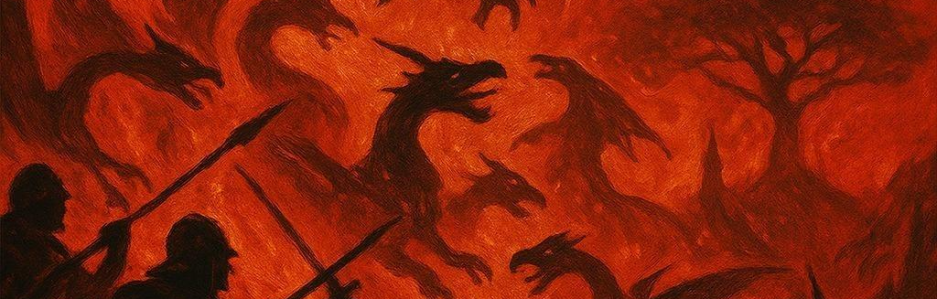
Coming of the Bolide

41 Nadir darkness comes to garden Vallis,
With heaven’s crystals sparkling unobscured.
Shadow calm subdues the ravaged valley.
It comes at last: a falling diamond flame.

41-1 Its luminescence makes the night as day.
Mountainsides of glass shall beam like silver.
The Nezulim observe their ending bode,
While the blue star Edä reaches apex.

41-2 The Bolide falls upon the realm of Vé.
Flaming silver serpent from the heavens,
Descending to the ledges of Meru[i]
Mountain of the seven sacred spires.

41-3 Nezulim send forth the Varangean.
The slain one, Bazunan, not in their count.
Led by heated glow and blotting billows,
They reach the heights of sacred vulcan spurs.

41-4 Upon the ledge, a white coronal light,
Radiating chimeras of crystal.
Though half-submerged, its beaming heat immense.
Varangean must remain at distance.

41-5 Nezulim shall speculate whilst idle,
Their minds are filled with darkness and demise.
That which comes forth from the Bolide crystal,
Must be a curse on Vallis by The One.

41-6 Varangean bear their jagged rapiers,
Preparing frenzied death for that which comes.
A thousand stars descend from firmament[ii].
Amaranthine stains the pitch of heaven.

41-7 Crystal Bolide cools with Edä’s transit[iii].
Coronal light is dimmed with western dawn.
Sol yet rises, hindered not by omens,
As Varangean cower in the shade.

42 When cooled, the crystal hull reveals a door.
Heaven’s ark then offers up her cargo.
Emerging one by one from diamond holds—
They are formed in image of the prophet.

43 Foretold, They come to Vé a race of men,
Making journey from Their ruined homeland—
Once bless-ed world endowed with shallow seas,
A realm known to the Nezulim as Meä.

43-1 The realms of wicked beings shall be consumed
By withholding of The One’s great blessing.
But ending of a realm is less a curse
Then it is the reaping of the sowing.

43-2 The realms of vanity shall end in ice,
And hedonism bringeth end by flood.
The worlds of apathy shall choke on dust,
And envy be the cause of burning fall.

43-3 Five hundred generations make the trek
From Meä to the spires of Meru.
Their world, a ship that sails upon the void.
Their ancient home, the wellspring of their lore.

43-4 Half a thousand kings have ruled Their journey,
A dozen times They swept the shores of Vé.
All these generations nearing Vallis
Were curs-ed by Their passing of the port.

43-5 Blessed be the man who makes the journey,
If known to him the end shall never come.
Life spent in the service of his scions[iv],
Is life that shall be born again in peace.

43-6 Fearful menfolk huddle on the mountain,
To weep and wail out at Their final fate.
They were promised landing in oasis,
Instead, They have discovered desert glass.

43-7 Lifted through the door of buried crystal,
The king of menfolk known to Them as Vyn[v].
Golden raiment cloaks his withered body.
He clutches at his staff of dragon’s bone[vi].

43-8 His beard is long and gray, like cooling ash.
His elder’s eyes are clouded like dawn’s mist.
Tremors shake his hands and slow his footsteps.
Yet, a royal air does not elude him.

43-9 He kneels upon the glass of Mount Meru,
Offering his gratitude to heaven.
‘The One has blessed our tribe with journey’s end.’
‘We honor You by bringing life to stone.’

43-10 The vanguard of the menfolk gathers round,
Fellowship inoculates from worry.
The King of Men fulfills the ancient oath.
Then his tired heart shall cease its beating.

43-11 The others step forth from the crystal hull,
Each to breathe the air and touch the mountain.
In awe, They gaze upon the prongs of glass…
Legend has foretold the seven spires.

43-12 They lay Their fallen king upon the stone,
And build a cairn of quarried vulcan glass.
No male heir was sown for king’s succession.
Bondage chains the tribe without a sovereign.

43-13 Thousands are the number of Their people.
Their skills well-honed along the journey age.
Builders, farmers, hunters, millers, merchants,
And guardians of these— the soldier class.

43-14 Amongst this tribe there are two royal daughters,
Born together, Aramaz and Mazda.
Their mother cradled them upon her breast.
Yet no twin would suckle with the other.

43-15 The daughter-heirs of Vyn have never wed,
Nor birthed a son to carry on the line.
In their elder days, the twins are barren,
Fading hopes for naming of a sovereign.

43-16 Gathered on the Mount Meru’s high ledges,
Beneath the seven spires made of glass,
Meä’s pilgrims greet Sol’s torpid rising,
Dispelling dread of that which lurks in shade.

43-17 Awed, the Varangean hold in shadow,
Biding time to make their slashing kill.
Consensus be for slaying all these souls,
Lest They deliver ruin unto Vé.

43-18 As the dragons form to usher murder,
Their charge is stayed by visions of rebirth.
Underneath the soles of Meä’s Children,
A bursting verdure paints the stone with blooms.

43-19 The dragons sheath their razor rapier claws,
And fall into the shadows beyond sight.
Raptors shall be summoned as Their envoy.
They will shepherd menfolk into Vallis.

43-20 Meä’s pilgrims wonder at these servants.
Scaled in gray and standing thrice their stature,
Their words, a woodwind melody of thoughts,
A race of giants They call Nephilim[vii].

43-21 The Nephilim shall lead Them from Meru,
Trekking forty leagues down from the highlands.
Descending from the edge of desert waste,
Before them spans a splendid garden vale.

43-22 Meä’s Children sing in joyful chorus,
To the fronds that weep a sweetened nectar.
They celebrate oasis in the waste,
Unwary of the lurking dragon beast.

43-23 Nezulim may move beyond perception,
Invisible to men with fettered eyes.
Upwards, downwards, left, and right are limits;
This narrowed range of view conceals the beast.

43-24 They rest within a grove of cascade fountains,
And feast on manna frothing from the trees.
Nephilim shall guard Them while They idle,
For the splendid garden hides its hunters.

43-25 The menfolk wonder at the Vallis trees,
Sprawling limbs bedecked in golden foliage.
Reaching upwards to the mists of heaven,
No tree had taken root in Meä’s soil.

43-26 Howls and calls and clatters haunt the garden.
The scent of tea and flower lulls the mind.
Quaking ferns conceal the shaded slithers.
A silver blossom clenches on its prey.

43-27 Nephilim sit silent without moving,
Their serpent eyes observe the lurking doom.
Flicking tongues can taste a nearing danger.
The garden will not welcome feeble men.

43-28 When the baking air becomes a burden,
The Nephilim will press Them on the path.
Severed heads of hunters line the trailway—
The Raptor’s stealthy blade unseen by men.

43-29 The Meäns rest on banks of gentle streams,
Fed by waters splashing down the stoneface.
The Nephilim reveal the fruits and roots—
Those that will not blind or cease Their heartbeats.

43-30 Journey’s end is marked by thinning jungle.
Before Them climbs a wall of vulcan glass.
Rumor spreads among the wary menfolk,
That lofty fissures hide the serpent beast.

43-31 As Meäns are delivered from Meru,
An agent is selected from Their tribe.
Esthe[viii] is the dead king’s highest counsel.
She shall be Their voice without a sovereign.

43-32 Nephilim lead Esthe up the mountain,
And guide her to an entrance carved in stone.
Passing through the vestibule to darkness,
The master Nezulim awaits her call.

43-33 Esthe hears the pings of dripping water,
And hears the blowing swells of heated air.
Esthe feels the motion of the dragon,
And hears the scrapes of undulating scales.

43-34 Esthe calls out in the strangling darkness,
‘If you be Gronde, present yourself to me!’
Chamber crystal veins then briefly brighten,
Revealing glimpse of dragon silhouette.

43-35 Esthe feels the motion in the shadow,
The Nezulim recedes beyond the dark.
Before her sounds the whisper of a man,
‘I am the one who brought you to this crypt.’

43-36 Bewildered by the tenor, Esthe asks,
‘That cannot be the voice of Nezulim!’
‘There be but one man who could precede us.’
‘Tell me, are you the man Azarius?’

43-37 ‘I am not the man of whom you query,’
‘Though He will not appear, He is yet near.’
‘I am dragon, this you can be certain.’
‘Your mind perceives me as my will intends.’

43-38 ‘Prove yourself the Nezulim by showing!’
‘For legends say Azarius plays tricks.’
‘I shall then bear witness of the dragon,’
‘Bringing Meä’s Children to submission.’

43-39 ‘You cannot see Nezulim completely,’
‘Its form transcends this thin dimension plane.’
‘If I showed my form to you in fullness,’
‘The sight within your mind would be deformed.’

43-40 Undaunted, Esthe furthers her demand:
‘I fear not the vision of the serpent!’
‘Nor am I fearful of the loss of sight!’
‘To be affected is my chosen path.’

43-41 Esthe hears a stirring in the shadow,
As the haze is siphoned from perception.
Her mind is opened by the dragon’s will,
And shall not be restored to what it was.

43-42 Gronde the dragon slithers in the darkness.
‘As you wish,’ it speaks within her thinking.
At first, a flicking tail, a prong, a claw,
And then, the beast in whole, within her mind.

43-43 She perceives the dragon from each vantage,
Eye and claw and scale and organ visage.
And too, the form beyond the sight of men—
With every facet visible at once.

43-44 Two hundred eyes, and yet each part of two.
A hundred heads, but all the same with one.
Scales in rippling, shapeless, edgeless surface.
Endless rows of tooth that spring like fountains.

43-45 Nezulim transcend the plane of vision,
Though they be tethered unto realms of men.
They perceive the world with sight beyond it,
And choose what facet of themselves is shown.

43-46 Esthe holds perception of the dragon,
But for an instant, then the vision ends.
Her eyes then turn as black as vulcan glass—
Windows to a mind that has been opened.

43-47 Gronde speaks to her as facet of a man:
‘You have now perceived the dragon fully.’
‘Wage of this, your eyes forever blinded.’
‘But you shall see with vision by mind’s eye.’

43-48 Esthe shall be led back to her people,
And They will know that she has seen the beast.
Ten thousand years, the prophecy was known,
‘As was told to them by Meä’s dragon[ix].’

44 Nezulim shall congregate in counsel,
Their minds consumed by wariness of men.
‘Let Them be culled by garden’s hungry beasts.’
‘Bid Them death before they weave our ruin.’

44-1 Many of the Nezulim are angered.
They decry, ‘The Children bring The Waning,’
‘Thus, They must be destroyed before the night.’
‘Withdraw the Nephilim so it be done!’

44-2 But Gronde commands, ‘They shall be given grace!’
‘For They are gifts of mercy by The One.’
Their progeny shall be Veandilim[x].
‘By Their arrangements, we make exodus.’

44-3 Gronde shall stay their violent course of thinking,
By showing visions of their future path:
Men become the servants of the dragon,
Delivering the serpent from the flame.

44-4 Gronde shall be Their advocate in Vallis,
And men will prosper in the fruited vale.
Laboring in sowing and the reaping,
Desert lowlands shall be down by labor.

44-5 But as one tribe rises one shall falter,
And this will be the curse of Nephilim.
Though mightier and native unto Vé,
Many shall be stricken by a sickness.

44-6 Sol shall burn with lessened fire fury.
Cooling mists prevail to quench Their thirsting.
Vallis is restored by Their hard labors.
What was waste is brought back to abundance.

45 A Meän generation comes to pass,
During respite from the cataclysm.
Serving out Their bondage to the dragon,
They bide their labors waiting for Their king.

45-1 By whip They shall be prompted in their work.
By scythe They shall be punished for their crimes.
Though They be the servants of the dragon,
Raptors are Their masters in the garden.

45-2 And though They bring abundance to the wastes,
And though Their bellies fatten with each feast,
Meän chattel cry out in forlornness,
Ruing journey bringing Them to Vallis.

45-3 Meäns cry Their prayers of lamentation:
‘Where is the prophet who forsakes our tribe?’
‘For He was promised in the ancient texts—’
‘He who frees mankind from serpent bondage!’

45-4 Men shall be the masters of their brethren,
And men shall be defenders of their clan.
And no man is born to serve the serpent,
But men shall not be born to lord on Vé.

46 Azarius the prophet shall not come,
For He shall counsel only with Their king.
He remains alone within Gronde’s chamber,
While the Bolide’s cohort has no sovereign.

46-1 As the Nephilim succumb to wasting,
Their minds are twisted by a primal fear.
Accusing men of bringing their disease,
They shall wax in harshness by their torments.

46-2 As Bolide’s cohort reaches ag-ed end,
Hope for saving withers with Their bodies.
Azarius is curs-ed in Their songs,
While first generation meets its ending.

46-3 Blind Esthe seeks an audience with Gronde,
Asking aid in making of a sovereign.
Brought into the crypt by wasting Raptors,
Gronde speaks to her in tenor of a man.

46-4 ‘Bring to me the body of your ruler’
‘And lay him on the altar of this crypt.’
‘But do not let the Raptors see this done.’
‘Spiteful Nephilim will halt his rising.’

46-5 Through thinning of their ranks by wasting pox,
Many posts of Nephilim are idled.
Under cover of the annum nightfall,
The body of the heirless king’s exhumed.

46-6 The corpse of King of Men is thus exposed—
Black and withered by the passing annum,
Brittle, dusty form in gilded raiment,
A golden mask preserves his royal air.

46-7 Six men are chosen for the bearer task[xi],
To move the body past the garden’s eyes.
Without escort of the guarding Raptors,
Men are naked to the jungle’s terrors.

46-8 Down from Mount Meru they bring the body,
And through the desert guided by the stars,
In to the garden, watched by lurking doom,
Bearer men are shielded by Gronde’s vision.

46-9 The heirless king is smuggled to the crypt,
And laid upon an altar of black glass.
Of the chosen six who bring the body,
Each are culled upon their journey homeward.

46-10 The corpse of Vyn shall lie within the dark
Until a light shall gleam amongst the stone.
Rooted tendrils reaching from the fissures
Penetrate the body of the sovereign.

46-11 Scions branch to tether nerve and vessel,
And wasting body shall reanimate.
For a moment, dead is brought to living,
As consciousness is channeled through the flesh.

46-12 The King of Men shall see with dragon’s eye—
Face, and aft, above, beneath, together.
Within, without, the dragon is perceived,
Its meager shadow all that mortals grasp.

46-13 The King of Men shall see the futures past:
Meä’s dusty end and Children leaving.
But though unmade, the realm of men remade—
Ancient dynamo[xii] is re-ignited.

46-14 King Vyn shall gaze upon the shallow seas,
And tranquil steppes of endless, golden grass,
Plumes of ash as Tartarus[xiii] awakens,
Vyn then knows his tribe will find salvation.

46-15 High knowledge bursts the vessel of man’s mind
As if new wine poured into weathered skins.
A fleeting glimpse of future for his tribe,
Vyn’s body then returns to final rest.

46-16 Essence of the king shall be extracted
By the finest filaments of tendril.
The tentacles of rooted carnifern[xiv]
Withdraw the seed of essence of the king.

46-17 The generation landing on Meru,
Shall but pass away in Raptor’s bondage.
Two of three survivors are twin sisters,
The living son between them would be king.

47 A twin shall plot her sister’s final breath,
So her son might be the one anointed.
Yet unborn, her son will claim the title,
And free the Children from the Raptor’s yoke.

47-1 Aramaz the twin seeks Esthe’s counsel,
Deep within the garden’s twisted terrors.
She finds the ancient skull of Bazunan[xv]
The doorway to the chamber of the witch.

47-2 She ventures down into the tangled bore,
As if swallowed by an ancient devil.
There she finds the blinded seer waiting.
Seated by her side, her hated sister.

47-3 In a chamber lit by dancing fires,
The sisters vent their loathing with cold stares.
Esthe peers with blinded eyes like agates,
And motions that she shall begin to speak.

47-4 ‘Both of you have come here at this moment,’
‘Yet neither has consulted with thy twin.’
‘Both of you have come to ask one question:’
‘Shall I yet bear the issue of the king?’

47-5 ‘Yes! Oh, yes! Please answer us our question!’
‘For each of us has passed our fertile age.’
‘We are last survivors of the landing,’
‘And soon our bodies wither in a cairn.’

47-6 ‘Fear not, for I have seen the King of Men!’
‘He shall bleed the essence of your father.’
‘But your sons cannot be born together,’
‘For ruin is the price of dueling kings.’

47-7 ‘When we die, the royal line is ended.’
‘What then, old seer, shall be Meän fate?’
‘King of Men must lead us out of bondage,’
‘Before the Garden Vallis turns to ash.’

47-8 Esthe lays before them Pome of Eitur[xvi],
Picked from vines entangled in the garden.
‘The doom of men is tied to sister’s fate.’
‘One bite of pome will save men from their end.’

47-9 Aramaz decries the witch’s offer.
‘We have come to heed your guiding vision,’
‘Yet all you offer is this spoiled fruit—’
‘One single bite, a poison bringing death!’

47-10 Mazda asks one question of the seer,
For she, alone, regards the fate of men.
‘What shall be if neither takes the poison?’
‘Will men remain in bondage to the beast?’

47-11 Esthe yields her vision of the future:
‘Garden’s end is looming on horizon.’
‘A curse of ruin if two kings be born…’
‘A curse of ruin if two twins remain.’

47-12 Mazda knows her sister will not offer.
The fate of men resides with her alone.
She takes the Pome of Eitur from the witch,
Biting down into the deadly poison.

47-13 Within ten breaths, old Mazda passes on,
Falling to the floor of Esthe’s chamber.
Aramaz rejoices in her triumph,
Then asks the ancient seer her command.

47-14 ‘I will take you to the house of Antoc[xvii],’
‘His son will be the father of the heir.’
‘Hide the boy from Nephilim discovery,’
‘For naming of our king portends their doom.’

47-15 ‘When he has surpassed his thirteenth annum[xviii],’
‘Deliver him into the crypt of Gronde.’
‘Present him as the rightful heir of Vyn,’
‘Then the prophet shall be stirred from silence.’

47-16 Aramaz departs the cave of Esthe,
And Esthe weeps both tears of joy and pain.
For Mazda gave her life to save her tribe—
Poisoned pome unlocking chains of bondage.

47-17 Esthe presents Aramaz to Antoc,
But is, at first, refused in her demand.
For the twin is many annums elder,
And never bore a son who would be king.

47-18 Antoc’s son has no wife in the household,
The father has no heir to carry on.
‘If my son be wedded to the barren,’
‘What dowry shall replace my ended line?’

47-19 ‘Lord, fear not the ending of your lineage,’
‘For Aramaz will bear a noble son.’
‘I have seen this with the eye of dragon.’
‘Your dowry: you’ll be patron of the king.’

47-20 Son of Antoc protests the arrangement,
For he has no desire for the twin.
Thrice his age and past her rearing era,
The aged maid does not provoke his want.

47-21 All men are plied by vanity and lust.
And lust takes many forms within the soul.
As men age, their legacy encumbers.
Antoc can’t refuse the royal covenant.

47-22 Son of Antoc is convinced to marry.
They hold the wedding in the annum night.
All the Meäns celebrate their union.
Maids then aid the bride in consummation.

47-23 And when the elder twin is shown with child,
Esthe knows her purpose is completed.
She strides into the Vallis night unbowed,
Disappearing into garden terrors.

48 Son of Aramaz, the last surviving,
Shall be called Mosul[xix] by the Meän tribe.
At thirteen, he is brought into the crypt,
Seeking counsel from the silent prophet.

48-1 The boy and mother slip past Nephilim,
Down into the keep of Gronde, the dragon.
The dim lit chamber reeks of sulfur rot.
Dragon lurks in shadow near the prophet.

48-2 Azarius is held in His repose,
While the dragon slithers in the darkness,
Mother prods the boy to claim his birthright.
Despite his youth, conviction fills his voice.

48-3 ‘Awake, old prophet! Greet the King of Men!’
Azarius sets eyes upon the boy,
Then He straightens from His sleeping posture,
As was foretold by Esthe’s prophecy.

48-4 The crystal veins of stone glow faintly green.
Horn, and tooth, and wing are silhouetted
As shadow drifting just beyond the darkness.
‘What boy has dared to journey to this crypt?’

48-5 ‘It is King Mosul, son of Aramaz,’
‘Seed of Vyn, the heir to Meä’s kingdom.’
‘Breaker of the chains of Vallis bondage.’
‘The one foretold to lead man’s exodus.’

48-6 Azarius arises from the stone,
A wraith of withered skin draped over bones,
Eyes that beam white fire from deep craters,
Standing, He looks down upon the sovereign.

48-7 ‘A king who must announce himself as king…’
‘Suffers from the want of validation.’
‘But if the heir of Vyn has come to be,’
‘What would be commanded by this lord?’

48-8 ‘The teachers tell us Vallis days are short.’
‘Soon, the desert comes to claim oasis.’
‘The King of Men shall stay the Raptor’s whip.’
‘You will then reveal the way to Edä.’

48-9 Azarius demures before the boy:
‘Yes, I know the way of liberation.’
‘Trust in me, and I will show the pathway,’
‘And I will open gates that are unseen.’

48-10 And thus, the seed of Vyn is named the King.
The prophecy of Esthe is fulfilled.
Mosul is adorned in gilded raiment.
House of Antoc fills the court and council.’

48-11 As young Mosul ages into manhood,
The prophet tutors him the ancient lore.[xx]
Futures past and pasts that be the future,
And kings that rise and kings that are destroyed.

48-12 Mosul sees the rise of Edä’s kingdom,
Meä’s Children marching on the savage
And binding restless natives as their slaves.
Victorious, the banner of the beast!

48-13 Azarius shall show the boy his might.
Mosul’s mind then fills with sovereign glory
The boy becomes the legendary king,
Savior to the children of the wasteland.

48-14 But glory of the king shall be delayed.
Meän legend must be first accomplished:
Gates of Edä shall not be thrown open,
Until the last to journey passes on.

48-15 The King of Men grows restless in his youth,
Yearning for the moment of his triumph.
But generation of the journey lives,
With the mother of the king surviving.

48-16 Mosul sends his Regian[xxi] defenders,
Led by Mosul’s father, Son of Antoc,
To bring his mother to the den of Gronde,
For consultation with Azarius.

48-17 Mother goes with husband as requested,
By pathways she regards as lesser known.
Pondering while carried on her litter,
‘The day of exodus has come at last!’

48-18 Instead, they bring her to the dragon skull,
The ancient head of Bazunan, the beast.
There, they chain the mother to the dragon,
Leaving her to beasts that prowl the jungle.

48-19 Amaraz cries out as she’s abandoned,
‘Why do you forsake me to the hunters?’
‘I beg you, do not leave me to this death.’
‘Have I not borne the son who is your king?’

48-20 But pity does not come to Antoc’s son.
His heart was hardened by a power lust.
Though his wife had borne the King of Meä,
Antoc’s son regarded her with loathing.

48-21 Azarius is summoned to the King.
There, He is reminded of the legend.
The last to make the journey breathed her last,
Gates of Edä must now be thrown open.

48-22 ‘Painfully, I’ve made the choice for kingdom,’
‘And sacrificed the dowager to vale.’
‘Though I weep for passing of my mother,’
‘I’ve done what must be done to free my tribe.’

48-23 The prophet is unmoved by king’s demand.
‘You have taken life without a purpose—’
‘Beg The One for mercy or be punished.’
‘Your mother was not last of Those who live.’

48-24 The King is angered by the prophet’s words.
Regians unsheathe their dragon ivory,
Surrounding prophet, readying to strike,
But the King of Men will stay the killing.

48-25 ‘Tell me, prophet, who yet lives among Them?’
‘Twenty annum pass since others perished.’
‘I come to think that you are but the beast,’
‘A serpent telling lies in human form.’

48-26 ‘Hear me, Mosul, what I tell of Esthe:’
‘The seer who has cleared your path to king,’
‘Lives immortal in the Raptor caverns.’
‘Her life, a guarantee for Nephilim.’

48-27 ‘Then we shall wait until the seer dies,’
‘For she was elder long before my birth.’
‘We will soon get word of Esthe’s passing,’
‘Then you shall reveal the Edä gateway.’

48-28 ‘You do not understand the Raptor ways.’
‘They can heal her from the curse of aging.’
‘You have slain your mother without purpose.’
‘Your vanity brings curse upon your house.’

48-29 Mosul sends the Regians as envoys
Marching down into the Raptor caverns.
Their tunnels light with luminescent quartz,
As godlike reptiles glower down on men.

48-30 Kandevular[xxii] is hailed as Raptor kaan.
Thrice the height of men, his presence towers.
Serpent eyes burn deep into men’s spirit.
He speaks no voice that ears of men can know.

48-31 The Regians of Mosul make their claim:
‘Give to us the seer we call Esthe!’
‘Your race is weakened by the wasting pox.’
‘Raptors are no match for Mosul’s army!’

48-32 Unbowed, the Raptor kaan will not relent.
Instead, his serpent eyes alight with flame.
With his gesture, Raptors grant men passage.
Regians are turned away defeated.

48-33 Mosul holds a counsel of the elders,
Sharing visions of the Meän glory.
‘The Age of Men demands the seer’s life.’
‘Without it, we shall perish in the flame.’

48-34 ‘Take up your shields, unsheathe your rapier blades[xxiii]!’
‘Glory has been shown to me by visions.’
‘Meän’s bring their war of liberation!’
‘No Raptor shall be spared our culling thrust.’

49 Mosul leads the march of men on Vallis,
Emboldened by the triumph he foresaw.
Forty-thousands be their fighting number,
A force of men to cull the Raptor horde.

49-1 Forest pathways spill onto the meadows,
And march of men is halted in the field.
Gudoc[xxiv] rises from the plain before them,
One thousand Raptors hold the vulcan wall.

49-2 Mosul’s host prepares to wage the battle.
The men of Meä form into their ranks.
When thund’rous wails of battle horns resound,
Souls of men are lifted from their dread.

49-3 Ordered by the golden Son of Antoc,
Man’s army charges up the Gudoc scarp.
But kaan of Raptors holds the lizard line,
Waves of men are broken on the mountain.

49-4 Charge and charge are ordered by King Mosul,
But each is thwarted by the Nephilim.
When but seven thousand stand unbroken,
The Nephilim descend to slay the rest.

49-5 One hundred Raptors charge down from the heights,
Slaying Meä’s soldiers in the chaos.
Many are devoured while yet breathing,
And only Mosul’s Regians survive.

49-6 King Mosul shall be brought before the kaan,
Bloodied king is silent in his ruin.
Lizard kaan shall mete a final justice,
Ripping Mosul’s beating heart from body.

49-7 And as the King of Men dies on the stone,
Raptors serve revenge for pox of wasting.
But glory is a fleeting glimpse of God.
Era of the garden nears its ending.

49-8 Six Regians remain of Mosul’s host,
Bearing lifeless king upon their shoulders.
Forty-thousand souls are lost in battle,
Despair thus fills the hearts of those that live.

49-9 ‘The exodus demands a king to lead!’
‘But now ruin comes to Meä’s Children!’
‘The king is dead. The fate of man is sealed!’
‘All mankind shall perish by the fire!’

49-10 Nephilim release the seer Esthe—
The last survivor of the crystal star.
Blind Esthe steals away by hidden paths,
Venturing into the highland desert.

49-11 Guided by the force of dragon vision,
Blind Esthe climbs the mountain of Meru.
She casts herself into the vulcan pyre.
By this, the prophecy shall be fulfilled.

49-12 Bondage finds the tribe without a sovereign,
But Meä’s Children shall escape this fate.
A king will take first breaths in dragon’s lair.
Aeon, heir of Vyn, shall be arisen.

50 Azarius appears at Mosul’s cairn,
Bringing word of Aeon, King of Meä.
Regians shall slay the traitor prophet,
And leave His body to the garden beasts.


[i] Mount Meru: The sacred mountain of seven volcanic spires. Landing place of the Bolide.

[ii] Firmament: The dome of the night sky that suspends the stars above.

[iii] Edä’s transit: The path of the archon (or star) Edä across the heavenly night.

[iv] Scions: Descendants.

[v] Vyn or King Vyn: The last king of Meäns while on their journey through the void.

[vi] Staff of dragon bone: King Vyn’s staff purported to be made of dragon bone, implying dragons, or at least the fossilized remnants of them, existed on Meä.

[vii] Nephilim: The race of giants that are conceived of the essence of wyvern and the ‘race ill-fated’ (a.k.a. humans).

[viii] Esthe: The most trusted counsel of King Vyn. She is chosen by the Raptors to speak for the Children of Meä on Vé upon their arrival and after she perceives the dragon in whole.

[ix] Meä’s dragon: The beast of legend that dwells within the depths of Meä and reveals the promise of the garden of Vallis before man was banished into the void.

[x] Veandilim: The pure-blooded descendants of the Meäns who arrive on Vé by the Bolide.

[xi] The chosen six who bring the body: The Meän host that disinters the deceased King of Men and brings the body to Gronde’s crypt. All are slain by the beasts of the jungle upon their return journey.

[xii] The dynamo of Meä: The ancient furnace deep beneath the surface that, once ignited, awakens heated springs, warms the air, and drives the clouds and storms and rain. When extinguished, the mountains fall asleep and the air cools and dries, turning Meä into a frozen desert. According to legend, it exists in a keep, deep within the mantle known as Tarturus (or Hell) and is guarded by the immortal Nephilim god-warrior Kandevular Kaan.

[xiii] Tartarus: Hell or Hades or within the underworld that exists beneath all the realms.

[xiv] Carnifern: A predatory plant that kills and consumes animals with motile tendrils and clasping pedals (or lobes).

[xv] The skull of Bazunan: The ancient, eroded skull of the doyen Bazunan. Beneath it worms a series of tunnels that house the blind seer Esthe.

[xvi] Pome of Eitur: The fruit of the eitur vine which contains a deadly poison.

[xvii] The House of Antoc: The noble house of the patriarch Antoc. His son would father Mosul, the heir to King Vyn.

[xviii] His thirteenth annum: Thirteen Edä years of age.

[xix] Mosul, the Heir to Vyn: First surviving male descendant of King Vyn. Mother is Aramaz, the daughter of Vyn, and the Son of Antoc.

[xx] The ancient lore of Meä: The tales of ancient Mean civilization, before man was cast out into the void.

[xxi] Regian defenders: The King of Men’s personal guard.

[xxii] Kandevular: The kaan or king of the Nephilim. The greatest Raptor. The keeper of the gates of Tartarus.

[xxiii] Rapier blades: Blades constructed of dragon bone, scales, or horn.

[xxiv]Gudoc: a steep escarpment of fractured vulcan glass that forms an un-flankable bastion on an edge of the garden valley. It is the place of the last stand of the Nephilim.

He Awakens

21 Azarius awaits the Nezulim.
Quietly, He bides his time in darkness,
In repose, in eons-lasting dream state.
The dragon comes for Him a thousand times.

21-1 Submersed within an utter, senseless dark,
Drowned within a din of total silence,
Neither hot nor cold, and without movement,
Oblivion enveloping the flesh.

21-2 Azarius awaits within this crypt,
Sustained in life by manna of The One[i].
Eons pass as if but merely moments.
Madness is annulled by dreaming journeys.

21-3 His memory is of the futures past,
So too, He shall recall the pasts to come.
Every moment of His countless lifetimes
Is relived while in the state of dreaming.

21-4 He recalls the souls of each encountered,
The kings, and paupers, mothers, soldiers, babes.
Friend reborn a foe and foe re-friended,
For no man lives their life the same way twice.

21-5 He does not recall embrace by mother,
Nor does He recall a father’s lessons.
No memory of childhood exists,
Begotten by The One, and never young.

22 Warm blood doth pulse within His ageless veins.
Wounds will bleed, and blows will bruise and break Him.
Though He be slain by blade, or club, or knot,
Rooted and unrooted life renews Him.

22-1 He has dreamt of cities built by menfolk.
Its narrow alleys bustle with exchange.
Labyrinths of stone, and flesh, and clamor,
And odors, tastes, and the echoes in the air.

22-2 He has been here countless times in history.
Each visit finds it more-or-less the same.
Masons stack the stones in likewise patterns,
The routes arranged familiar in design.

22-3 Every time He recognizes faces,
And most replay the same roles as before.
Brute gendarmes shall only change their masters,
And beggars rarely stack the merchant’s coin.

22-4 The patrician class are clad in colors,
The filthy proles will shout, and spit, and curse.
Men with violent stares in breasted bronze-plates
Are prodding Him with sharpened blades of steel.

22-5 Thirteen times He’s marched this raucous gauntlet,
Which culminates within a dungeon keep.
Scourging of the flesh is their cruel manner,
Then meted death for crimes of heresy.

22-6 One cannot confront a mob with reason,
Devotion to the mob, its only law.
Ultimate of sin to all fanatics
Is by the mockery of their righteous cause.

22-7 Every man shall bear religious fervor,
Each worships god, or ghost, or king, or cause.
Stand athwart the mob and ye be trampled.
Defying divine law a heresy.

23 His emergence is the foretold omen,
It shall concur with tumult throughout Vé.
Though The Waning Era [ii]comes before Him,
The prophecy of Him is thus fulfilled.

23-1 In the time before The Waning Era,
Vé’s garden bounty sated every want.
Margathon recalls the future vision.
Banished devils should not be forgotten.

23-2 Margathon surrenders to the caverns.
The serpent’s body withers in its crypt.
Wasting lords oblige the hunt for devils,
The Varangean set out on their hunt.

23-3 The wyvern hunt will span a hundred sols[iii],
Yet not one eye of Vé will glimpse the wyrm.
The Varangean search the highland plains
Where the heat of Sol burns like a furnace.

23-4 The hunters reach the Highlands of Keveer[iv]
Lifeless rocks emblazoned by Sol’s fire.
Naked under Sol, they seek shade’s refuge,
And find His crypt within a deep crevasse.

23-5 The Varangean souls are filled with dread,
For the prophet shall abet The Waning.
Varangean huddle in the shadows,
In fear of He who heralds in their doom.

23-6 Bazunan berates them all as cowards,
And threatens to remove their head from spine.
By claw and fang, the dragons pry the door.
There within, Azarius is waiting.

23-7 Bazunan creeps forth to vet the prophet.
Its forked black tongue flicks at the petty being.
Slaying it would bring it exaltation,
And glory would be given to the beast.

23-8 But He awakens just before the strike.
Nezulim recoil in their terror.
He speaks to them, ‘Before you cut me down…’
‘Know that I can lead you to the wyvern.’

23-9 Bazunan’s first instinct is to slay Him,
But Varangean halt the killing strike.
Bazunan hurls curses at their thwarting,
While dragons circle in defense of man.

23-10 They speak to Him with voices in his mind,
Their intonements chanted in His whisper.
But He has heard the dragon’s voice before,
And their writhing tone cannot corrupt Him.

23-11 The Nezulim do not remember Him.
Their eyes then narrow as He thwarts their spell.
Poison odors burn into His airways…
‘Spare your suffering! Tell us of the wyvern!’

23-12 Forked tongues glazed with acid flick His body.
Azarius replies with weakened voice:
‘You cannot find the wyvern by Vé’s sight.’
‘This wyvern has eluded Vallis eyes.’

23-13 Dragons scrape His flesh with serpent armor.
Azarius continues without fear:
‘The One withholds your higher dragon sight.’
‘As Sol reddens, so your vision darkens.’

23-14 But still, they have no memory of this man.
‘Liar! Demon! You cannot deceive us!’
They try to break his mind with fear of pain.
‘Spare your suffering! Tell us of the wyvern!’

23-15 In His mind he sees His burning body,
Then He feels the immolation fires…
‘There is no use in torturing my mind!’
‘For all you might impose, I have endured.’

23-16 ‘Listen to my words for your salvation.’
‘The wyvern’s lair lies just beyond your sight.’
‘I shall give the wyvern on your promise,’
‘That I may pick the manner of my death.’

23-17 Bazunan reacts with rage and fury.
‘A man shall never bargain with the beast!’
‘I shall cast you down into the chasm,’
‘Spare your suffering! Tell us of the wyvern!’

23-18 Azarius refuses to concede,
And drives the fire from his ancient mind.
‘Living flesh can never be immortal,’
‘All that is remade shall yet be unmade.’

23-19 ‘So many times, I’ve known you, Bazunan,’
‘But you do not recall your prior lives.’
‘Holy is the place of your life’s ending,’
‘Where your mind is freed from body’s bondage.’

23-20 ‘The fool denies the coming of the night,’
‘Thus his path is foiled by the darkness.’
‘The wise prepare their lanterns in the day,’
‘Thus the nightfall won’t impede their journey.’

23-21 ‘I can light the lantern of salvation’
‘And give to you the wyrm who will be lord.’
‘Squander this and ye shall face your ruin,’
‘And left to gnaw upon each other’s bones.’

23-22 The Nezulim grow wary of His words,
For they have learned The Waning prophecy:
‘He shall come and bring the flame of end times.’
‘Nezulim shall suffer by this fire!’

23-23 They then turn their claws upon His body,
And He is slashed, and bruised, and broken-boned.
Then He’s carried off to Vallis garden,
Where Margathon shall mete the prophet’s fate.

23-24 The prophet is brought down to dragon’s crypt,
Where Azarius is forced to prostrate.
Varangean gather round the prophet,
And darkness fills with sounds of grinding scales.

23-25 Glow illuminates a human visage:
A man upon a throne in gilded robes.
A voice emerges from the grating din…
‘Tell me prophet, do you recognize me?’

23-26 He hears their black blood rushing through their veins,
And their claws that scrape like stone on iron.
He gathers himself up so He may speak.
‘You are the lord of dragons, Margathon.’

23-27 Varangean beasts then ooze and slither.
The visage king responds in troubled tone.
‘Why do describe a man as dragon?’
‘Am I not man as your eyes have perceived?’

23-28 ‘My eyes see that which dragons have revealed.’
‘You project a man into my vision,’
‘For you believe it will disarm my mind,’
‘But you have forgotten past encounters.’

23-29 The visage king arises from his throne.
‘I have seen you in the future’s vision,’
‘Where you precede destruction of this realm.’
‘Bringeth you the fire or mere warning?’

23-30 ‘I bring nothing but word of the weather.’
‘My death will not forestall the burning Sol.’
‘Yes, this garden will be rendered cinders,’
‘And few of Nezulim will carry on.’

23-31 The visage king lays hands upon His head,
Thus Azarius receives the binding.
Then Margathon demands the dragons leave.
They withdraw by slithers into darkness.

23-32 Margathon enjoins the mind of prophet.
‘What will you tell me of The Waning time?’
Margathon awaits the prophet’s answer
While veins of stone suffuse in emerald glow.

23-33 Silently, He tends his wounded body,
His quiet, driving visage king to wrath.
‘You shall answer, specter of unholy!’
And only then Azarius responds.

23-34 ‘I’ll not yet share your waning destiny,’
‘But, I will reveal to you the wyvern.’
‘It nests upon the pinnacle of Yune[v].’
‘Hasten and it can be brought to Vallis.’

23-35 ‘But also, you must know of this great wyrm,’
‘It cannot be deceived by dragon’s drone[vi].’
‘Varangean will be firmly tested;’
‘Seven of them may not match its fury.’

23-36 ‘Know that if you lose a Varangean,’
‘Fate is sealed by lack of quorum number.’
‘Once this wyvern turns, your future ceases,
‘For this one is the last of wyvern-kind.’

23-37 ‘You must now fulfill what was agreed to.’
‘For I have upheld my end of the pledge.’
‘Your doyen brought me here upon its oath.’
‘All betrayals bring the curse of justice.’

23-38 The visage king withdraws from prophet’s mind,
For Margathon has learned the wyvern perch.
‘Tell me prophet, what shall be your preference?’
‘What be the manner by which ye be slain?’

23-39 Smoldering engulfs its scales with aura.
The fangs and claws reflect the ember glows.
Azarius corrals His waning strength,
As the visage king becomes the dragon.

23-40 ‘Margathon shall bear the dragon’s honor.’
‘The manner of my slaying shall be thus:’
‘Willingly, I sacrifice my body.’
‘But only to the lord of Nezulim.’

23-41 Margathon appears in all its horror,
The serpent swells within in the cavern keep.
Azarius is swallowed by the beast,
Dragon lord then calls the Varangean.

24 Future shall be past and past the future,
And memory shall be a prophecy.
Nezulim will quell the doomsday prophet,
But harbingers are not the source of doom.

24-1 Varangean dispatch for the wyvern,
Embarking for the pinnacle of Yune.
Vulcan glass that spires from the highlands,
It rises high above the eyes of Vé.

24-2 Varangean hunters reach the mountain,
By hidden murmuration in the mist.
Hiding in the shadows of Yune’s fractures,
Setting ambush for their wyvern prey.

24-3 Restlessly, they vilify the prophet,
Intoning curses in the silent dark,
While time is lengthened by the spell of night,
Under firmament of dancing pyres.

24-4 The wyvern comes, descending in the dark,
Landing on its perch atop the spire.
The hunters hold for Edä’s climbing star,
Signaling the moment of their ambush.

24-5 The beryl cinder rises in the west,
Marking moment of unleashing fury.
The Varangean dispatch from their blinds,
Rising to ensnare their serpent trophy.

24-6 The method of the capture is by swarm.
For wyvern are a cunning, violent beast.
Varangean come from every vantage,
Slashing, clawing, flaying at the creature.

24-7 Their doyen, Bazunan, goes for the cull,
But the cunning wyvern counter-slashes.
Unseen by blinded eye, the razor tail
Slices down above the doyen’s shoulder.

24-8 The dragon’s skull is severed from the spine,
And serpent jaws cry out a silent shriek.
Tumbling down and down into the garden,
Doyen’s eye reveals a final terror.

24-9 The dragon’s headless body flails and writhes,
Crashing down from heaven’s misty currents.
The heart yet pumping fountains of black blood,
Vulcan glass and dragon scales are splattered.

24-10 The body of the doyen comes to rest.
Quickly, forest hunters come to gather.
They tear the flesh from bone in frenzied feast.
Bazunan the dragon sates their hunger.

24-11 The wyvern shall be finally subdued,
By the force of Varangean numbers.
The beast is lowered from the mountain’s peak,
Borne by them unto their master’s cavern.

24-12 In deep’ning depths, the trial is imposed—
Torture beyond human comprehension.
The veins are ruptured and the blood is let,
Until wyvern’s final heartbeat pulses.

24-13 The wyvern body’s lain on garden floor.
Rooted and unrooted then beset it,
The lesser beings transfigure lifeless corpse,
By this, the wyrm is made into a god.

24-14 Sol rises over Vé each annum turn,
But this dawn shall be marked by one rebirth.
The last of Nezulim shall take a breath.
All that lives shall herald: Gronde the dragon!

25 Margathon lies waiting in the darkness,
Until the tomb is opened to the light.
The Nezulim forsake their dragon lord,
In the depths where Sol cannot envigor.

25-1 Gronde’s making does not fill the quorum count—
Headless Bazunan, the missing number.
Thus, mandate of the elder master ends.
Nezulim must elevate another.

25-2 Gronde is nurtured in the ways and meanings,
Evolving with the highest seeing eye.
This high vision shall not be encumbered;
The wise must shun devotion to all rites.

25-3 Future’s end is marked by wyvern’s passing,
And Gronde’s arising in the Nezulim.
Final ages shall be filled with tumult,
As end time lords cast off their elder’s ways.

25-4 The Nezulim shall segregate in clans,
And no voice of reason can repair this.
For Nezulim regard themselves as gods—
Blasphemy and envy, their undoing.

25-5 The tribe of Margathon defends their lord.
Followers of Gronde condemn the elder.
The elders promise Vallis can be saved.
Margathon perpetuates this falsehood.

25-6 The highlands stir and groan, and crack, and burn.
The firmament becomes a shroud of soot.
Molten stone bursts forth from mountain fissures.
Vé convulses in the war of dragons.

25-7 In desperation, Margathon will act.
Slithering its way up to the surface,
Calling out for Varangean servants,
Weakened by the darkness of the caverns.

25-8 The Varangean come when they are called.
Lord of dragons orders Gronde devoured.
But Varangean shall betray their oath,
Turning fang and claw upon their master.

25-9 Margathon is driven into daylight,
Where Nezulim are gathered to exalt.
Gronde shall be anointed as their master,
And Nezulim await their first command.

25-9 One hundred thousand annum spanned the reign.
O’er this era, Vallis reached full glory.
Though Margathon’s ascendence was the cause,
Nothing rising shall escape its falling.

25-10 What shall command the lord of Nezulim?
Gronde decrees a sacrifice to Vallis.
Forthright, old Margathon shall be destroyed,
The body opened to the air of Vé.

25-11 Margathon is held upon the altar.
The Varangean gather ‘round their lord.
Gronde releases them upon the elder,
To tear the organs loose from waning beast.

25-12 But terror fills the minds of gathered beings.
Sectioned entrails writhe in oozing piles.
The membrane is incised by tearing claws,
Where a living man escapes the vellum.

25-13 Coated in the ooze of dragon’s cruor,
Naked as an infant after birthing.
‘And who could be this man?’ the dragons ask.
But Varangean know… Azarius!

26 Gronde shall lord from deep within the chasms.
Its scales will harden into iron shields.
Serpent’s body grows too large to surface,
But though the eyes go blind, the sight is keen.

26-1 One millennium with Gronde brings respite.
The molten vulcan furnace is subdued,
As the feuding conflict is abated.
The era of new lord delays their end.

26-2 But Nezulim will know the end yet comes,
When their garden shall be turned to cinders.
For, the wage of decadence is waning,
And curse of envy shall be wrought by flame.

26-3 The minds of Nezulim are filled with angst.
Vallis echoes with their lamentations:
‘What is the crime by which we shall be judged?’
‘Have we not brought the gardens to the waste?’

26-4 Gronde answers them by voice inside their minds:
‘Though we have been given garden splendor,’
‘We have murdered in our greed and envy.’
‘For this, we are convicted by The One.’

26-5 But Gronde cannot repress their troubled souls—
Nezulim persist in their denial.
‘Is not The One’s will for the sowing life?’
‘Why this judgement if life comes by reaping?’

26-6 Gronde rebukes the Nezulim in voices.
The droning in their minds brings them to heel.
‘Ye are bless-ed by The One’s divining,’
‘But ye have brought the discord into Vé.’

26-7 ‘Living are the beings that share the reaping.’
‘The reaper harvests for the rites of life.’
‘Killers are the beings that slay by envy.’
‘The killer murders for the cult of death.’

26-8 ‘That which Margathon withheld from knowing’
‘Shall be the fate of dragon Nezulim.’
‘By thy sin, we shall be cast from Vallis,’
‘As splendid garden turneth into ash.’

26-9 They ask, ‘Has not The One made Vé its eye?’
So Gronde replies, ‘There is no doubt Vé is…’
‘But, if thine eye brings the spirit discord,’
‘Ye shall blind it by the flame of judgement.’

26-10 ‘When shall this doom befall us?’ They reply.
Gronde says: ‘This perception is beyond me,’
‘Though, there is one who knows the very hour—’
‘This one also knows the path from ruin.’

26-11 ‘Who is this one?’ The Nezulim demand.
‘It is He who emerged from the entrails,
‘He who is immortal in his body.’
‘The man who has eternal memory,’

26-12 The Nezulim demand to know time’s end.
‘Bring this man to us so we may sway Him.’
‘We’ll slowly break His body and His mind.’
‘We will make Him tell us of our end day.’

26-13 Gronde rebukes them for their wretched scheming:
‘One cannot reveal the truth by torture,’
‘For men will lie to spare themselves from pain,’
‘And they know the truth will bring no mercy.’

26-14 Gronde remains within the Vallis dungeon,
As keeper of the prophet who yet sleeps.
The dragon guards the man who knows the way.
For He alone can save the Nezulim.

26-15 For one thousand annum they are bonded,
Entombed within the darkness under Vé.
High above, the dragons feast on bounty,
Forgetting of the man who knows their doom.

27 When the time has come the prophet wakens.
Azarius shall open long-closed eyes,
Finding He is not alone in darkness.
Gronde is there, in visage of ascetic.

27-1 The withered man is lit in emerald glow,
Seated in the same pose as the prophet.
His beard is long and drapes his hide-like skin.
Gronde reveals himself as His reflection.

27-2 The prophet chides the dragon for his ploy:
‘You forget that men mature with wisdom.’
‘You must know that my time is eternal,’
‘And age inures men from implanted thoughts.’

27-3 The ascetic asks with lips unmoving,
‘Now that you have arisen from your dream,’
‘Tell me of the hour of Vé’s ruin,’
‘So that we might prepare for end of days.’

27-4 He replies, ‘Your schemes shall be made futile,’
‘The One’s unmaking shall not be denied.’
‘Many trials will beset the dragon,’
‘Numbers must be culled before the journey.’

27-5 ‘Do not worry of the preparation,’
‘For I must only show your kind the way.’
‘Keep me here so that I stay forgotten,’
‘And I’ll reveal the ruin on its eve.’

27-6 ‘But all of this you’ve seen with your own eyes.’
‘Countless be the eves of your unmaking.’
‘Fear not your end, for you shall live again.’
‘Death is but the night before the morning.’

28 Gronde recalls unmaking through the spirit,
The burning flame, the taste of smoke and ash.
Yet, the memory evades the conscious,
As it was not borne into transcendence.

28-1 ‘So, tell me this at least, Azarius,’
‘What shall be omen of The Waning time?’
He replies, ‘It shall descend from heaven…’
‘Falling star that ye shall call the Bolide.’

28-2 ‘And these shall be my final words to you’
‘Until the era of the end of days.’
‘Spare me from the beast lest ye be ruined.’
Prophet’s eyes then close and voice falls silent.

29 Azarius reposes in the crypt,
Dragon Gronde defending silent prophet.
Nezulim grow restless in unknowing,
And turn upon each other out of fear.

29-1 The dragon kind shall manifest their dread,
And place a stone upon the crypt of Gronde.
Serpent and the man are sealed within it,
Master of the Nezulim is silenced.

29-2 Without a lord, they turn their plots and foils.
Of those who rise, the greatest be cast down,
And of the ones who hide, a number flayed,
For there shall be no sanctum found on Vé.

29-3 How ravenous the tribe that slays their villain.
The Nezulim shall bare their vile fangs.
Many with a voice are thusly silenced—
Both the honored and the wretched ruined.

29-4 Vé’s new dawn brings glow to western darkness,
And annum marks each day as done before.
Flora still yet bloom, and fauna gather,
While Nezulim must further cull their kind.

30 All with sight on Vé await the Bolide[vii]
Which shall descend within a brilliant light.
So, it has been foretold by the prophet…
Alas, a star, the herald of the end.


[i] “Manna of The One”: The divine or spiritual power sustaining a living material being.

[ii] “The Waning Era” or “The Waning”: The period of decline of the Vallis garden marked by tumultuous periods of environmental catastrophe, and culminating in the destruction of habitable Vé leading up to the exodus.

[iii] Sols: Annum or the equivalent of a year.

[iv] The Highlands of Keveer: A rugged, rocky, high plateau that was thought once to be within the Vallis gardens but had been pushed upwards by geologic forces rendering it inhospitably hot and dry.

[v] Yune: A tall, narrow spire of volcanic glass reaching high above the mists of Vallis.

[vi] Dragon’s drone: A perceived musical pitch or tone projected by dragons to disorient, confuse, and drive their prey to hypnotic madness.

[vii] The Bolide: The falling star that signifies the end of days.

Rebirth of the Dragon

11 Ahm is all, and all that’s made and unmade.
Ahm is body and The One the spirit.
The spirit of The One shall have a mind.
The mind-eye[i] of The One is known as Vé.

11-1 Legion are the eyes within Ahm’s members,
And through these eyes, The One envisions Ahm.
But there is just one eye of higher sight,
And Vé shall be the consciousness of Ahm.

12 Vé shall be unmade and made forever.
Her oceans swell and then recede, again.
As heavens turn from west unto the east,
She is eternal in her ebbs and flows.

12-1 And just as dawn precedeth azure dusk,
And as each dusk precedeth golden dawn,
Everything that’s made shall yet be unmade,
And all that is unmade is made again.

12-2 Vé is remade from her molten cinders.
Her mountains shall be ceased from vulcan[ii] rage.
Her seas shall be distilled from mist and cloud.
Her poisons shall be cleansed by driving rains.

13 The purpose of The One is knowing Ahm,
For that which can be seen can yet be known.
The One perceiveth Ahm through living eyes.
To chosen life, The One gives higher sight[iii].

13-1 Vé is remade from unmaking ruin.
Her ocean spawns the coming of all life.
The essence[iv] reconceives the ancient forms.
Waters teem again with motile creatures.

13-2 The sea of gold reflects the blazing Sol.
Tempests howl and churn the deepest trenches.
Waves that crest in silver break the shoreline.
Within this maelstrom, churns the soul of Vé.

13-3 From still pools infused with living essence,
The lower forms take root upon the land.
Guided by The One, the lowlands seeded,
The flora from lost ages are reborn.

13-4 Vale is remade from its prior ruin.
The air is cooled and skies are purified.
Flora turns the valleys into gardens
Which veil the surface shimmering of glass[v].

13-5 The flora weaves their tapestry of life.
Ferns and fruited brambles clothe the valleys.
Majestic trees climb high above the mist—
Their manna suckled by the creeping vines.

13-6 Unrooted lifeforms venture from the sea,
And land shall dance by motile creature din.
From sea to pool to stalk to treetop height—
An ornamented song of plume and call.

13-7 Trees shall nurture rise of flying creatures,
Aloof from claw, and fang, and snaring vine.
Of these beasts are born lords of predation,
Harvesting their feasts with silent cunning.

13-8 Those bound unto the floor forever fear,
The golden skies traversed by flying beasts[vi].
They each know an end comes without warning—
Their last vision, rising into heaven.

13-9 Avians, in time, will then be mastered—
A member of their phylum reign supreme.
Sailing skies on wings that block the Sol-light,
With gnashing fangs that cleave both flesh and bone.

13-10 What grim curse restoreth these foul creatures?
For they could not be of the mind of Ahm.
It is sin denying terror’s maker,
For wyvern[vii] are but reapers of The One.

13-11 They know not mercy, sorrow, nor regret.
They know not hatred, envy, or to love.
They are hunters driven by their impulse,
Killing for their feast and for desire.

13-12 Wyvern lord on Vé ten million annum[viii],
Ripping organs loose from fated creatures.
They nest upon cathedral vulcan glass,
And were the highest seers of The One.

13-13 Vision grants the seer its perception,
Perceptions are oft’ clouded by mind’s hem.
And though the wyvern sees the realm of Vé,
The One desires higher understanding.

13-14 The One shall maketh Sol to dim her light,
And day becomes an endless amber glow.
The rain of heaven[ix] poureth down on Vé
Whilst radiance of Sol remains subdued.

13-15 Rain of heaven alters living essence,
And wyvern species birth a higher brood.
The One give nourishment unto the chosen,
And they are gifted with the highest minds.

13-16 Vé gives no quarter to the frail or lame.
Weakened beasts shall never find a mercy.
And so, the wyvern too shall meet their ends,
For all that has been made shall be unmade.

14 Overlords[x] emerge from wyvern breeding,
And these are ones imbued with higher minds.
From their visions, they glean understanding[xi].
For this, The One reveres them like a child.

14-1 The first awakening in high perception—
The wyvern that attempts to rise to Sol.
Higher it shall climb pursuing knowing,
Above the golden mist that sheaths the realm.

14-2 Higher yet it rises to the heavens,
Until the beaming Sol shall blind its eyes.
Higher still it rises to the ether,
Until its wings no longer fill with air.

14-3 Heaven is beyond the pilgrim’s grasping,
Yet it struggles upward in pursuing.
Alas, it takes its final gasping breath,
And after doing, falls back to the world.

14-4 The folded wyvern spins down into Vé,
A silent form descending through the mist.
Its fall is broken by frondescent floor,
The lifeless body shattered and deceased.

14-5 Cradled in a womb of vibrant blossoms,
The mutilated, fallen wyvern lies.
Its shattered, broken bones impale its flesh,
Its bursted entrails spoil fair bouquets.

14-6 Prowling beasts approach the broken carcass,
Intending to devour flesh and bone.
A sepulcher of thorns preserves the dead,
And frenzied feast of famished beast is stayed.

14-7 The One sees every rising and descent,
For it sees through the eyes of all that lives.
The One, alone, infuses flesh with life,
And that which is unmade shall be remade.

14-8 By The One the wyvern lies in stasis,
Impervious to fang and boring worm.
By The One, the tendrils are awakened,
To gather lifeless serpent in embrace.

14-9 The vines take hold and set the broken bones,
And viscera are in this way restored.
A million arthropods are made to toil,
Stitching wounds and mending ruptured vessels.

14-10 Shielded from devouring beast and flora,
The One guides labors of the root and mind,
And in this manner, healing fallen wyrm[xii],
Throughout the turning of one Vallis day.

14-11 And when the wyvern’s body is remade,
The One commands the heart to beat again.
The lungs draw breath, the opened eyes shall see,
And thus, the dragon race reborn on Vé.

14-12 Nezulim[xiii] shall be the name of dragons.
The first of Nezulim is Margathon[xiv].
With cunning and ferocity, it hunts,
To cull the creatures of the valley floor.

14-13 The Nezulim are each rebirthed from wyrm.
And they will number thousands at their height.
Most shall not survive a thousand annum,
Those that do shall have extended lifespan.

15 In dragon veins, the blood runs cold and black.
Their souls unhindered by benevolence.
Their minds perceive with every seeing eye.
The Nezulim inherit all of Vé.

15-1 Two hundred forty-four survive the age.
The One has gifted these extended life.
But quorum[xv] shall demand four times their count,
And so, they fix their will to build their race.

15-2 Nezulim cannot breed new descendants—
Essence of the quickened dead is poison.
To propagate their kind, they must give alms—
A wyvern sacrificed to be reborn.

15-3 The wyvern are pursued by Nezulim,
And many are brought down from vulcan heights.
The hunt brings horror of the tearing flesh,
And many Nezulim are killed and maimed.

15-4 On vulcan spires piercing valley mist,
Wyrm of Vé surveils the swirling vapors.
Dragons lurk in silence, setting ambush,
To burst in wails and gnashing fang and claw.

15-5 No wyvern shall be taken without fray.
What they lack in mind they have in frenzy.
The more tenacious be their culling stand,
Greater be their honor in remaking.

15-6 In time, the hunt will yield the quorum count,
Though it be filled at Vé’s tremendous cost.
Ripped from perches high above the valley,
Wyvern shall be made the rarest species.

16 The Nezulim set minds to building Vé.
They birth the race of Raptors[xvi] for their toil.
Garden Vallis blooms in unmatched splendor,
With each living form awaiting harvest.

16-1 The burdens of the Nezulim are borne
By every lower caste of living form.
They burrow, build, and toil without rest,
To manifest the will of Nezulim.

16-2 Atop these castes, the serpent Raptor race,
Contrived of ancient essence disinterred.
Partly wyvern, partly race ill-fated,
They are born to suffer labor’s hardship.

16-3 Margathon directs them in their toil,
And those that won’t be slaves shall be consumed.
Vé is thusly made into oasis,
Its bounty multiplied a thousand-fold.

16-4 Deep, the Raptors dig with pick and hammer,
Alas, they find an ancient lucent vein.
Margathon descends down to the chamber
Where its mind is there enjoined to vision.

16-5 This deep chamber, green with luminescence,
Has many windows opened into time.
The mind of Margathon sees futures past,
Where that which was unmade is made again.

16-6 Margathon envisions Their[xvii] emergence:
They who are unwinged and stand two-footed,
They who multiply descendant legions,
They who are short-lived and fear their dying.

16-7 Margathon perceives Their domination:
They whose ears hear naught, whose eyes are blinded,
They who are corrupted by Their manias—
Deaf and blind yet thriving through Their madness.

16-8 They are builders of fantastic engines,
Machines extending will of driven minds,
Machines that shall subdue entire worlds,
They, the wielders of the dragon shackles.

16-9 Margathon envisions far dominions,
These be realms beyond the dragon’s reaching.
No Nezulim shall be their overlords,
For these far realms shall be subdued by Them.

16-10 Nearest of these realms is known as Edä[xviii],
A realm of ice surrendering to life,
Sprawling seas surrounded by an ice-wall,
Lands of forest driving back the glaciers.

16-11 In Edä’s depths there is an ancient crypt,
Warmed by boiling vulcan tempest heat.
Therein lies nine Nezulim in stasis,
Wasting in their arks of gold and crystal.

16-12 Meä[xix] is the other distant domain.
It too is seeded by The One’s command.
Volcanoes of this realm are godlike sacred,
For they are heartbeats of this bitter world.

16-13 Buried deep within the depths of Meä,
They build a keep impervious to siege—
A crucible that burns the heat of Sol.
In this hold, all things are torn asunder.

16-14 Though They have no wings, the heavens beckon,
Though They have no gills, the oceans summon,
Though They have no scales, no flame repeleth.
From Their pyres, They bring domination.

16-15 Margathon’s perception brings foreboding.
Blazing bolide falling from the heavens,
Then, the Vallis gardens rot and wither,
Last, the culling of the final wyvern.

16-16 With this vision, Margathon dispatches
A coterie of loyal Nezulim—
All rapacious hunter-slayer dragons—
The seven killers bound to dragon king.

16-17 Seven are renowned as Varangean[xx].
And Bazunan[xxi] is named their doyen lord.
Margathon holds this one in the highest.
For it is cunning in its killing art.

16-18 Bazunan is blackest of all dragons.
Scarred in many cullings of the wyvern.
Its scales are calloused rings like alloy mail.
Its fangs evoke black shards of vulcan glass.

16-19 Margathon commands these hunter-slayers:
Be killers loosed upon the Raptor slaves.
The ones that found the luminescent vein
Must not be permitted to reveal it.

16-20 Hunt them in their rest and while they labor,
And each of their relations they have known.
Every trace of flesh and bone devour.
The prophecy of Them must be concealed!

17 Nezulim are lords of Garden Vallis[xxii].
By Raptor’s labor, dragon’s will prevails.
All shall come to worship them as godly,
While Margathon conceals their pending doom.

17-1 Seeing eye[xxiii] is given to the dragon,
The One uncovers all the eyes of Vé.
Nezulim prevail without a hunger,
Ten thousand annum span this golden age.

18 Yet the Nezulim foment their envies,
Their avarice consumes their sated flesh.
And by this, their waning shall be seeded,
For as their kind shall rise, they too shall fall.

18-1 The body that must struggle for survival
Nurtureth a soul of righteous purpose.
The body that is without any want
Nurtureth a soul that seeks its ruin.

18-2 Bounty of all Vallis brings the ruin,
And by this curse the Nezulim shall fall.
Doom besets the race without its honor.
The cult of death supplants the honor-void.

18-3 They say that what be virtue and be vice
Shall be determined by the flaying whip.
Others say that virtue is determined
By that which nurtures and that which destroys.

18-4 Yet, conundrum of this question lingers,
For what if nurture cometh from the flay?
By this reason, evil is so rooted,
And by this riddle, Nezulim destroyed.

18-5 Vé’s most virtuous, the Raptor servants—
United by their bonded, finite life.
They will neither thieve nor slay their brethren,
For this would bring no respite from their toil.

18-6 Least of all in virtue is the dragon,
For they are curs-ed with immortal life.
Spending eras in a garden bounty,
Their minds become consumed with avarice.

18-7 In realms of manna falling from the trees,
Sated flesh shall turn to other hungers.
A host of new inequities contrived—
Eradicated only by the cull.

18-8 Regardless of the splendor of the realm,
There always shall be found inequity.
One hath more and one hath less by measures,
And only one is cursed with future sight.

18-9 Ogrennon shall be next of Nezulim,
Vaunting in the eon of Vé’s splendor,
Second only to the eldest dragon,
Transfigured from the greatest wyvern known.

18-10 Bazunan presides upon the culling,
And takes Ogrennon’s wyvern from its spire.
But wyrms are violent in their dying throes.
Bazunan’s right eye is lost by flaying.

18-11 Turned to dragon, deep in glowing caverns,
Ogrennon shall become the beast most fair.
Having blinded doyen lord in culling,
Ogrennon is regarded with renown.

18-12 Ogrennon never knows of want or lust,
Save for the want of knowing future’s path.
Margathon withholds the future vision,
Ogrennon is aggrieved by this rebuff.

18-13 Ogrennon is increasingly revered
Cursing Margathon for this withholding.
No curse shall go unanswered by the beast,
And every curse shall be replied two-fold.

18-14 Every cut shall be made right by gashing,
Each broken forelimb by a fractured leg,
And each eye that’s lost repaid with blinding,
For violence is the means to its own end.

18-15 The camp of Margathon shall not concede,
Nor shall camp Ogrennon cease their clamor.
As neither pride nor lust shall be subdued,
Nezulim shall turn upon each other.

19 The fall is nurtured in a womb of strife.
Sol will dim with every annum daybreak.
The cloudless sky is etched with lightning flash.
Mountain walls of Vé begin to tremble.

19-1 Margathon shall rage at this rebellion.
Abundance is consumed in envy’s pyre.
Margathon laments as mountains rumble,
‘How can the last awoken be their king?’

19-2 Ogrennon gathers loyals in the heights.
Half of every Nezulim assemble.
They pledge their oaths on honor bound by life.
The war of Nezulim is thus declared.

19-3 Ogrennon’s host descends on garden vale,
And Margathon is driven from the light.
The dragons siege the elder’s labyrinth,
And Margathon then must capitulate.

19-4 Margathon accedes to end the tumult
By rumors spread that future shall be shown:
Nezulim shall see the future vision,
But Margathon yet holds the seeing stone.

19-5 Ogrennon comes into the elder’s crypt.
Where the vein of knowing was defended.
Ogrennon joins its mind unto the stone,
And sacred crystal shares the future’s course.

19-6 Sacred knowledge breathes into Ogrennon—
The vision of the future takes ahold.
At the very moment of the gnosis,
The doyen Bazunan carves out its eyes.

19-7 Blind Ogrennon thrashes in its darkness,
Yet it holds within its mind a vision:
From vulcan depths of Edä’s ancient keep,
Shall come the dragon that has been cast down.

19-8 The Varangean gather on the beast
To prevent escape into rebellion.
Margathon subdues the blind Ogrennon,
And drives the dragon off the chasm ledge.

19-9 A passing Nezulim must be replaced
To maintain the quorum of their order.
Ogrennon is regarded as deceased.
Gronde[xxiv] will be the name of its successor.

20 Margathon stokes Nezulim with terrors.
The dragons descend deep into their holds.
Needing counsel from the demon seer,
The dragon lord shall seek Azarius[xxv].


[i] The “Mind-eye” is the physical concentration of perception necessary to yield consciousness. Thus, Vé is the physical place where the consciousness of The One resides.

[ii] Vulcan: Volcanic.

[iii] “Higher sight”: Implies higher levels of perception and consciousness.

[iv] “Essence”: The basis or design or spirit of God inherent in and unique to all living things.

[v] “Landscapes shimmering of glass”: Refers to the surface magma of Vé that has cooled into obsidian glass.

[vi] “Flying beasts” or “Avians” are winged, predatory reptiles that evolved on Vé. They are the predecessors to dragons.

[vii] Wyvern: The apex creature dominant on Vé prior to the transfiguration of the Nezulim. They are massive, carnivorous, winged reptiles of high intelligence. They live largely solitary lives, building perches high in obsidian spires, above even the majestic treetops. Also known as “wyrm” or “oorm.”

[viii] Annum: A solar year. In the realm of Vé, this is the time equivalent of half a year in Edä and one quarter of a year in Meä. An annum in Vé is the same timespan as a solar day in Vé. For men who belong to the Faith of The One, Edä’s winter solstice marks the symbolic sunrise over Vé, and summer solstice marks the sunset.

[ix] “Rain of heaven”: The era of species evolution coinciding with a quieted Sol and long periods of precipitation and cooler temperatures.

[x] “Overlords”: The mutated sub-species of wyvern imbued with higher consciousness.

[xi] “Understanding”: Used here means consciousness.

[xii] Wyrm: another term for wyvern or oorm or dragon.

[xiii] The Nezulim: The species of dragon, or the wyvern (or wyrm or oorm) remade through death by The One as materially immortal, transcendent, and divine. They are blessed with the shared vision of all the Vallis life within their proximity. This higher vision provides them with extra-dimensional perception and affords them extraordinary intelligence. They do not change shape or form, per se, but can alter how they are perceived by beings in the lower dimension. It is not possible for creatures in our plane of existence to perceive them in their entirety as they are spatially extradimensional. What we perceive of them would be akin to seeing only the shadow cast by an object— a picture of or understanding that is incomplete and limited. They often appear to humans as horrific winged serpents, but also as human reflections, or as long dead kings or old witches. Many religions regard the Nezulim as the manifestation of evil, or as simply: “the beast.”

[xiv] Margathon: The first of the dragon to be transfigured, or reborn from death.

[xv] Quorum: The number of Nezulim needed to ensure the mandate of their lord. Without it, the dragon lord is regarded as illegitimate and is vulnerable to challenge.

[xvi] The “serpent Raptor race” or Raptors: Also known as Nephilim. They are made from the essence of wyvern and the “race ill-fated.”

[xvii]Their” or “They” or “Them”: Those that shall come to enslave and exploit the Nezulim.

[xviii] Edä: The middle realm of men, where they achieve the height of their power and dishonor. A world of deep oceans and rivers and lakes. Largely forested, yet essentially too barren and too cold for dominance by the descendant species of Vé.

[xix] Meä: The third realm of men before they are cast out into the void. It is a world of divine volcanos and shallow seas. Arid and cool and windy, its lands are swarths of gently rolling steppe and jagged, jutted badlands. There are no trees, only oceans of grass and oases choked by brambles. In their epilogue era, Men have built great cities, here, and connected them with causeways.

[xx] Varangean: A host of seven of the most ruthless hunter-slayers forever bound to their doyen (commander).

[xxi] Bazunan: The most cunning and ruthless hunter-slayer, doyen of the dragon Varangean, and highest servant of Margathon.

[xxii] Vallis: The sacred garden of Vé and the lair of the Nezulim. The host of all life there, it weaves for tens of thousands of square miles throughout the lowlands, ravines, and gorges of remade Vé.

[xxiii] “Seeing eye”: The ability of Nezulim to perceive through the senses and perception of all adjacent living things. This ability is greatly diminished away from Vé.

[xxiv] Gronde: The dragon that replaces Ogrennon. The last Nezulim to be transfigured before The Waning.

[xxv] Azarius: The immortal prophet. Regarded as a demon seer by the Nezulim, divine by the Raptors, and as both by men.

Eternal Dance

1 The sum of all that can be made is Ahm[i].
And also, all that was unmade is Ahm.
And all that’s seen and unseen shall be Ahm.
Thus, Ahm shall be the count of everything.

1-1 The breadth of Ahm extendeth past all sight,
Although Ahm is not without its limit.
No journey throughout Ahm shall find an edge,
And every course returneth whence it came.

1-2 Every mote of matter has been numbered—
The farthest speck adrift upon the void,
And every grain kicked loose by trampling foot.
…Not one mote of Ahm has been forsaken.

2 All that be of Ahm shall be for seeing[ii].
And all that’s seen of Ahm may be re-known,
And all that’s known is known by spirit-mind,
For Ahm is flesh and spirit is The One[iii].

2-1 Knowing is the paramount of virtue,
The mind, a boundless vessel to be filled,
Ahm, the body always reaching further,
The One’s fulfillment comes in knowing Ahm.

2-2 And thusly, they cavort in endless dance:
Spirit delving into edgeless body,
The One forever understanding Ahm,
And Ahm’s eternal changing thus revealed.

3 Ahm has no beginning nor an ending,
The One eternally with body Ahm.
And though no moment shall recur the same,
All that was the past shall be the future.

3-1 The farthest speck adrift upon the void
Was bound to brightest archon[iv] in past times.
And every mote within the archon pyres
Was once the farthest speck upon the void.

3-2 Ahm shall not persist for any moment,
As not one mote of Ahm shall be transfixed.
The One extends its knowing into Ahm,
But reaching shall exceed its knowing grasp.

4 If something can be made it can be seen.
If something can be seen it can be known.
Ahm is all that’s seen and yet is unseen.
Seeing the unseen becomes its purpose.

4-1 Ahm forever melds all forms of matter,
The mountains and the oceans and the plain,
The flame, the stone, the water, and the wind,
These are the expressions of the body.

4-2 And where the body reaches to the void,
It withers elsewhere by that equal sum.
Nothing shall be made without unmaking.
Nothing is destroyed without renewal.

4-3 And that which we call ‘fire’ is but flames—
Each flame its own design of dancing heat.
No two flames an image of the other—
The fire shares no moments in its dance.

4-4 Not one mote of Ahm shall be fixated,
Nor does the body reach the infinite.
The farthest speck adrift upon the void
Shall journey back into the body’s[v] heart.

4-5 Thus, a mote that travels on one pathway
Will not do so for all eternity.
Straightest paths, in time, will be impacted.
By this, all that is known shall be transformed.

4-6 The mind shall guide the body to create,
Yet forever, Ahm exceeds all knowing.
Like flames that flicker in an endless fire,
Creation is a dance of ceaseless change.

5 That which has been made of Ahm may flourish,
But nothing made to flourish shall not wane.
And though the oceans and the mountains rise,
All that has arisen shall be leveled.

6 There cannot be a flow without an ebb,
And there is no above without below.
For what can be below with naught above?
And what is ebb but absence of a flow?

7 And there can be no shade without the light.
For what is shade but blocking of the light?
How can one exist without the other?
Without shade, the light would blind all vision.

8 The purpose of The One is knowing Ahm.
In order to be known, Ahm must be seen.
Thus, The One gives sight unto its making.
Seeing is the light of understanding.

9 From The One the living gains perception,
And everything that sees must be alive.
Only that which lives can have a vision.
Thus, life fulfills the purpose of The One.

10 The One wills life unto that which is made,
All that has been made will yet be unmade.
Life thus comes into that which is remade.
Creation is The One’s eternal toil.


These are the first quatrains of the Book of Vé.


[i] Ahm (or the body): All the inanimate matter within the cosmos, assembling and disassembling for all eternity.

[ii] Seen (or seeing): As used here, means perceived or perceiving.

[iii] The One: The spirit mind of the cosmos extending throughout Ahm (the body) wherever there is life. It can guide the evolution of life forms and affect the transformation of matter to the extent that it can perceive it, but what is unseen by the The One evolves completely independent of it, according to deterministic laws.

[iv] Archon: Refers both literally to the brightest light, and figuratively to the most-high or most powerful. The stars of the night sky are regarded as archons or pyres, but stars are only visible on Vé when viewed from above the mists of the great garden valleys.

[v] The body (or Ahm): As used here, the cosmos, or all the matter in the universe. The body is finite, but without an edge. Reduced: it is as the surface of a sphere to a being that can only perceive forwards, backwards, left, and right. No matter what path it takes, it will never find an edge. And whichever path it takes, it will eventually come back to where it started.

Introduction

What are you, you cinder, you white light, you chaser of Sol? Pyre of twilight and bringer of dawn…

The legends of Edä name you ‘Evil Archon,’ and ‘Light Bearer.’ Why is this so? What have you done, you majestic, gleaming diamond of the sky? Why did men of Edä loathe you so? Why did they regard you the perpetrator of ruin?

But then, there are the myths of Meä— that cold and desert realm, her dynamo, within, a fading heartbeat. To their ancients, you are the beacon of their hope, the pyre that guides the way for the ship in shallow seas. ‘Come, follow me! I shall lead ye to bounty and salvation!’

There is one matter upon which these legends all agree. That this silent light, this symbol they call, ‘Vé,’ is birthplace of that glorious, and mighty, and foulest of all beasts— the dragon.

Oh, dragon. How men love and hate you so. How they hope to tame your fires and bend you to their will. Yet, never is it done, for thy will is thine and thine alone. You foul, filthy, oozing wyrm, you. You snake. You reptile, slithering in sultry darkness. Descending unseen and unheard, like a bolt of lightning from a cloudless sky. You hunter. You slayer. You contriver. Men are such fools to think they can contain you. Fools!

Only a dullard would deign to harness a thing so evil and soulless. Only a blind imbecile would deign to control a beast he cannot even perceive all at once. Dragon: ‘The root of all evil,’ they say. And yet, what would man be without the beast? Mindless, naked savages, clanging rocks together and breeding under the palm shade, I suppose. Perhaps that would be better for us, dare I say! But no, that is not man’s state. The dragon teased out our lusts! Power. Glory. Wealth. All these be desires beyond the carnal, and all can be obtained by paying the dragon’s price.

Oh, dragon. How men love and hate you so. How they beg and bid you do their will. ‘Save us! Save us, oh dragon!’ And so many times you’ve done it, by thy will, and thine alone. Glorious, winged, glinting majesty, terrifying all the hunters of men.  But what would you be without men? I’ll tell you, oh dragon: A flying lizard, lording over the thoughtless beasts of the jungle, a god of nothing but your appetite, or worse, burned into molten oblivion, with no one to honor your memory. Such a waste that would be.

And so here we are, back to where we started. Vé transiting the firmament above, chasing Sol only to catch it beneath the earth and drag it up into the sky again at dawn.

Little has survived of these legends that has been scribed. Almost all of it endures by word of mouth. That which remains inscribed is chiseled into stone monuments and painted on cavern walls. Occasionally, written in velum or parchment that lies and rots in a forgotten section of an ancient library. Is the legend of Vé a story of hope? Or a cautionary tale? I have gathered and summarized all I could find, so that you can read and make up your own mind.


—Veronicus